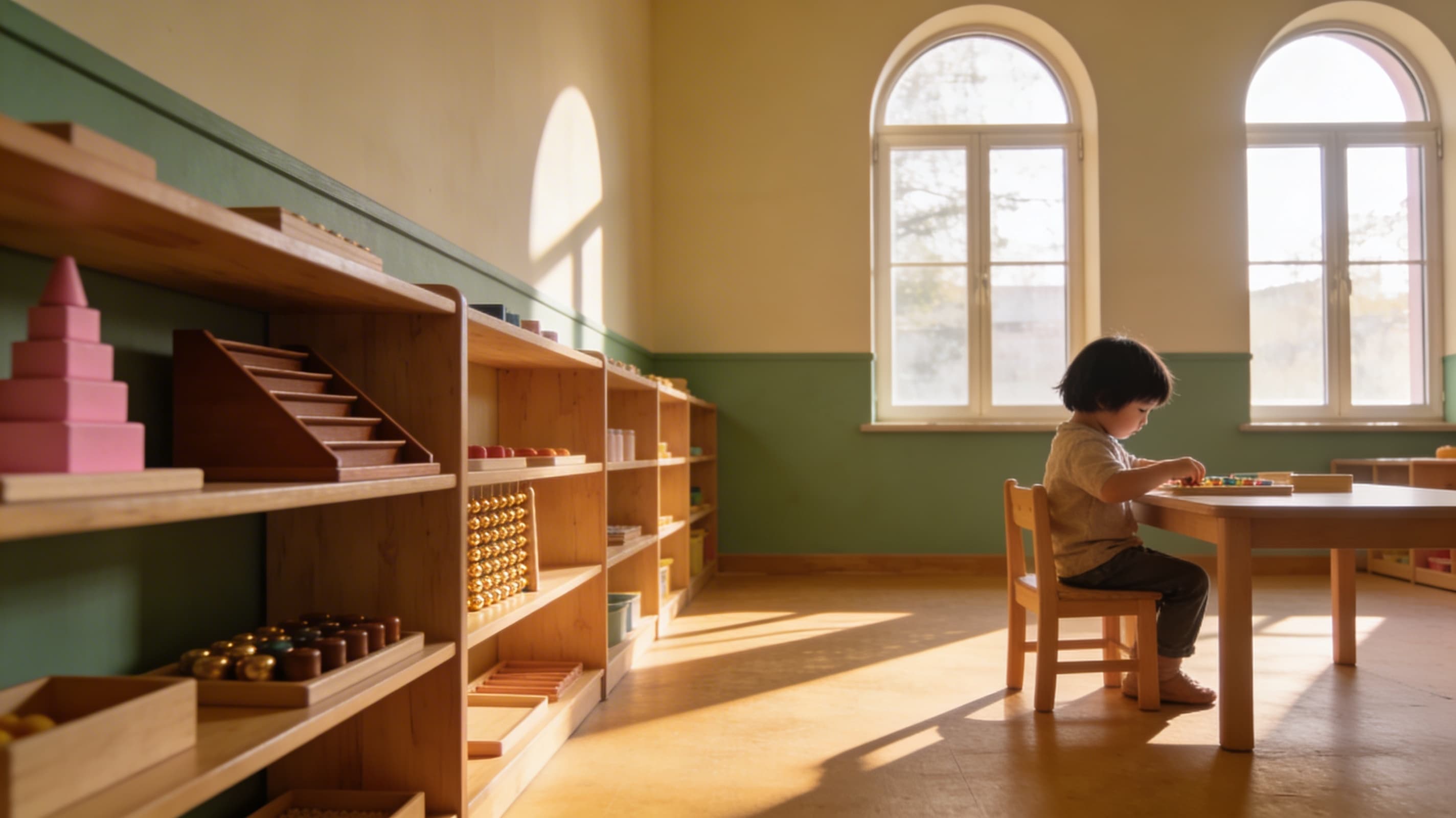
Walk into any authentic Montessori Casa — the 3-to-6-year-old environment — and you will find ten pink wooden cubes arranged in ascending order. The smallest is one centimeter. The largest is ten. Between them lies an entire grammar of perception: dimension, gradation, weight, and the satisfaction of order.
Maria Montessori called this material the Pink Tower, and she placed it deliberately at the beginning of the sensorial sequence. Not because it is easy — in fact, the precision required to carry, arrange, and return each cube is considerable — but because it isolates a single quality: three-dimensional size, varied only by a factor of ten.
The isolation of a single quality
In the Montessori method, each sensorial material isolates one property and varies it systematically. The Brown Stair isolates width. The Red Rods isolate length. The Color Tablets isolate chroma. The Pink Tower isolates volume.
This isolation is not a pedagogical gimmick. It reflects how the young child's mind actually learns — by repeatedly encountering the same variable across different objects, and refining perception until the pattern becomes abstract.
“The senses, being explorers of the world, open the way to knowledge.”
— Maria Montessori, The Absorbent Mind
Why pink?
The color choice is not arbitrary, though it is often questioned. Pink was selected because it stands out against both the typical wooden shelves and the child's clothing, making it easy to return to its place. It also has a warm, non-threatening quality that invites repeated use.
In some modern adaptations, you'll see "natural wood" towers — but these lose the deliberate visual signal that Montessori built into the design. The pink is functional.
The hand teaches the mind
When a three-year-old carries the 10cm cube, their whole body adjusts to its weight. The 1cm cube requires delicate pincer grip. In between, the child's hand learns proportion — and through the hand, the mind learns the mathematics that will later support algebra and geometry.
This is why Montessori insisted the Pink Tower must be wooden, precisely weighted, and graduated by exact tenths. The physical precision of the material is what teaches the abstract concept.
First material, first discipline
There is also a social dimension. The Pink Tower teaches the cycle of work: choose the material, carry it to the workspace, complete the activity, return it precisely to its shelf. This cycle — repeated thousands of times across three years — builds the executive function that underlies all later academic work.
When we watch a child carefully restoring the ten cubes to their exact positions, we are watching the foundation of future self-discipline being laid. Not through instruction, but through the child's own encounter with order.