Dezimalbruch-Übung
Dezimalbruch-Übung ist das Begleitset zur Dezimalbruch-Tafel und gibt einem Kind im Alter von 6 bis 12 Jahren greifbares Material für Dezimaloperationen, indem es die Dezimalmenge mit ihrem geschriebenen Symbol verbindet. Die Holzbox enthält farblich kodierte Würfel für hierarchische Werte sowie einen vollständigen Satz Dezimalzahlenkarten, sodass Menge und Notation stets gemeinsam gebildet und gelesen werden. Dieses AMI konforme Nienhuis Mathematikmaterial aus Buchenholz und Kunststoff vertieft die Dezimalarbeit, die ein Kind an der Dezimalbruch-Tafel im Faborino Sortiment beginnt.
“Das Kind ist sowohl eine Hoffnung als auch ein Versprechen für die Menschheit.”
The Decimal Fraction Exercise transforms the abstract concept of decimal place values into tangible experience through color-coded cubes that children can hold, count, and arrange.
- Understanding decimal place value through tenth, hundredth, thousandth, and ten-thousandth positions
- Converting between concrete cube representations and written decimal notation
- Comparing decimal quantities by physically arranging and counting cubes
- Building mental images of decimal relationships through repeated concrete manipulation
Mehr lesen
Each cube in the beechwood tray represents a specific decimal place value, allowing mathematical relationships to become visible and touchable. The exercise addresses the developmental need for concrete manipulation before abstraction, particularly crucial when children encounter decimals that represent quantities smaller than one. Through arranging these cubes and matching them with notation cards, children discover how our decimal system extends beyond whole numbers into fractional parts. The five compartments in the beechwood tray create a physical representation of place value positions, from units through ten-thousandths, making the systematic nature of decimals apparent. This material bridges the gap between the familiar golden bead material used for whole numbers and the abstract decimal notation children will encounter in advanced mathematics.

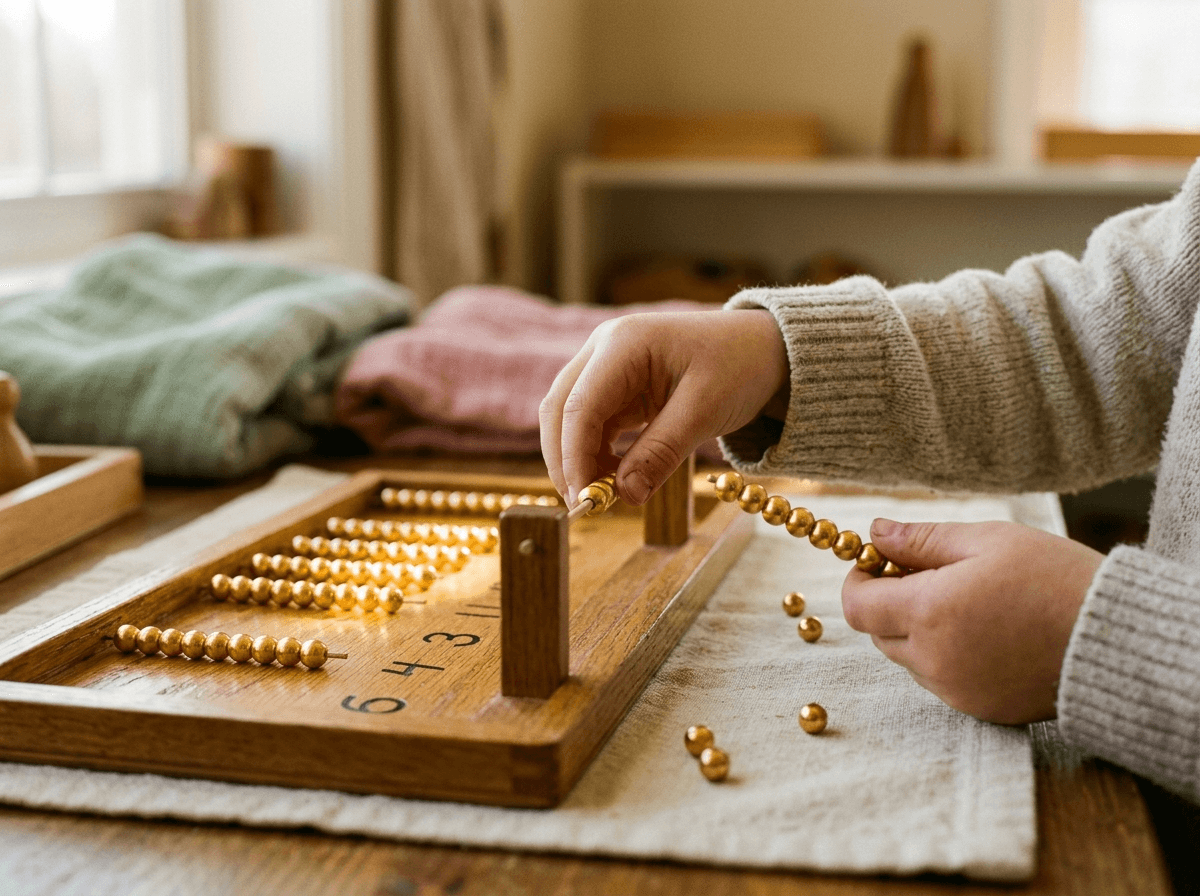
So führen Sie das Material ein
Folgen Sie der Montessori-Methode für optimale kindliche Entwicklung.
Bereiten Sie Dezimalsystemmaterialien auf einer großen Arbeitsmatte vor. Ordnen Sie nach Kategorien: Einer, Zehner, Hunderter, Tausender.
- 1
Stellen Sie eine Einheitsperle, einen Zehnerstab, eine Hundertplatte und einen Tausenderwürfel vor
Beginnen Sie mit konkretem Material, lassen Sie Kinder Perlen halten und zählen - 2
Zeigen Sie, wie 10 Einer einen Zehner bilden, 10 Zehner einen Hunderter
Betonen Sie das Größenverhältnis zwischen Kategorien - 3
Üben Sie Benennung und Identifikation jeder Kategorie
Verwenden Sie die Dreistufenlektion für Namen: Einer, Zehner, Hunderter, Tausender - 4
Führen Sie schrittweise den Aufbau mehrstelliger Zahlen aus Perlen ein
Lassen Sie das Kind selbstständig Zahlen bauen
Jedes Kind ist ein kleiner Schöpfer

Tradition
Seit 1929

Marken für Schulen
weltweit

Europäische Marken

AMI
anerkannt
Verwandte Materialien
