
Triangular Prisms: 2 Identical Geometric Solids for Exploration
Made by Nienhuis Montessori · shipped by Heutink International (Netherlands) About the maker
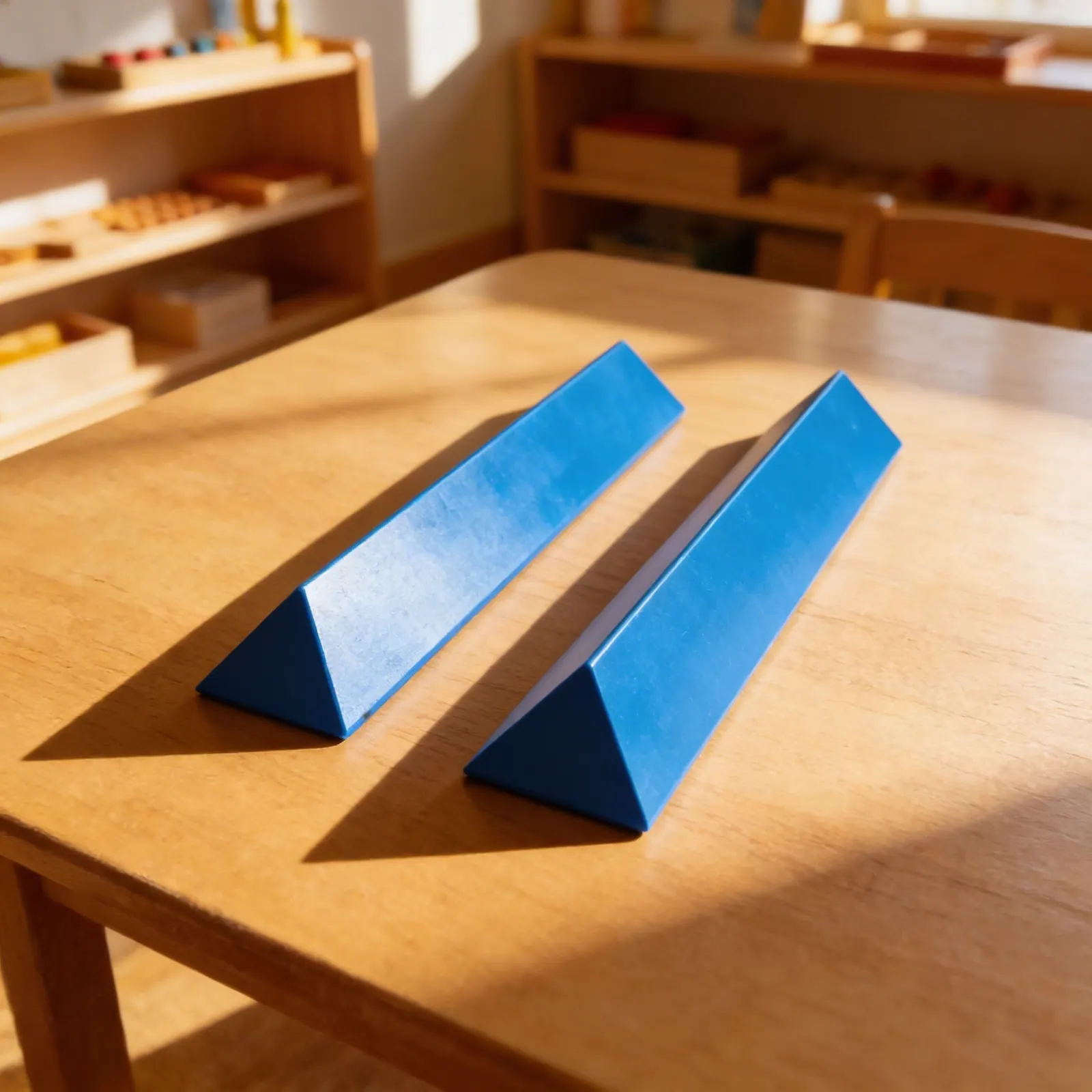
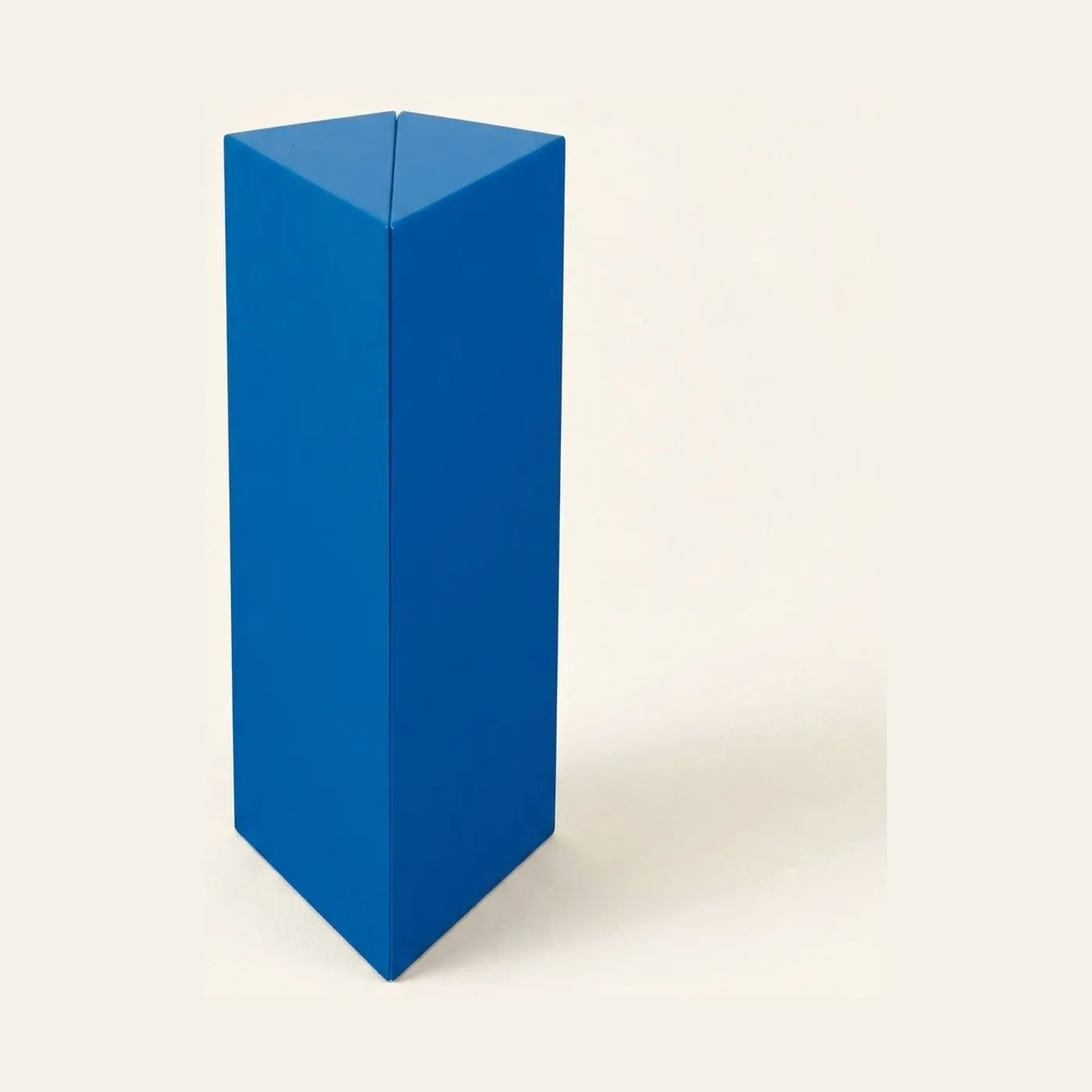
Two identical blue prisms on a triangular base, from the volume set derived from a base of 10 by 10 cm and a height of 20 cm. They come as a pair because the triangle is half of the square: stood together the two rebuild the square based prism of the same set exactly, which is how a child discovers that halving a base halves the volume without anyone writing it down. One prism proves nothing, two prove it in a second. Sold as a pair, for ages 6 to 12.
“Children display a universal love of mathematics, which is par excellence the science of precision, order, and intelligence.”
The triangular prisms embody Montessori's principle of isolation of difficulty by presenting one specific geometric concept clearly.
- Understanding that two congruent triangular prisms form a rectangular prism
- Developing spatial visualization and 3D reasoning skills
- Exploring relationships between different geometric solids
- Building foundation for volume calculations and geometric proofs
Read More
Through concrete manipulation, children discover abstract relationships between forms, supporting the elementary child's reasoning mind. This material bridges sensorial exploration with mathematical thinking, allowing children to physically construct their understanding of how shapes relate and transform. The hands-on nature satisfies the elementary child's need to understand the 'why' behind geometric principles, moving from concrete to abstract thought. By combining identical prisms to form new shapes, children experience the mathematical concept of equivalence and transformation through their senses, preparing them for advanced geometric proofs and spatial reasoning in later studies.
How to present it
Follow the Montessori method of presentation for optimal child development.
Place both triangular prisms on a mat with the rectangular prism from the Geometric Solids nearby. Ensure adequate workspace for manipulation and comparison.
- 1
Invite the child to explore one triangular prism, identifying its faces, edges, and vertices
Use precise geometric vocabulary consistently - 2
Compare the two triangular prisms to establish they are identical (congruent)
Let the child discover this through manipulation rather than telling - 3
Demonstrate joining the two prisms along their rectangular faces
Move slowly and deliberately, allowing observation time - 4
Guide discovery that the combined shape forms a rectangular prism
Ask leading questions rather than stating the conclusion - 5
Compare the formed rectangular prism with the solid rectangular prism
Encourage measurement or tracing to verify equivalence
Every Child Is a Little Creator

Heritage
Since 1929

In classrooms
Around the world

European brands
Nienhuis, GAM, Educo

AMI approved
To the association standard
Triangular Prisms: 2 Identical Geometric Solids for Exploration
