
Addition Equations Box: Self-Correcting Facts Practice
Made by Nienhuis Montessori · shipped by Heutink International (Netherlands) About the maker
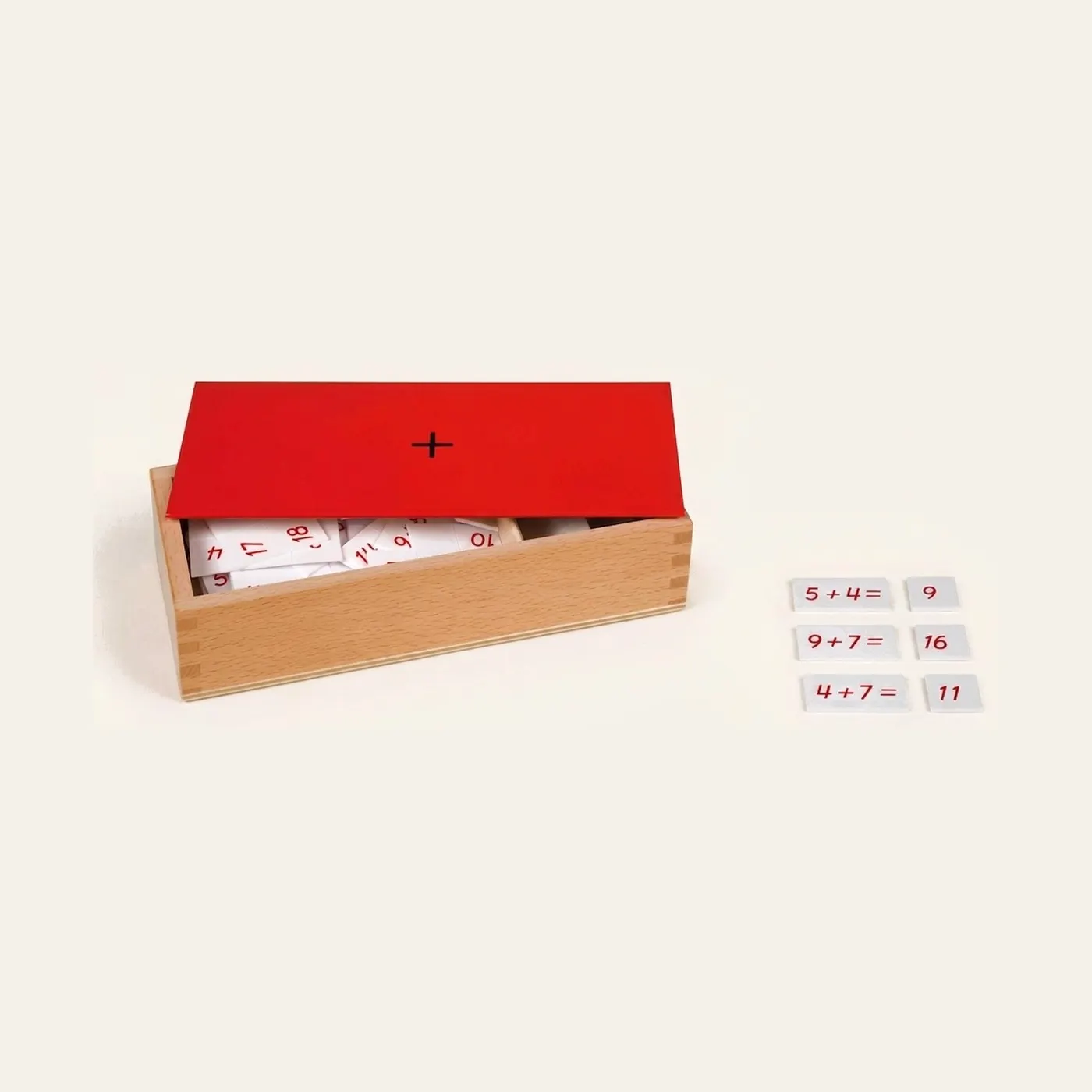
A two compartment wooden box with a lid holding two sets of plastic chips: one printed with equations, one with the answers. Every equation and every sum for the addends one to nine is there. Laying an equation down and then finding its answer among a hundred chips is slower than being told, and that slowness is the material: the answer arrives as something the child located rather than something they were given. Used with the addition working charts, sold separately. Plastic and wood, for ages 3 to 12.
“Education is a natural process spontaneously carried out by the human individual, and is acquired not by listening to words but by experiences upon the environment.”
The Addition Equations and Sums Box exemplifies Montessori's belief that mathematical concepts must be presented through concrete, manipulative materials before moving to abstraction.
- Recognition and memorization of addition facts from 1+1 through 9+9
- Development of visual discrimination between numerals and mathematical symbols
- Understanding of the commutative property of addition through matching
- Strengthening of fine motor control and pincer grip through card manipulation
Read More
This material honors the child's mathematical mind, an innate human tendency to seek order, precision, and exactness. The self-correcting nature of the material allows children to work independently, fostering the development of executive function and concentration. Through repeated handling of equation and answer cards, children internalize mathematical relationships kinesthetically and visually. The compartmentalized organization satisfies the child's need for order while the sliding lid provides a point of interest that engages fine motor skills. This material bridges the gap between the concrete mathematical work with golden beads and the abstract understanding of number facts, allowing children to discover mathematical patterns through their own activity rather than through direct instruction.
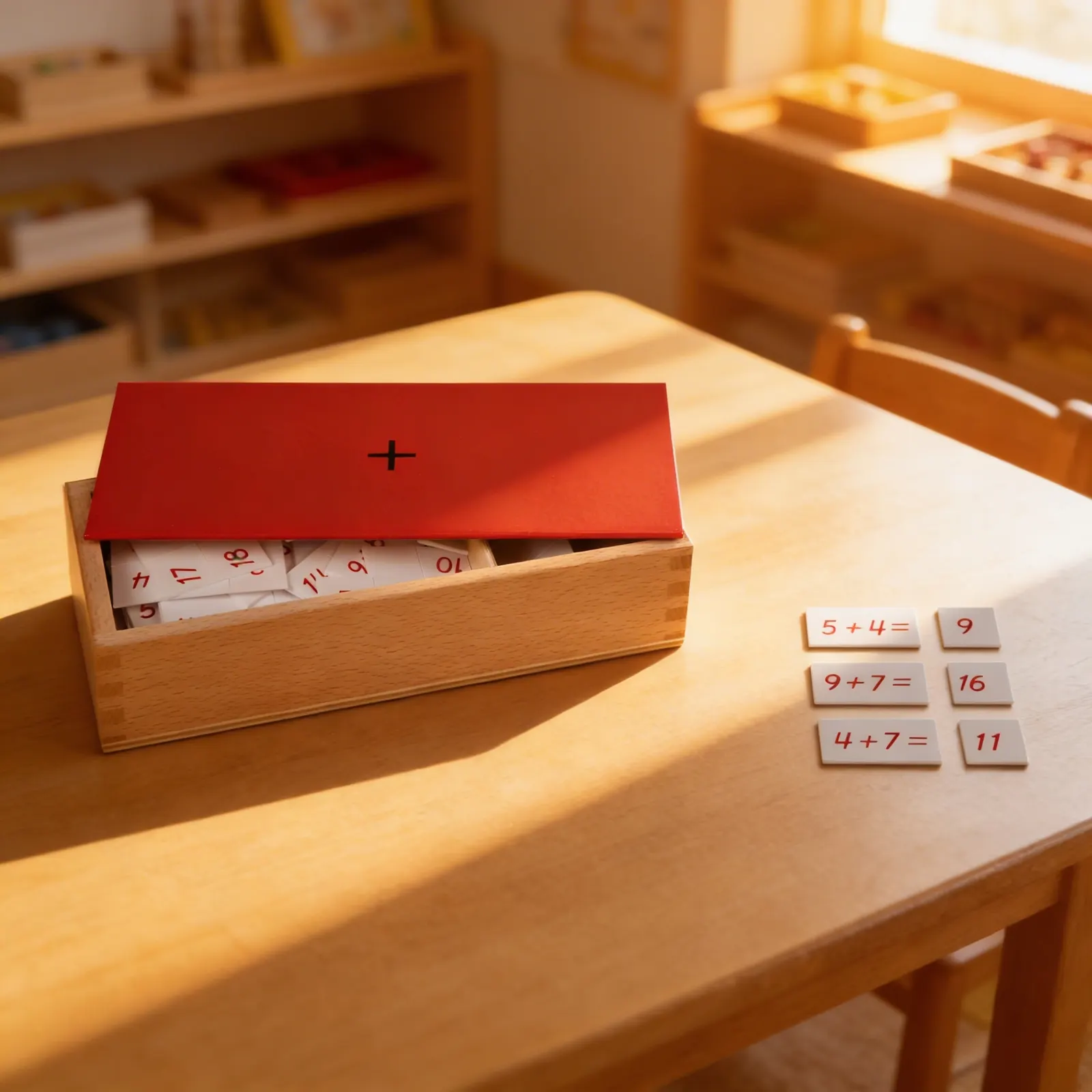
How to present it
Follow the Montessori method of presentation for optimal child development.
Place the box on a mat with the sliding lid closed. Ensure all equation cards are in one compartment and sum cards in another. Have a small basket nearby for completed matches.
- 1
Demonstrate sliding open the lid with slow, deliberate movements
Use both hands to model careful handling of materials - 2
Remove one equation card at a time, reading it aloud: 'Two plus three'
Touch each numeral and symbol as you read to reinforce left-to-right progression - 3
Search through sum cards to find the matching answer, comparing carefully
Model how to organize sum cards in a row for easier visual scanning - 4
Place matched pairs together on the mat in organized columns
Leave space between pairs to emphasize each complete equation - 5
After matching several, show how to verify by counting on fingers if needed
This connects abstract symbols to concrete counting - 6
Return cards to proper compartments when finished
Emphasize restoring order for the next child
Every Child Is a Little Creator

Heritage
Since 1929

In classrooms
Around the world

European brands
Nienhuis, GAM, Educo

AMI approved
To the association standard
Addition Equations Box: Self-Correcting Facts Practice
