
Africa Control MapLabeled
The first photo is the maker's own. The other shots are illustrative.
Inv. no. NIE-554400
- Maker
- Nienhuis Montessori, since 1929
- Approval
- AMI
- Base
- Paper
- Surface
- Laminate coating
- EAN
- 8719924029395
Final price incl. VAT. Delivery €5.90, €128.10 to go for free delivery.
Advice, warranty and returns are handled by us.
Why it costs €20.90
Behind the price of the original are things you can check yourself.
AMI approval
The material is approved by the Association Montessori Internationale (AMI). Nienhuis has made Montessori materials since 1929.
A verifiable original
The EAN 8719924029395 is on the box. It is the maker's number, not ours.
Africa Control Map in a child's hands
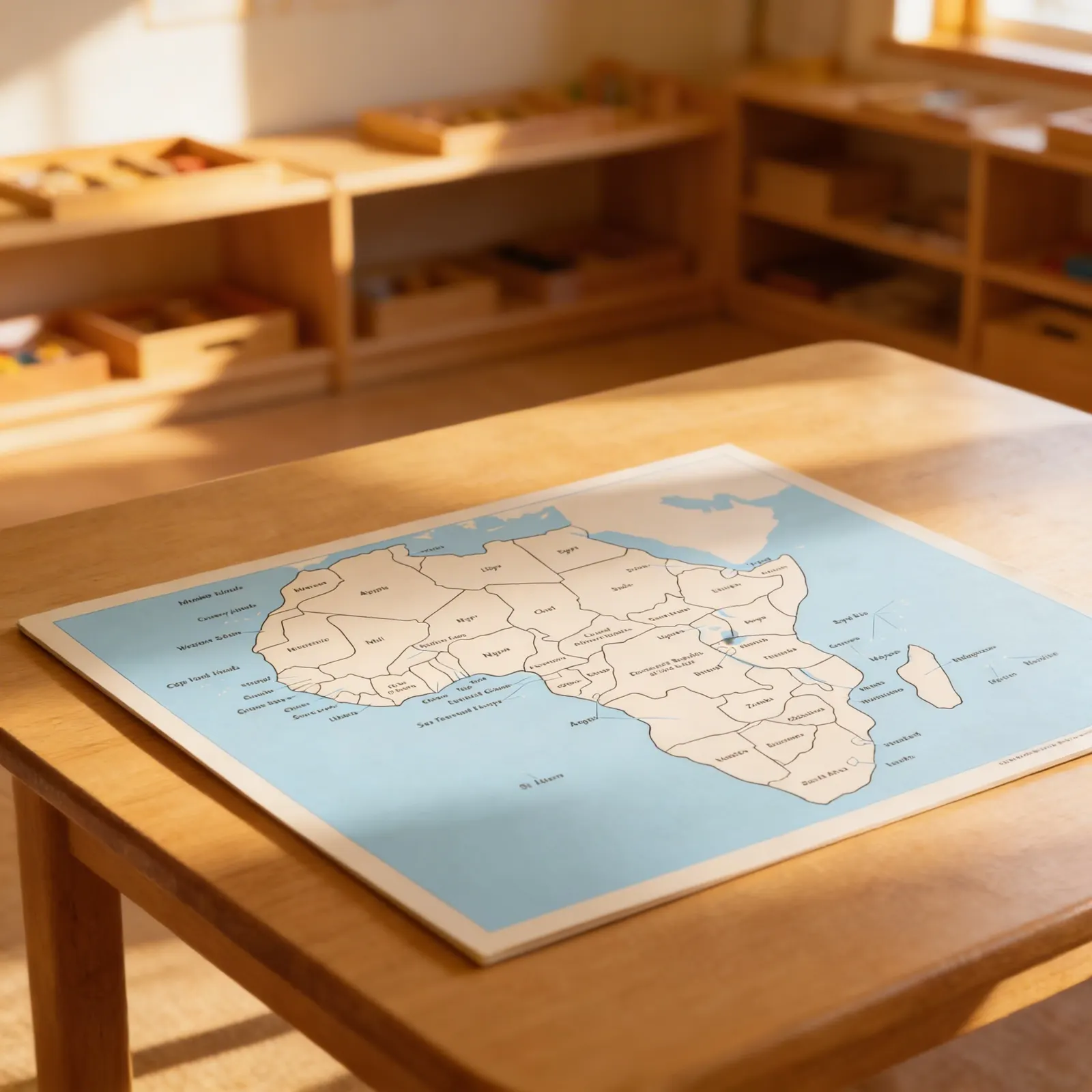
The labeled control map for Africa, with the names printed on it: the reference a child checks their own work against after laying out the puzzle map. It is worth saying who else uses it, because most adults cannot name the whole of Africa from memory either, and having the answer on the shelf is what lets a guide stay out of the way instead of guessing aloud. The unlabeled map and the printed labels are separate items, as is the puzzle map. Laminated print.
Geographic Literacy
Builds knowledge of African countries, their names, and relative positions through visual reference.
Self-Correction
Enables independent verification when working with unlabeled puzzle maps, promoting autonomous learning.
Reading Practice
Reinforces reading skills as children match country names between materials.
Cultural Awareness
Introduces the diversity of African nations, laying foundation for cultural studies.
How to present it
Place the Africa Control Map on a low table or mat alongside the Africa puzzle map. Ensure good lighting for reading the labels. Have a soft cloth available for cleaning the laminated surface.
- 1Invite the child to bring the Africa puzzle map to the work area
- 2Place the control map to the right of the puzzle map
- 3Remove one puzzle piece and place it below the puzzle
- 4Look at the control map to find the matching country shape
- 5Read the country name aloud from the control map
- 6Return the puzzle piece while saying the country name
- 7Continue with additional pieces as interest allows
3 tips for parents
- Point out Africa on globes or world maps at home to connect this detailed study to the bigger picture
- Share family heritage connections to African countries when looking at the map together
- Find African countries mentioned in news or books and locate them on the control map

If you are not sure it suits your child, we answer in person.
Norbert Kovalčín, founder of Faborino · write to him
There is no review here yet. We will ask you for one after you buy. Write the first review
What's in the Box
- Africa Control Map: Labeled with all countries
Size and material
| Packaging | 43 × 56 × 0 cm |
| Base | Paper |
| Surface | Laminate coating |
| Recommended Age | 3-6 years |
Care
Wipe with damp cloth, dry immediately
Frequently Asked Questions
What is the purpose of this Africa control map in Montessori education?
This control map serves as a reference tool for children to check their work when using Africa puzzle maps. It helps them verify correct placement of countries, learn country names and locations, and develop independent learning skills through self-correction.
What size is the Africa control map and what material is it made from?
The map is laminated for durability, making it resistant to spills and frequent handling by young children. While specific dimensions aren't provided, it's sized appropriately for ages 3-6 to handle comfortably while working with corresponding puzzle maps.
Does this map show physical features like mountains and rivers?
No, this is a political control map showing country boundaries, names, and surrounding water bodies. For physical features like mountains, rivers, and terrain, you would need a separate physical features map of Africa.
How do children use this control map with other Montessori materials?
Children typically use this alongside the Africa puzzle map, placing puzzle pieces and then checking their work against the labeled control map. It's also used for activities like coloring blank maps, learning country names, and geography lessons about African nations.
What age is most appropriate for introducing this Africa control map?
While suitable for ages 3-6, most children begin using control maps around age 4-5 when they have developed the concentration and interest in geography work. Younger children may use it simply for country recognition, while older children engage in more complex activities.
Product safety
Manufacturer: Nienhuis Montessori, Anders Celsiusstraat 15, 7442 PB Nijverdal, Netherlands
Africa Control Map