
Africa Control Map: Unlabeled
Made by Nienhuis Montessori · shipped by Heutink International (Netherlands) About the maker
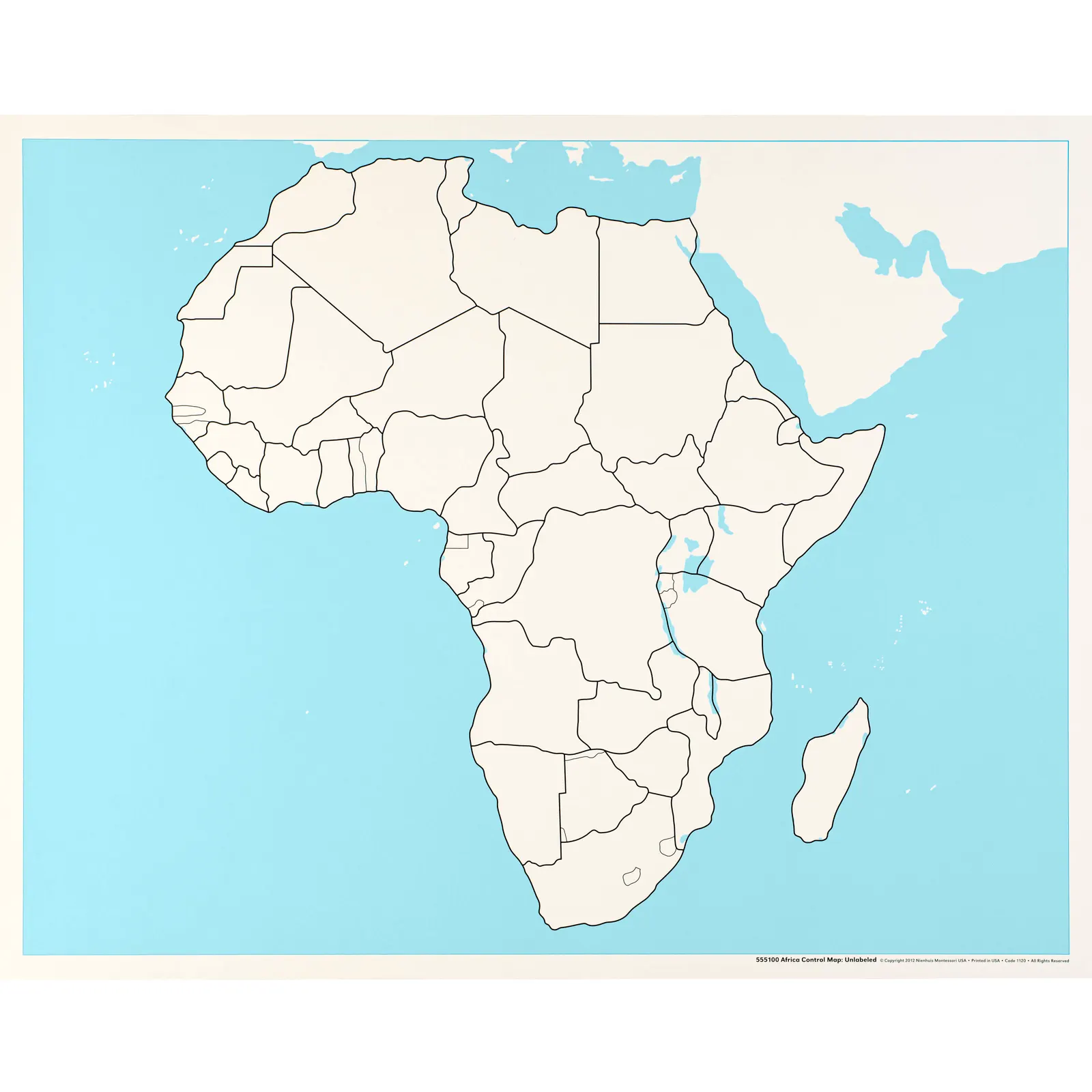
Africa Control Map, Unlabeled prints the continent's outline on sturdy cardstock backed paper with no text at all, so a child aged three to six can focus purely on shape and coastline. Used with the wooden puzzle map, it is the visual key the child checks their placement against, well before a single country name enters the lesson. This early, wordless stage trains the eye and hand together and builds the visual memory that later makes the labeled map and its names easy to grasp. The sturdy cardstock keeps the sheet flat through daily, repeated handling.
“The child is both a hope and a promise for mankind.”
The Africa Control Map serves as a fundamental reference tool in the Montessori geography curriculum, providing children with an accurate visual representation of the continent's political boundaries. This unlabeled map intentionally presents only the country outlines, allowing children to focus purely on shape recognition and spatial relationships without the distraction of text.
- Visual discrimination of African country shapes and boundaries
- Spatial awareness of relative country positions and sizes
- Self-correction skills through independent map checking
- Geographic vocabulary development through hands-on exploration
Read More
By working with this control map alongside other geography materials, children develop their ability to identify countries through visual discrimination alone. The large format of this map enables children to see fine details of borders and coastal features, essential for accurate pin map work and flag placement exercises. In the Montessori classroom, this control map functions as the answer key that children consult independently to verify their work, fostering self-correction and building confidence in geographic knowledge. The absence of labels on this particular map encourages children to rely on visual memory and spatial reasoning rather than reading skills, making it accessible to pre-readers while challenging older children to internalize country locations through repeated reference.
How to present it
Follow the Montessori method of presentation for optimal child development.
Place the Africa Control Map flat on a table or mount it at child height on the wall. Ensure good lighting and have the corresponding pin map, flags, or puzzle map nearby for reference work.
- 1
Introduce the map by tracing the continent's outline with your finger, emphasizing the distinctive shape
Move slowly and pause at notable features like the Horn of Africa or the Mediterranean coastline - 2
Select one country and trace its borders carefully, noting unique shape characteristics
Start with countries that have distinctive shapes like Madagascar or South Africa - 3
Compare the control map with the child's work on the pin map or puzzle, checking one country at a time
Place maps side by side for easier comparison - 4
Use the map for flag placement verification, matching flag positions to country locations
Work systematically from north to south or west to east
Every Child Is a Little Creator

Heritage
Since 1929

In classrooms
Around the world

European brands
Nienhuis, GAM, Educo

AMI approved
To the association standard
Africa Control Map: Unlabeled
