
Algebraic Binomial Cube: Advanced Mathematical Sensorial Material
Made by Nienhuis Montessori · shipped by Heutink International (Netherlands) About the maker
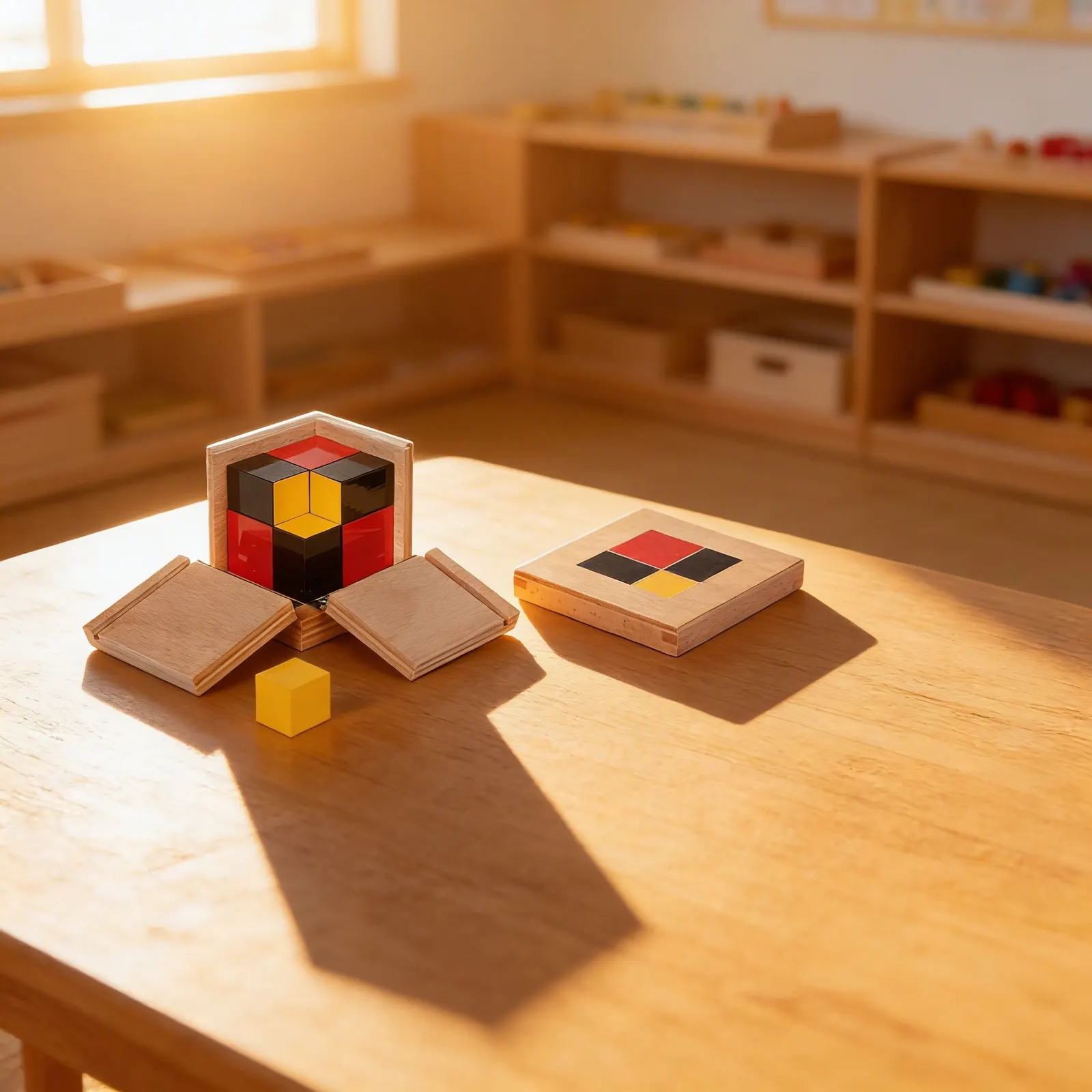
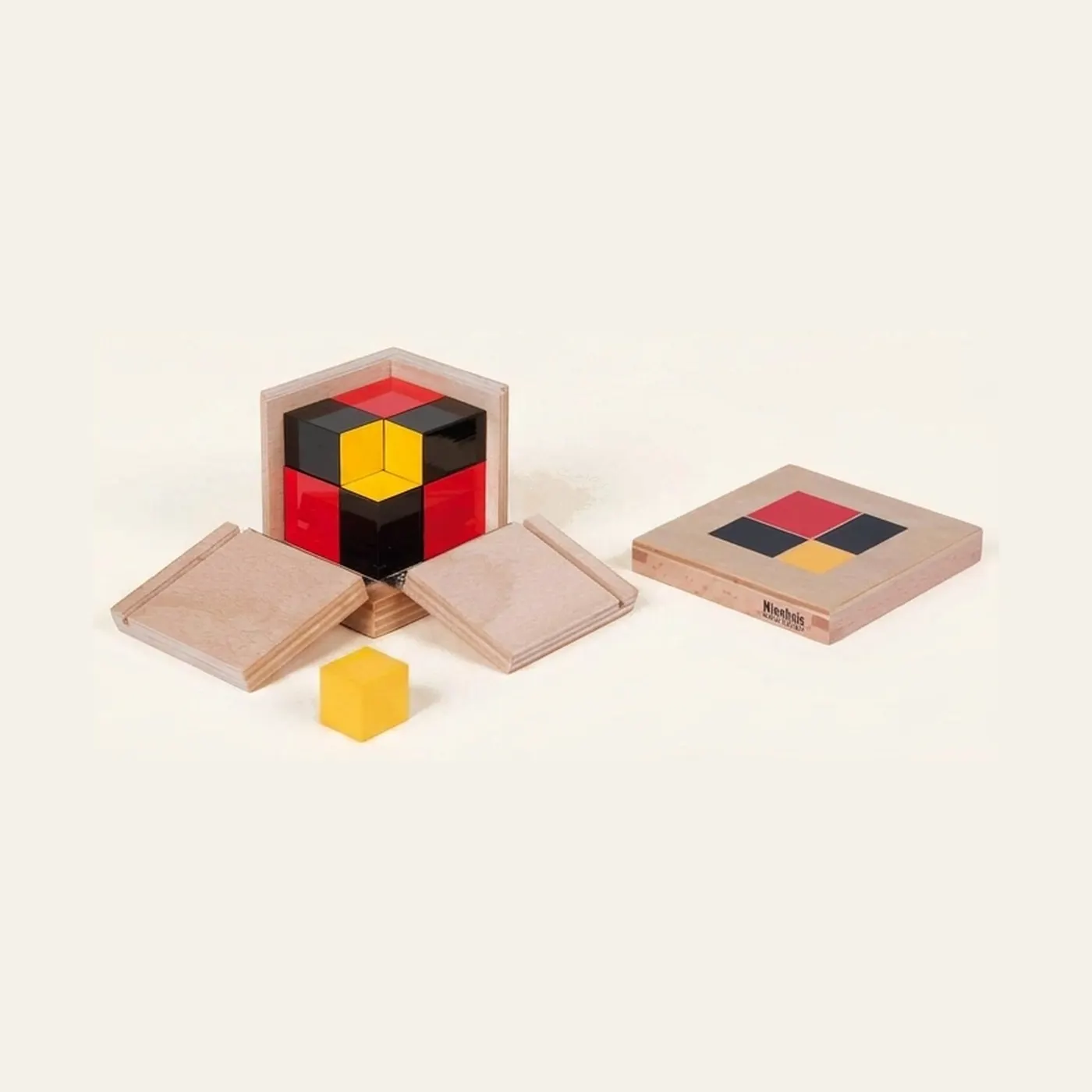
The cube of a binomial in solid form, built so that the pieces can only go back one way. Working it is patterning long before it is algebra, but the arrangement is the real thing: the child who has handled this has held the expansion of (a + b) cubed. It is also the foundation for the higher powers of the same binomial, so the same reasoning carries forward to the fourth and fifth. Hinged wooden box with lid. Solid wood with non toxic paint, for ages 6 to 12.
“The child is both a hope and a promise for mankind.”
The Algebraic Binomial Cube embodies Montessori's principle of concrete-to-abstract learning, where children manipulate physical objects to internalize mathematical relationships. This material demonstrates the power of indirect preparation, as children who explored the sensorial binomial cube in primary now discover its algebraic significance.
- Internalization of the algebraic expansion (a+b)³ = a³ + 3a²b + 3ab² + b³ through concrete manipulation
- Development of spatial reasoning and three-dimensional visualization skills
- Understanding of exponential growth and cubic relationships
- Preparation for polynomial multiplication and algebraic factoring
Read More
Through repeated manipulation, the child's mathematical mind naturally abstracts the formula (a+b)³ without formal instruction. The material respects the child's need for movement and sensorial exploration while developing precise mathematical thinking. Its self-correcting nature allows independent discovery and verification, fostering confidence in mathematical reasoning. The color-coding provides a visual bridge between the concrete blocks and abstract algebraic notation, honoring the child's developmental progression from sensorial to conceptual understanding.
How to present it
Follow the Montessori method of presentation for optimal child development.
Place the Algebraic Binomial Cube on a table mat. Have paper and colored pencils matching the cube colors (typically red and blue) available. Ensure the child has mastered the sensorial binomial cube from primary.
- 1
Begin by building the cube layer by layer, naming each piece algebraically: 'This red cube is a³, these red and blue prisms are 3a²b'
Use consistent color language - red represents 'a' and blue represents 'b' - 2
As you place each piece, write its algebraic notation on paper using matching colors
Connect the physical dimension to the algebraic expression by measuring edges - 3
Once assembled, count all pieces and write the complete expansion: a³ + 3a²b + 3ab² + b³
Have child verify by checking that opposite faces match in color pattern - 4
Disassemble systematically while verbally stating each term being removed
Work backwards from b³ to a³ to reinforce the formula structure - 5
Challenge the child to build the cube while writing the formula simultaneously
This parallel work strengthens the concrete-abstract connection
Every Child Is a Little Creator

Heritage
Since 1929

In classrooms
Around the world

European brands
Nienhuis, GAM, Educo

AMI approved
To the association standard
Algebraic Binomial Cube: Advanced Mathematical Sensorial Material
