
Algebraic Peg Board
The first photo is the maker's own. The other shots are illustrative.
Inv. no. NIE-013500
- Maker
- Nienhuis Montessori, since 1929
- Approval
- AMI
- Frame
- Natural wood
- Pegboard
- Perforated hardboard
- EAN
- 8719924007287
€94.90
Final price incl. VAT. Delivery €5.90, €54.10 to go for free delivery.
✓ In Stock. Delivery in 5 to 9 working days.
1
30 daysto return
Advicebefore and after
Invoicefor companies
Advice, warranty and returns are handled by us.
The original
Why it costs €94.90
Behind the price of the original are things you can check yourself.
AMI approval
The material is approved by the Association Montessori Internationale (AMI). Nienhuis has made Montessori materials since 1929.
A verifiable original
The EAN 8719924007287 is on the box. It is the maker's number, not ours.
What the child does
Algebraic Peg Board in a child's hands
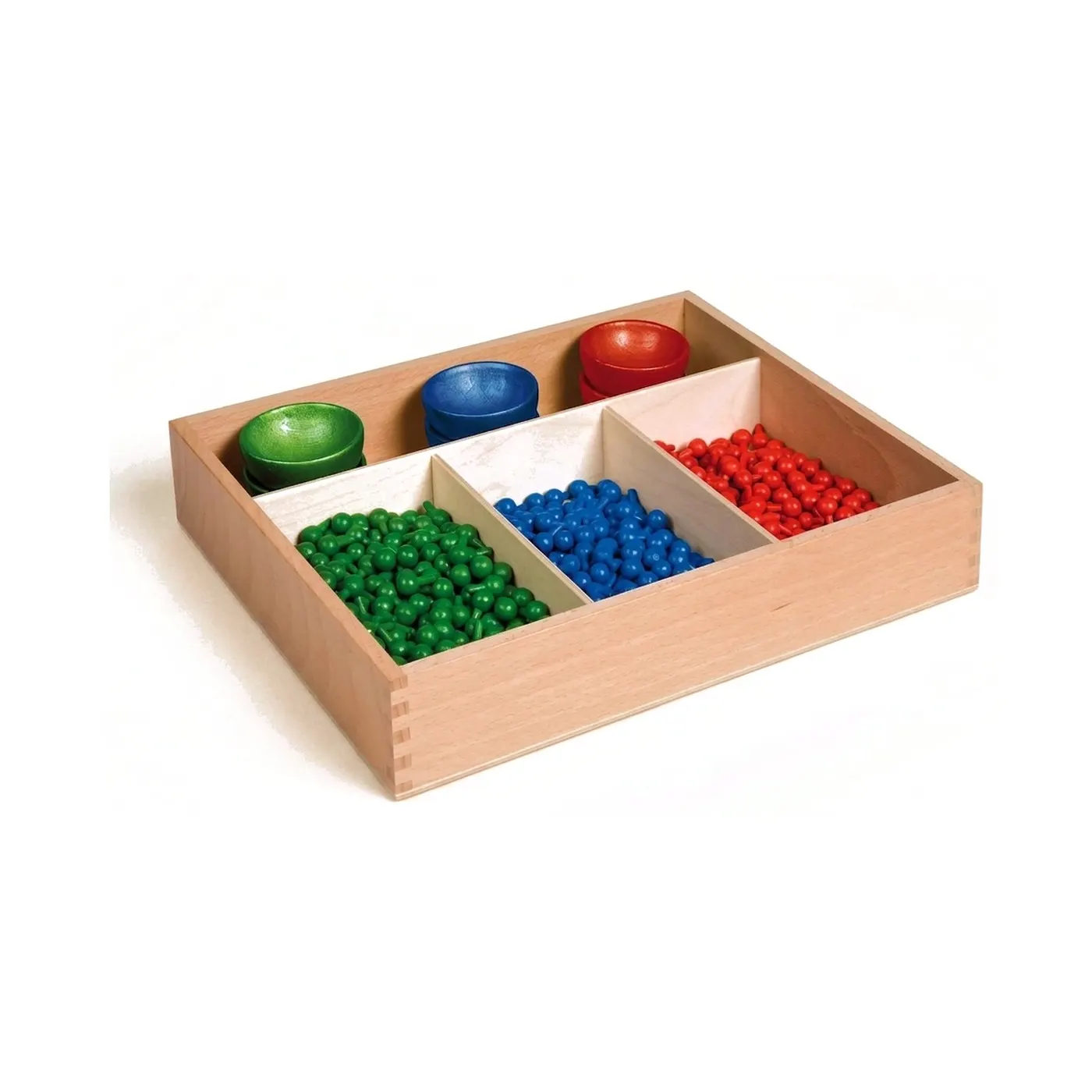
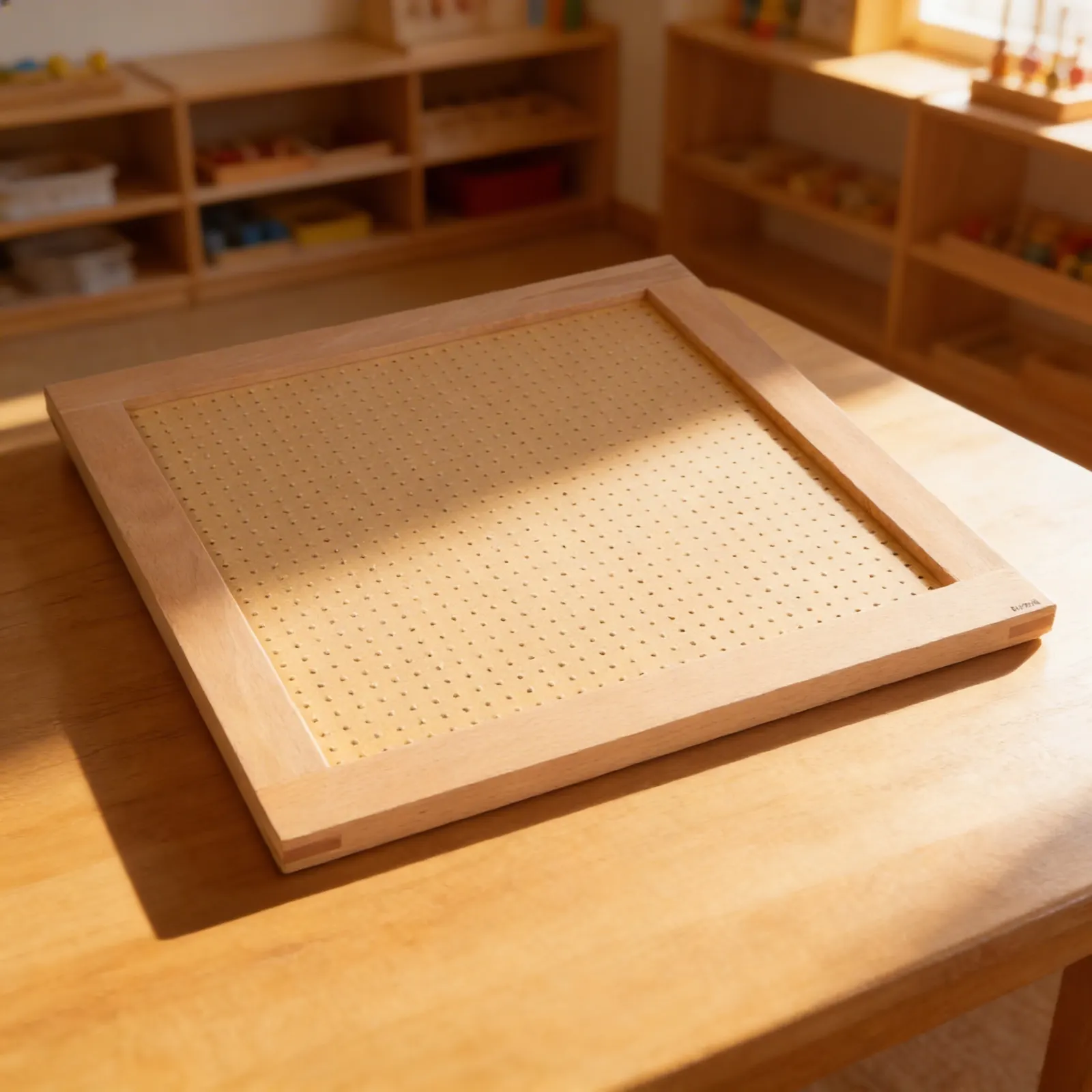
A pegboard for demonstrating square roots, lowest common multiples and factors, worked by arranging pegs into squares and rectangles. Finding a square root here is not a procedure but a question: can these pegs be arranged into a square, and if so how long is its side. A child who has done that will not later confuse the operation with the button on a calculator. Pegs and cups are a separate product. Wood with hardboard, for ages 6 to 12.
Abstract Thinking
Bridges concrete manipulation with abstract algebraic concepts through visual and tactile pattern creation.
Mathematical Reasoning
Develops logical thinking and problem-solving skills through hands-on exploration of mathematical relationships.
Pattern Recognition
Enhances ability to identify, create, and extend patterns essential for algebraic understanding.
Spatial Intelligence
Strengthens spatial reasoning through grid-based activities and geometric pattern formation.
Activity Guide
How to present it
Place the Algebraic Peg Board on a mat with a container of colored pegs. Have paper and pencil nearby for recording patterns.
- 1Begin with simple repeating patterns using two colors of pegs in the first row
- 2Create growing patterns where each row has one more peg than the previous
- 3Explore skip counting by placing pegs in every 2nd, 3rd, or 5th hole
- 4Build geometric shapes and calculate their perimeters using peg placement
- 5Introduce coordinate pairs by labeling rows and columns with numbers
3 tips for parents
- Focus on pattern recognition rather than algebraic terminology during home exploration
- Take photos of your child's peg creations to discuss mathematical thinking together
- Connect peg board patterns to real-world examples like tile floors or garden layouts
From the same makerNienhuis
Spare parts
Why it is in our selection
If you are not sure it suits your child, we answer in person.
Norbert Kovalčín, founder of Faborino · write to him
There is no review here yet. We will ask you for one after you buy. Write the first review
Details
What's in the Box
- Algebraic Peg Board: 40×40 cm with wooden frame
- Note: Pegs sold separately
Size and material
| Packaging | 47 × 47 × 2 cm |
| Frame | Natural wood |
| Pegboard | Perforated hardboard |
| Recommended Age | 6-12 years |
Care
Wipe with dry or slightly damp cloth
Frequently Asked Questions
What mathematical concepts can children explore with the Algebraic Peg Board?
Children can explore patterns, sequences, geometric shapes, multiplication arrays, factors, algebraic expressions, and coordinate graphing. The board allows visual representation of abstract concepts like variables, equations, and mathematical relationships through hands-on manipulation.
What materials come with the Algebraic Peg Board?
The board includes a smooth wooden frame with a uniform grid of holes. Pegs or manipulatives for use with the board may need to be purchased separately. Check product specifications to confirm if pegs are included with your specific purchase.
How does this material support the transition from concrete to abstract thinking?
The peg board bridges concrete and abstract learning by allowing children to physically create and manipulate mathematical patterns before moving to written equations. This hands-on approach helps children internalize algebraic concepts through sensorial experience before working with abstract symbols.
What age is most appropriate for introducing the Algebraic Peg Board?
While suitable for ages 6-12, children typically begin with simple pattern work around age 6-7 and progress to more complex algebraic concepts by ages 9-12. The material grows with the child, offering increasingly sophisticated applications as mathematical understanding develops.
Can this board be used for geometry lessons as well as algebra?
Yes, the Algebraic Peg Board is excellent for geometry exploration. Children can create geometric shapes, study symmetry, explore area and perimeter concepts, investigate transformations, and discover geometric patterns, making it a versatile mathematical tool beyond algebraic applications.
Product safety
Manufacturer: Nienhuis Montessori, Anders Celsiusstraat 15, 7442 PB Nijverdal, Netherlands
Algebraic Peg Board
€94.90