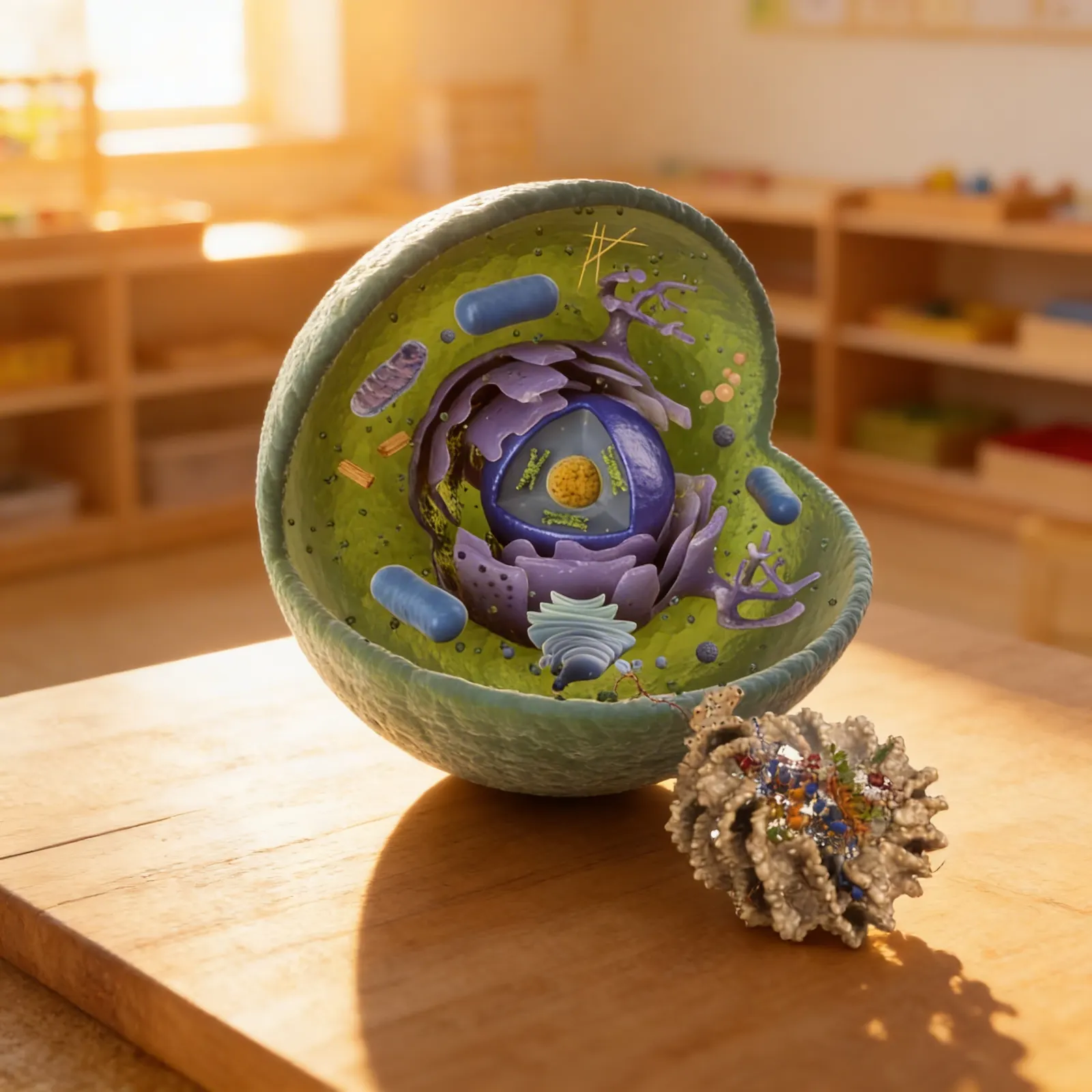
The Animal Cell is a category.biology Montessori material designed for children aged 3-6, crafted by Nienhuis Montessori to AMI standards.
This detailed three-dimensional animal cell model provides a hands-on exploration of cellular biology for young learners. The cross-sectional design reveals key organelles including the nucleus with nucleolus, mitochondria, and cell membrane, allowing children to physically examine and understand the fundamental building blocks of animal life through tactile investigation.
“Education is a natural process spontaneously carried out by the human individual, and is acquired not by listening to words but by experiences upon the environment.”— Maria MontessoriEducation for a New World
“The child is both a hope and a promise for mankind.”
— Maria Montessori, Education and Peace
The Animal Cell model introduces complex biological concepts through concrete, manipulable exploration. Young children naturally wonder about living things, and this three-dimensional cell allows them to satisfy this curiosity through direct sensorial investigation. The cross-sectional design transforms abstract cellular structures into tangible objects children can touch, examine, and internalize. By handling the nucleus, mitochondria, and cell membrane as physical forms, children build mental representations of microscopic life. This model respects the child's need to understand through movement and touch before advancing to abstract thought. The Animal Cell bridges the gap between the visible world children observe and the invisible structures that compose all living creatures. Through repeated manipulation of organelles, children develop precise vocabulary and accurate mental images of cellular organization. This hands-on approach to biology honors the absorbent mind's capacity to grasp complex concepts when presented through concrete materials.

Each order includes everything needed for proper presentation and long-term use.

Follow the Montessori method of presentation for optimal child development.
Invite the child to carry the tray to their workspace using both hands
Present the whole cell first, allowing the child to hold and examine the complete structure
Point to and name each major organelle slowly: 'This is the nucleus'
If the model opens, demonstrate how to carefully separate sections to see inside
Invite the child to explore independently, remaining available for questions
Each material supports multiple areas of child development simultaneously.
Introduces fundamental biology concepts through concrete, manipulable materials that make abstract cellular structures tangible and comprehensible.
Builds scientific vocabulary as children learn proper names for cell parts like nucleus, mitochondria, and cytoplasm through hands-on exploration.
Develops spatial reasoning as children examine the three-dimensional relationships between different organelles within the cell structure.
Transforms microscopic concepts into tangible learning experiences, following Montessori principles of concrete to abstract understanding.

Designed for child-sized hands
Professional tips from AMI-trained guides to maximize the educational value of this material.
“Present this material after children show interest in body parts or ask 'what's inside' questions about living things”
Keep initial presentations simple - name only 3-4 main parts rather than overwhelming with all organelles
Create matching cards with photographs of the model parts and their names for extended learning
Connect to practical life by explaining cells like 'tiny rooms' that make up all animals, including humans
Everything you need to know about this material.
Yes, this model is specifically designed for young learners with large, easily identifiable parts that are safe to handle. The three-dimensional design helps concrete learners understand abstract concepts through hands-on exploration.
The cross-sectional design shows key organelles including the nucleus with nucleolus, mitochondria, and cell membrane. These fundamental structures are clearly defined and appropriately simplified for young children.
This tactile model aligns with Montessori's hands-on approach by allowing children to physically explore cellular structures. It moves from concrete to abstract learning, helping young minds grasp complex biological concepts through sensorial experience.
Children can identify and name organelles, trace parts with their fingers, match organelle cards to the model, create cell drawings, and engage in simple discussions about how cells work as the building blocks of life.
The model is constructed with young learners in mind, featuring sturdy materials that withstand regular handling. The three-dimensional design is robust enough for repeated classroom exploration while maintaining clear definition of cellular structures.
Can't find what you're looking for?
Contact Our Experts
Share your experience with this material and help other educators and parents.