
Animal Homes 3 Part Cards
The first photo is the maker's own. The other shots are illustrative.
Inv. no. NIE-EC0605C
- Maker
- Nienhuis Montessori, since 1929
- Product size
- 9.5 × 12.7 cm
- Material
- Durable plastic
- Finish
- Pre-cut with rounded corners
- EAN
- 8719924043087
Final price incl. VAT. Delivery €5.90, €94.10 to go for free delivery.
Advice, warranty and returns are handled by us.
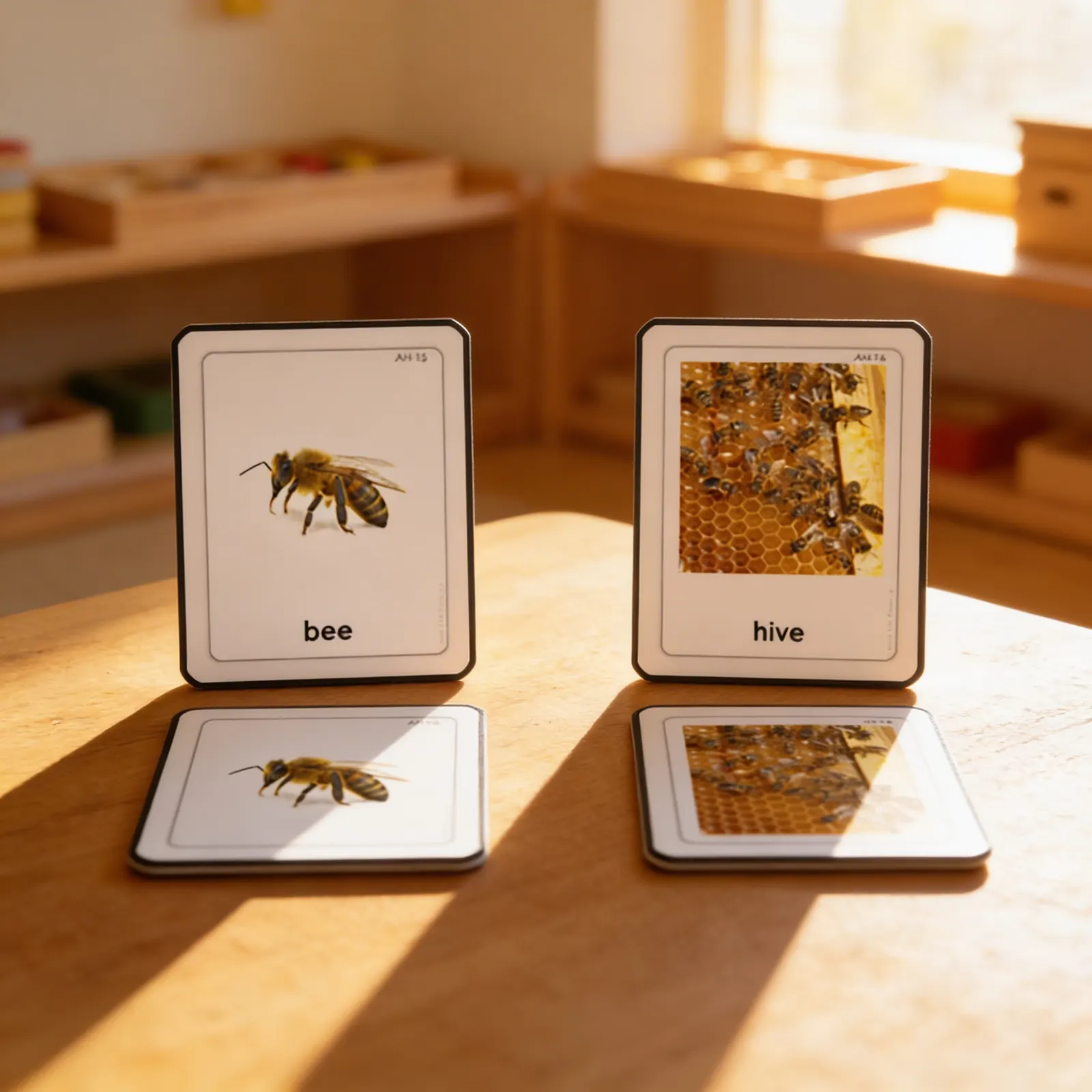
Animal Homes 3 Part Cards in a child's hands
Animal Homes 3 Part Cards, these Animal Homes 3 Part Cards introduce children to the fascinating world of animal habitats through the classic Montessori three-part nomenclature format. Each set features realistic photographs of animals paired with their homes, making it possible for children to explore relationships in nature while developing vocabulary and classification skills through matching picture cards, label cards, and control cards.
Language Development
Expands vocabulary related to animals and their habitats while reinforcing the connection between spoken and written language.
Classification Skills
Develops the ability to categorize and match related concepts, essential for scientific thinking.
Nature Connection
Fosters appreciation for the natural world by exploring where different animals make their homes.
Visual Discrimination
Refines the ability to distinguish between similar images and match corresponding elements.
How to present it
Arrange picture cards in a column on the left side of the work mat. Place corresponding label cards in a basket. Keep control cards separate for self-checking.
- 1Invite the child to match picture cards showing animals with picture cards showing their homes
- 2Once comfortable with picture matching, introduce the label cards one at a time
- 3Demonstrate how to use control cards for self-correction by comparing their work
- 4Encourage the child to create their own sorting categories based on habitat types
3 tips for parents
- Look for real examples of animal homes during nature walks to reinforce card work
- Create simple books together using the vocabulary learned from the cards
- Encourage storytelling about the animals and why they choose specific homes

If you are not sure it suits your child, we answer in person.
Norbert Kovalčín, founder of Faborino · write to him
There is no review here yet. We will ask you for one after you buy. Write the first review
What's in the Box
- Picture Cards: Approx. 6 animal photographs
- Label Cards: Approx. 6 habitat name labels
- Control Cards: Approx. 6 combined image-label cards
Size and material
| Product size | 9.5 × 12.7 cm |
| Packaging | 15 × 15 × 2 cm |
| Material | Durable plastic |
| Finish | Pre-cut with rounded corners |
| Recommended Age | 3-6 years |
Care
Wipe with damp cloth, dry immediately
Frequently Asked Questions
What animals and homes are included in this 3-part card set?
This set typically includes 12-18 different animals and their homes, such as birds/nests, bears/caves, bees/hives, rabbits/burrows, spiders/webs, beavers/dams, and more. Each animal-home pair includes a picture card, label card, and control card for complete three-part nomenclature work.
How do children use these animal home cards in Montessori activities?
Children begin by matching picture cards to control cards, then progress to reading and matching label cards. They can sort animals by habitat type, create their own classifications, or use the cards for vocabulary enrichment and discussion about animal behaviors and environments.
What skills do children develop using these animal habitat cards?
These cards develop vocabulary, reading readiness, visual discrimination, and classification skills. Children also gain scientific knowledge about animal habitats, develop an understanding of relationships in nature, and strengthen their ability to make connections between living things and their environments.
Are the images photographs or illustrations?
The cards feature high-quality, realistic photographs of actual animals and their natural homes. This aligns with Montessori principles of presenting children with real, accurate representations of the world rather than cartoon or stylized images.
Can these cards be used with non-readers?
Yes! Young children can start by simply matching the picture cards without reading labels. As they develop, they can learn the vocabulary orally, trace sandpaper letters to prepare for reading, and eventually progress to matching the written labels independently.
Product safety
Manufacturer: Nienhuis Montessori, Anders Celsiusstraat 15, 7442 PB Nijverdal, Netherlands
Animal Homes 3 Part Cards