
Animal PuzzleBird
The first photo is the maker's own. The other shots are illustrative.
Inv. no. NIE-0199E0
- Maker
- Nienhuis Montessori, since 1929
- Approval
- AMI
- Base Material
- Plywood construction
- Knobs
- Wooden handles
- EAN
- 8719924010867
Final price incl. VAT. Delivery €5.90, €109.10 to go for free delivery.
Advice, warranty and returns are handled by us.
Why it costs €39.90
Behind the price of the original are things you can check yourself.
AMI approval
The material is approved by the Association Montessori Internationale (AMI). Nienhuis has made Montessori materials since 1929.
A verifiable original
The EAN 8719924010867 is on the box. It is the maker's number, not ours.
Animal Puzzle in a child's hands
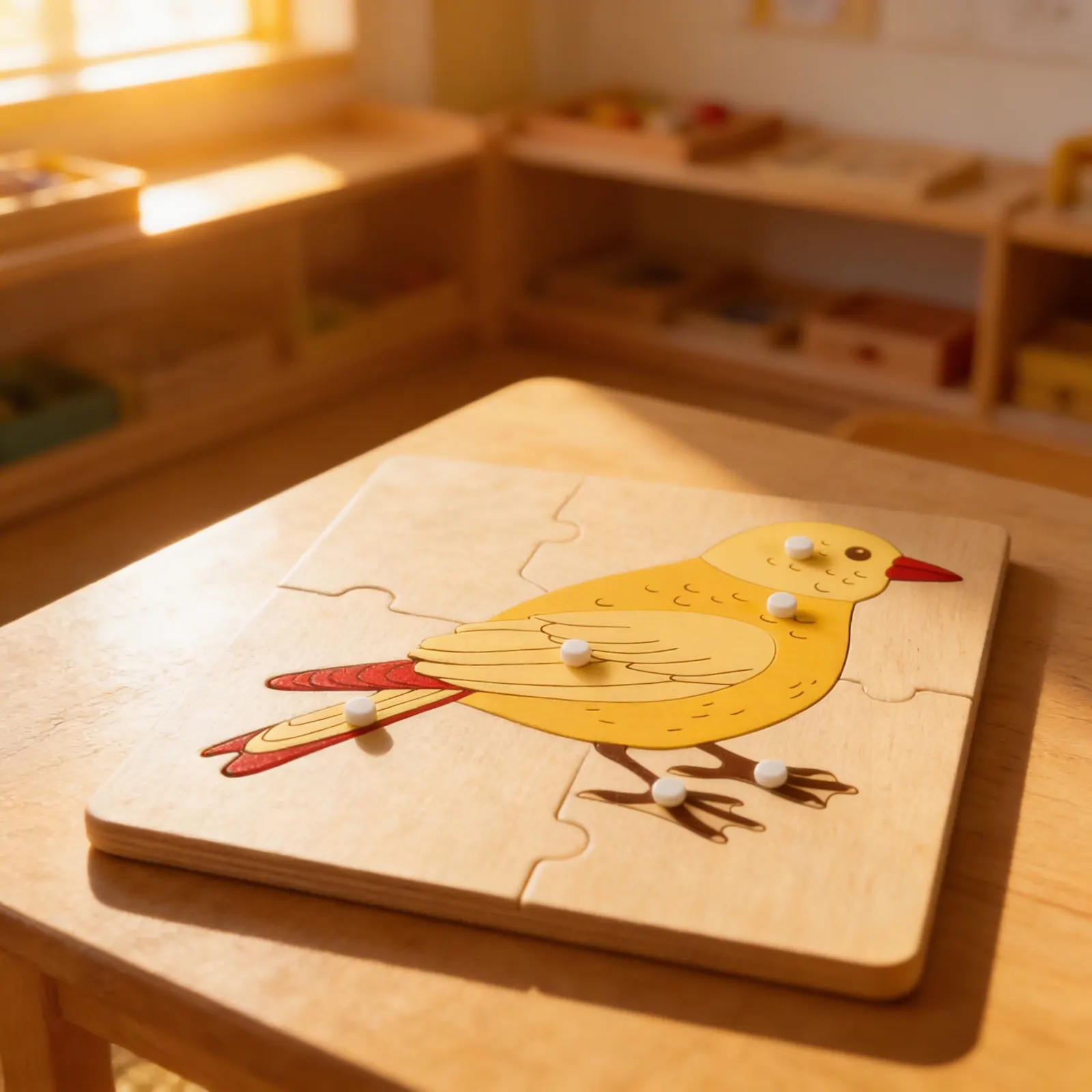
The bird puzzle from the zoology series, separating into the parts of a bird. A bird is the animal children see most and look at least, because it is nearly always moving and nearly always far away. Held still and taken apart, the parts that make flight possible stop being a blur: the wing is a shape, the tail is a shape, and both are larger relative to the body than anyone guesses from watching one fly past. Plywood, for ages 3 to 6.
Zoological Knowledge
Children learn to identify and name different parts of a bird's anatomy through hands-on manipulation.
Fine Motor Control
Grasping the knobs and fitting pieces precisely develops pincer grip and hand-eye coordination.
Part-to-Whole Relationships
Understanding how individual parts combine to form a complete organism builds logical thinking skills.
Scientific Classification
Introduces early concepts of animal classification and characteristics specific to birds.
How to present it
Place the bird puzzle on a small work mat at the child's table. Ensure all pieces are properly seated in the frame before presentation.
- 1Remove each piece slowly using the knob, starting with the head
- 2Place removed pieces to the right of the frame in order
- 3Name each part as you handle it: 'This is the bird's wing'
- 4Invite the child to return pieces, offering the name again
- 5Once comfortable, introduce a three-period lesson with the parts
3 tips for parents
- Point out birds during walks, using vocabulary from the puzzle: 'See its wings spreading?'
- Create a bird-watching journal together, sketching birds and labeling parts
- Visit a pet store or aviary to observe different bird types up close

If you are not sure it suits your child, we answer in person.
Norbert Kovalčín, founder of Faborino · write to him
There is no review here yet. We will ask you for one after you buy. Write the first review
What's in the Box
- Bird Puzzle: Approx. 4 removable pieces with knobs
- Wooden Frame: 20×20 cm plywood base with raised border
Size and material
| Packaging | 25 × 25 × 3 cm |
| Base Material | Plywood construction |
| Knobs | Wooden handles |
| Finish | Natural wood finish |
| Recommended Age | 3-6 years |
Care
| Cleaning | Wipe with slightly damp cloth, dry immediately |
| Storage | Store flat in dry environment |
Frequently Asked Questions
What are the main parts of the bird included in this puzzle?
The puzzle typically includes the head, body, wings, tail, and feet as separate pieces. Each part is designed to help children understand basic bird anatomy and how these parts work together to form a complete bird.
How does this puzzle support my child's development?
This puzzle develops fine motor skills through grasping the knobs, introduces scientific vocabulary, enhances problem-solving abilities, and builds foundational biology knowledge. It also supports hand-eye coordination and spatial awareness.
What makes this different from regular jigsaw puzzles?
Unlike traditional puzzles, this Montessori bird puzzle focuses on teaching anatomy with clearly defined body parts. Each piece represents a specific part of the bird, making it an educational tool that introduces scientific concepts while developing motor skills.
Can younger children under 3 use this puzzle safely?
While designed for ages 3-6, younger children can use it under supervision. The knobbed pieces are easy to grasp and typically large enough to prevent choking hazards, but always supervise children under 3 during use.
How can I extend learning activities with this puzzle?
You can name each body part, discuss what each part does, compare with real birds or pictures, create bird observation activities outdoors, or pair with bird books and three-part cards for vocabulary development.
Product safety
Manufacturer: Nienhuis Montessori, Anders Celsiusstraat 15, 7442 PB Nijverdal, Netherlands
Animal Puzzle