
Animals And Their Sounds
The first photo is the maker's own. The other shots are illustrative.
Inv. no. NIE-562100
- Maker
- Nienhuis Montessori, since 1929
- Approval
- AMI
- Card Material
- Laminated cardstock
- Finish
- Protective laminate coating
- EAN
- 8719924029975
Final price incl. VAT. Delivery €5.90, €119.10 to go for free delivery.
Advice, warranty and returns are handled by us.
Why it costs €29.90
Behind the price of the original are things you can check yourself.
AMI approval
The material is approved by the Association Montessori Internationale (AMI). Nienhuis has made Montessori materials since 1929.
A verifiable original
The EAN 8719924029975 is on the box. It is the maker's number, not ours.
Animals And Their Sounds in a child's hands
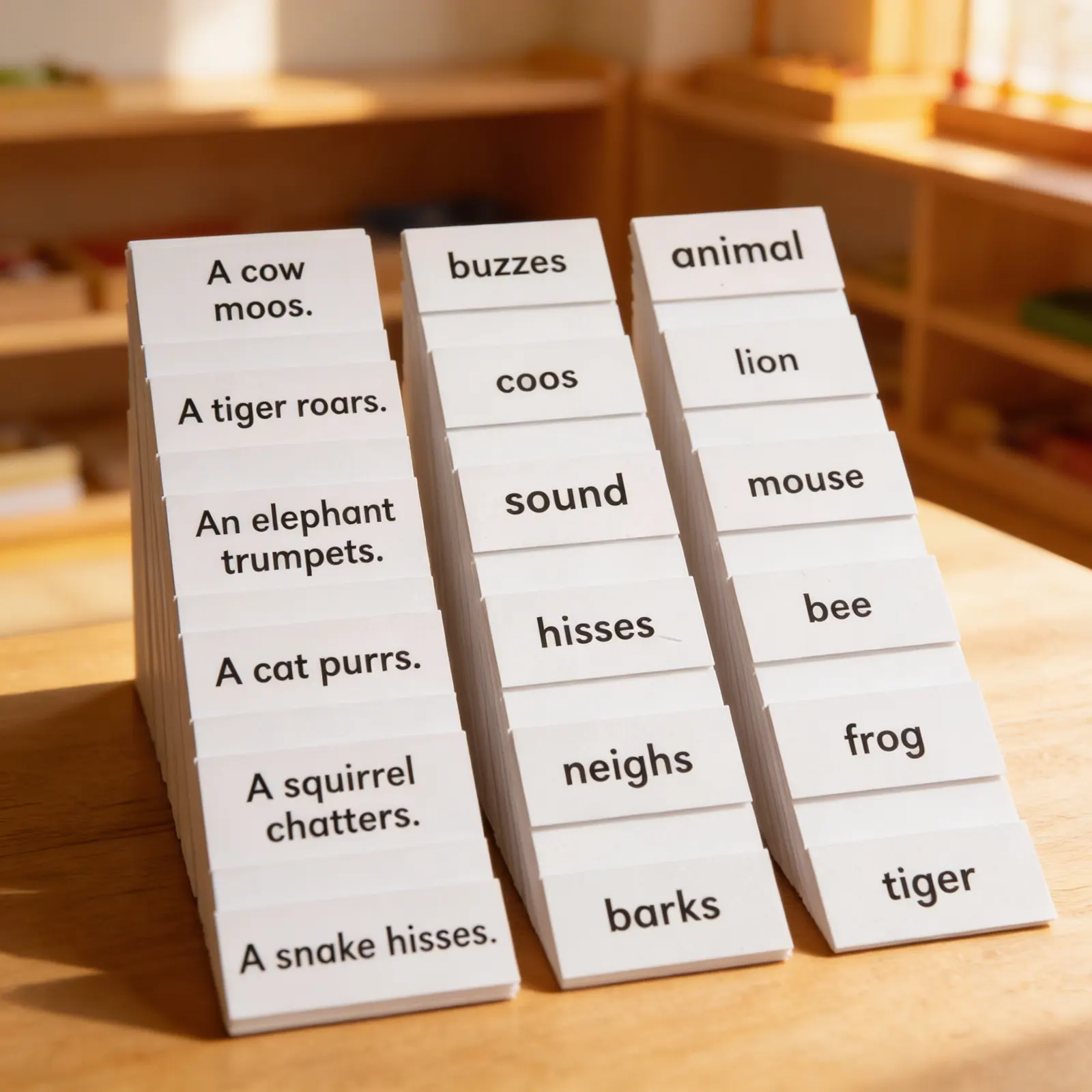
Nature as teacher, these Animals And Their Sounds cards provide a comprehensive language exploration activity combining visual recognition, reading, and auditory vocabulary. Children match full sentences describing animal sounds with corresponding individual animal name cards and onomatopoeia cards, creating meaningful connections between written and spoken language while developing early reading skills and zoological knowledge.
Language Development
Builds vocabulary through meaningful connections between animals, their names, and the sounds they make, supporting both oral and written language skills.
Reading Preparation
Progresses from simple word matching to full sentence comprehension, developing left-to-right tracking and early reading confidence.
Classification Skills
Encourages logical thinking as children categorize and match related concepts across three different card types.
Auditory Processing
Connects written onomatopoeia with remembered animal sounds, strengthening the relationship between visual and auditory learning.
How to present it
Lay out the full sentence cards in a column on the left side of the work mat. Place the animal name cards and onomatopoeia cards in separate baskets to the right.
- 1Read the first sentence card aloud, emphasizing each word clearly
- 2Search through the animal name cards to find the matching animal
- 3Place the animal name card next to its sentence
- 4Find the corresponding onomatopoeia card for the animal sound
- 5Continue matching all sentences with their component cards
3 tips for parents
- Practice animal sounds during everyday conversations to reinforce the vocabulary
- Point out written animal sounds in storybooks to connect with the card work
- Encourage your child to teach you the matches they've learned at school

If you are not sure it suits your child, we answer in person.
Norbert Kovalčín, founder of Faborino · write to him
There is no review here yet. We will ask you for one after you buy. Write the first review
What's in the Box
- Sentence Cards: Complete sentences describing animal sounds
- Animal Name Cards: Individual animal name labels
- Sound Word Cards: Onomatopoeia cards for each animal
Size and material
| Packaging | 11 × 5 × 1 cm |
| Card Material | Laminated cardstock |
| Finish | Protective laminate coating |
| Recommended Age | 3-6 years |
Care
Wipe with slightly damp cloth, dry immediately
Frequently Asked Questions
What exactly is included in this Animals And Their Sounds card set?
This set includes three types of cards: full sentence cards describing animal sounds (e.g., 'The dog says woof'), individual animal name cards with pictures, and onomatopoeia cards showing the sound words. Children match these three card types together to create complete learning connections.
How does this material support early reading development?
The cards progress from simple picture recognition to reading individual words and full sentences. Children first match pictures, then connect written animal names with sounds, and finally read complete sentences. This three-part matching system builds reading confidence through repetition and visual association.
What age is most appropriate for these cards?
These cards are designed for ages 3-6, perfectly aligned with the sensitive period for language development. Younger children (3-4) can start with picture matching and sound recognition, while older children (5-6) can focus on reading the words and sentences independently.
How many animals are included in this set?
While the exact number varies by set, typical Animals And Their Sounds materials include 12-20 common animals that children encounter in everyday life, ensuring the vocabulary is relevant and engaging for young learners.
Can these cards be used for children who aren't reading yet?
Absolutely! Non-readers can match pictures, learn animal names verbally, and practice making animal sounds. The material grows with the child - starting with visual and auditory learning, then progressing to reading recognition as their skills develop.
Product safety
Manufacturer: Nienhuis Montessori, Anders Celsiusstraat 15, 7442 PB Nijverdal, Netherlands
Animals And Their Sounds