
Arithmetic Signs Box: Mathematical Symbols for Equations
Made by Nienhuis Montessori · shipped by Heutink International (Netherlands) About the maker
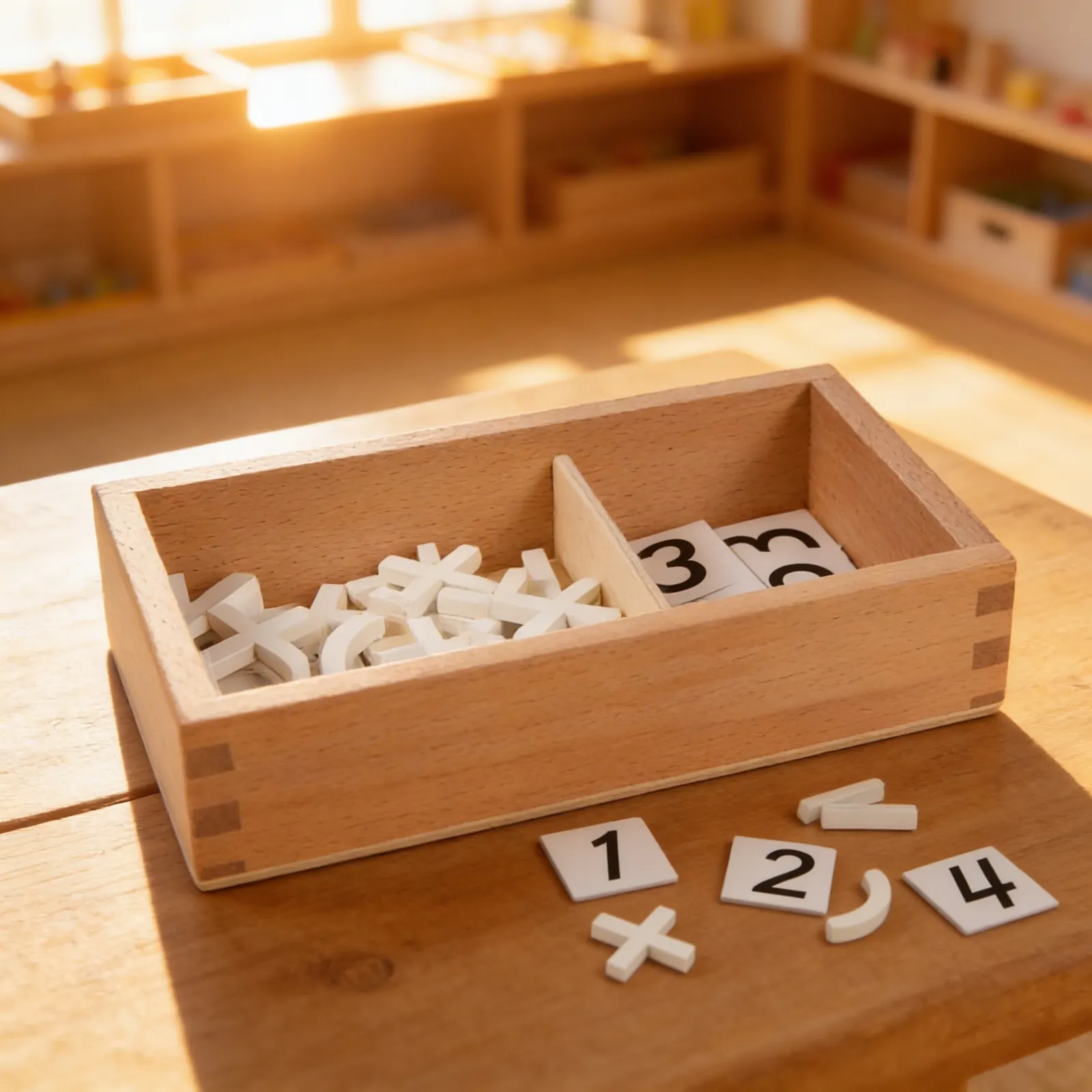
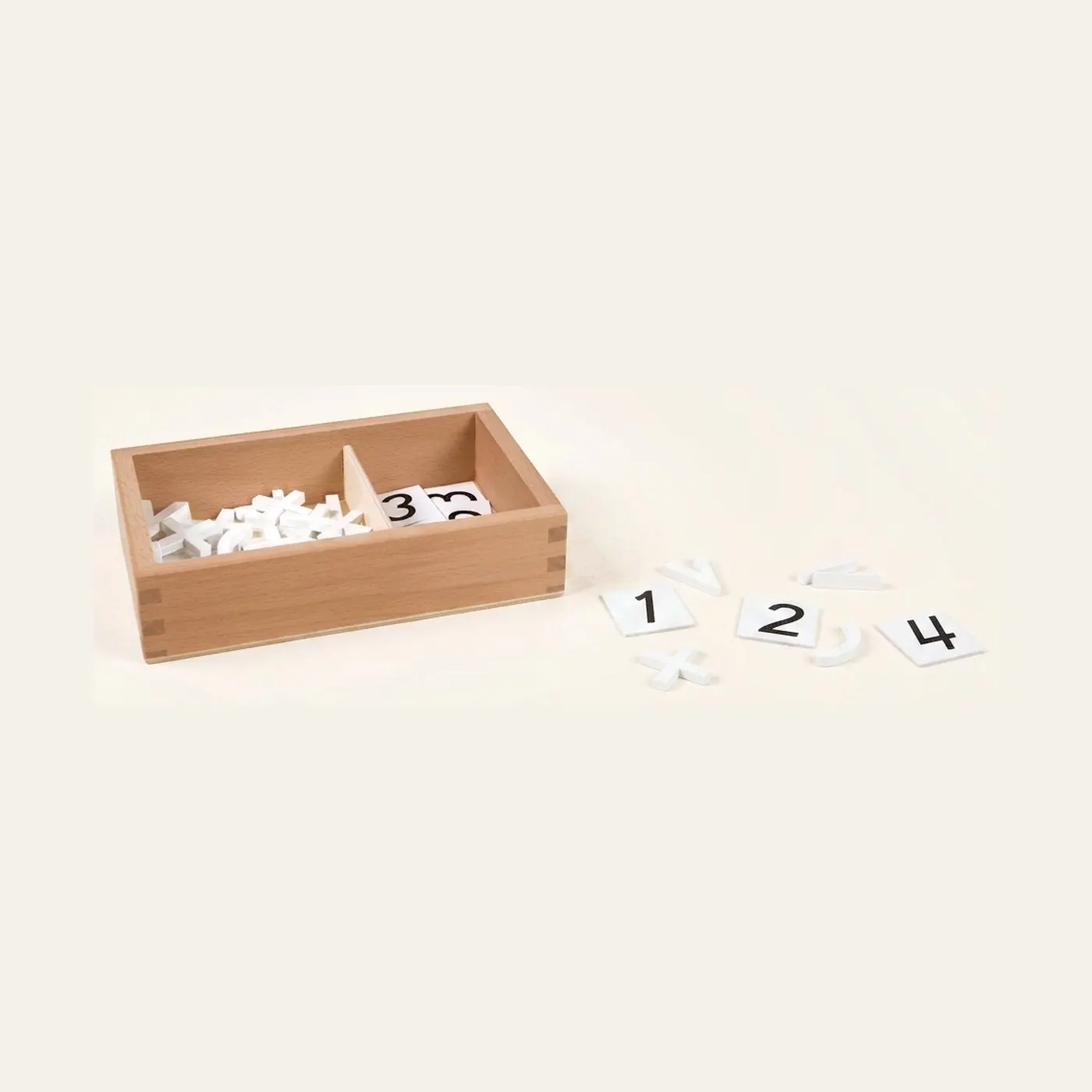
A beechwood box holding the arithmetic signs, plus, minus, times, divide and equals, together with number cards, so that any of the bead materials can be turned into a written equation. Until a child has the signs, work with beads stays an action: you fetch, you count, you exchange. Laying the signs beside the beads is the moment the action becomes a sentence that can be read back, and it is the same jump as putting a label under a picture. Wood with plastic, for ages 3 to 12.
“Education is a natural process spontaneously carried out by the human individual, and is acquired not by listening to words but by experiences upon the environment.”
The Arithmetic Signs Box embodies Montessori's principle of materialized abstractions, allowing children to physically manipulate mathematical symbols before internalizing abstract concepts. This material bridges the gap between concrete mathematical operations performed with golden beads or stamp game and purely abstract written equations. By isolating the difficulty of symbol recognition and providing tactile experiences with mathematical notation, children develop a profound understanding of how mathematical language represents quantity relationships. The material respects the child's need for repetition and self-correction, as equations can be built, verified, and reconstructed multiple times. This hands-on approach honors the Elementary child's reasoning mind and desire to understand the 'how' and 'why' of mathematical operations, moving beyond mere memorization to genuine comprehension of mathematical relationships.
- Recognition and proper use of mathematical symbols (+, -, ×, ÷, =)
- Construction of horizontal equations with concrete materials
- Translation between concrete mathematical work and abstract notation
- Development of mathematical reasoning through equation building
How to present it
Follow the Montessori method of presentation for optimal child development.
Place the Arithmetic Signs Box on a mat. Have completed work with golden beads or stamp game nearby. Ensure child has paper and pencil available for recording.
- 1
Begin with a concrete operation using golden beads (e.g., 234 + 125)
Let the child perform the operation completely before introducing symbols - 2
Build the equation using number tiles and operation signs below the concrete material
Place signs deliberately, discussing each symbol's meaning - 3
Read the complete equation aloud, pointing to each element
Use mathematical language: 'plus', 'equals', not 'and' or 'makes' - 4
Record the equation on paper while tiles remain visible
Keep the tile equation as a reference for accurate symbol formation - 5
Verify the answer by counting the concrete result
This reinforces the connection between abstract symbols and actual quantities
Every Child Is a Little Creator

Heritage
Since 1929

In classrooms
Around the world

European brands
Nienhuis, GAM, Educo

AMI approved
To the association standard
Arithmetic Signs Box: Mathematical Symbols for Equations
