
Arithmetic Trinomial Cube: Advanced Mathematical Formula Exploration
Made by Nienhuis Montessori · shipped by Heutink International (Netherlands) About the maker
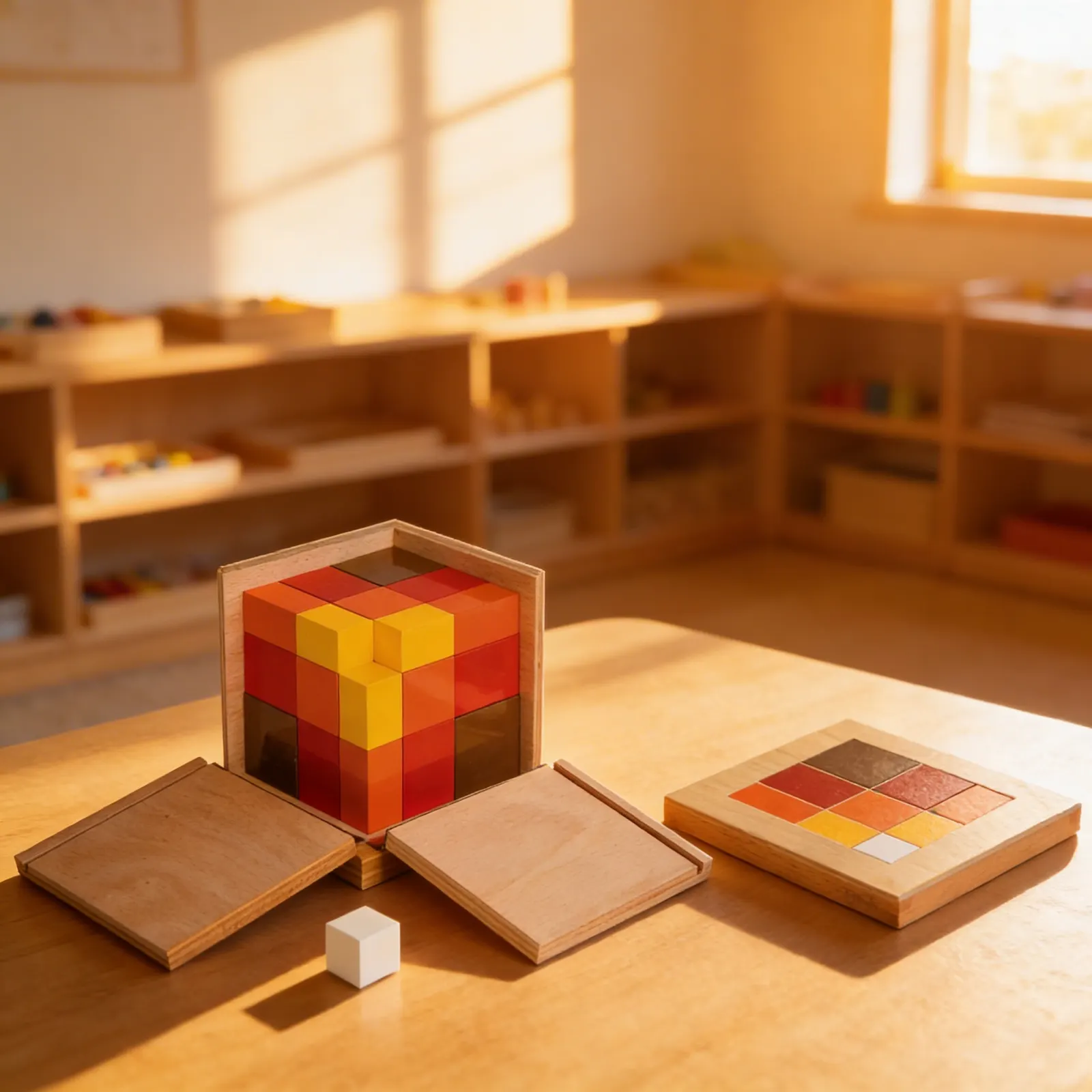
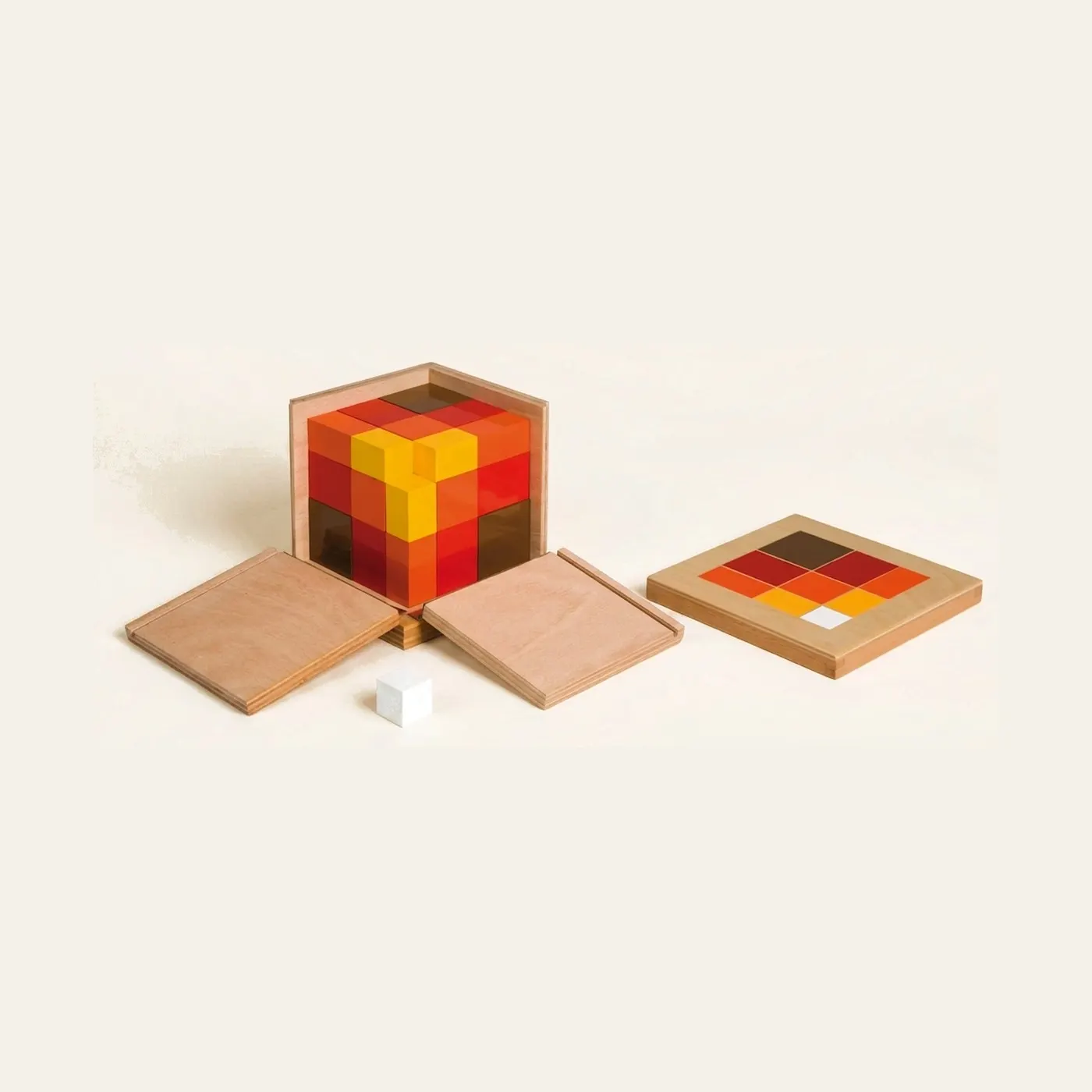
The trinomial cube built for arithmetic rather than pattern. It represents (a + b + c)³ in solid form, and unlike the plain trinomial cube its pieces are colour coded by hierarchical value, from one unit up to a million. That single change turns a puzzle into a calculation: a child can put a number on every cube and prism in the box and read the expansion off the pieces instead of memorising it. Sits naturally after the plain cube and before written algebra. Solid wood in a hinged box with lid, for ages 6 to 12.
“The greatest sign of success for a teacher is to be able to say, 'The children are now working as if I did not exist.'”
The Arithmetic Trinomial Cube embodies Dr. Montessori's principle that children possess mathematical minds capable of understanding complex concepts when presented through concrete materials. This material represents the transition from sensorial exploration to mathematical abstraction, allowing children to discover algebraic relationships through manipulation rather than memorization.
- Understanding of cubic expansion and algebraic formulas through concrete manipulation
- Development of spatial reasoning and three-dimensional visualization skills
- Recognition of mathematical patterns and relationships between components
- Preparation for advanced algebra and polynomial expansion
Read More
By working with the cube, children experience the formula (a+b+c)³ as a tangible reality before encountering it symbolically. The material respects the child's need for repetition and self-correction, as the cube can only be assembled correctly when mathematical relationships are properly understood. This bridges the elementary child's growing capacity for abstraction while honoring their continued need for concrete experiences, demonstrating that advanced mathematics emerges naturally from sensorial foundations.
How to present it
Follow the Montessori method of presentation for optimal child development.
Place the Arithmetic Trinomial Cube box on a large work mat. Have paper and colored pencils available for recording observations. Ensure the child has mastered the Binomial Cube and understands basic algebraic notation.
- 1
Open the box and carefully remove all 27 pieces, laying them out systematically on the mat
Group pieces by color initially to help children recognize patterns - 2
Identify the three different edge lengths representing a, b, and c values through careful observation
Use the largest cube (a³) as your starting reference point - 3
Begin reconstruction by placing the a³ cube in one corner, then systematically add pieces that share common faces
Think of building layers - complete one horizontal layer before moving up - 4
Notice how each piece represents a term in the expansion: a³, 3a²b, 3a²c, 3ab², 6abc, etc.
Have children verbalize what each piece represents as they place it - 5
Complete the cube and verify all faces show the characteristic pattern of the trinomial square
Each face should display (a+b+c)² when correctly assembled - 6
Record the completed cube pattern and write the algebraic expansion: (a+b+c)³
Use colored pencils matching the cube pieces to reinforce visual connections
Every Child Is a Little Creator

Heritage
Since 1929

In classrooms
Around the world

European brands
Nienhuis, GAM, Educo

AMI approved
To the association standard
Arithmetic Trinomial Cube: Advanced Mathematical Formula Exploration
