
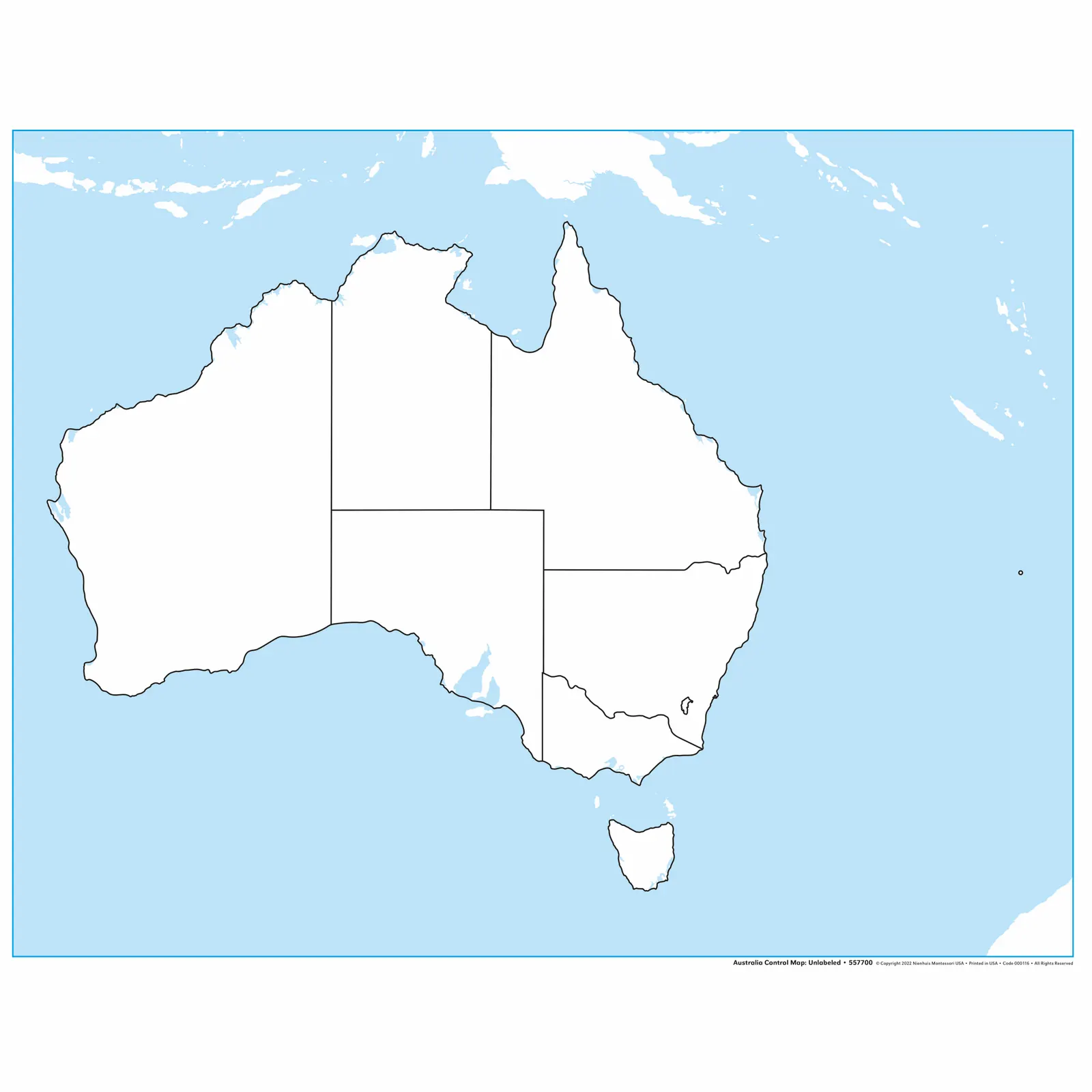
Australia Control Map: Unlabeled
Made by Nienhuis Montessori · shipped by Heutink International (Netherlands) About the maker
Australia Control Map, Unlabeled presents the continent's outline on laminated paper with no printed text, so a child aged three to six can focus first on shape and coastline alone. Paired with the wooden puzzle map, it works as the visual key the child checks their placement against, before names are ever spoken during the lesson. This early, wordless stage trains the eye and hand together and builds the visual memory that later makes labeled maps and country names easy to grasp. The laminate keeps the sheet flat and crisp through daily, repeated use.
“The senses, being explorers of the world, open the way to knowledge.”
The unlabeled control map of Australia serves as a foundational geography material by presenting only essential visual information - the continent's outline and internal boundaries. This deliberate absence of labels on the Australia map allows children to focus purely on shape recognition and spatial relationships without the distraction of text.
- Visual discrimination of Australia's unique continental shape and coastal features
- Recognition of internal state and territory boundaries through shape analysis
- Understanding of Tasmania as an island state separate from mainland Australia
- Development of finger control through precise boundary tracing
Read More
The laminated surface of this control map invites repeated finger tracing, enabling children to internalize Australia's distinctive coastal contours and state boundaries through tactile experience. By offering Tasmania as a separate landmass, the map respects geographical accuracy while teaching children that nations can include disconnected territories. This unlabeled format transforms the Australia map from a passive reference into an active learning tool where children must rely on visual discrimination rather than reading skills. The control map's role extends beyond mere identification - its clear boundary lines help children understand how humans organize geographical space into political divisions while maintaining awareness of the continent's natural form.
How to present it
Follow the Montessori method of presentation for optimal child development.
Place the laminated control map on a table at child height. Ensure clean, dry hands for optimal tracing. Have a soft cloth nearby for cleaning the laminated surface.
- 1
Invite the child to explore Australia's outer coastline with their index finger, starting at any point and moving slowly around the entire continent
Demonstrate smooth, continuous movement to model careful tracing - 2
Focus on one state or territory, tracing its complete boundary while noting how it connects to neighboring regions
Start with Western Australia or Queensland as their larger sizes make boundaries easier to follow - 3
Trace Tasmania's outline separately, then discuss its position relative to mainland Australia
Use directional language like 'south of Victoria' to build geographical vocabulary - 4
Challenge the child to close their eyes and visualize a specific state shape, then open and trace it
This builds mental mapping skills essential for later geography work
Every Child Is a Little Creator

Heritage
Since 1929

In classrooms
Around the world

European brands
Nienhuis, GAM, Educo

AMI approved
To the association standard
Australia Control Map: Unlabeled
