
Bank GameDecimal System Operations
The first photo is the maker's own. The other shots are illustrative.
Inv. no. NIE-007300
- Maker
- Nienhuis Montessori, since 1929
- Approval
- AMI
- Box
- Birch plywood and beech
- Number Cards
- Plastic (PVC)
- EAN
- 8719924004354
Final price incl. VAT. Delivery €5.90, €37.10 to go for free delivery.
Advice, warranty and returns are handled by us.
Why it costs €111.90
Behind the price of the original are things you can check yourself.
AMI approval
The material is approved by the Association Montessori Internationale (AMI). Nienhuis has made Montessori materials since 1929.
A verifiable original
The EAN 8719924004354 is on the box. It is the maker's number, not ours.
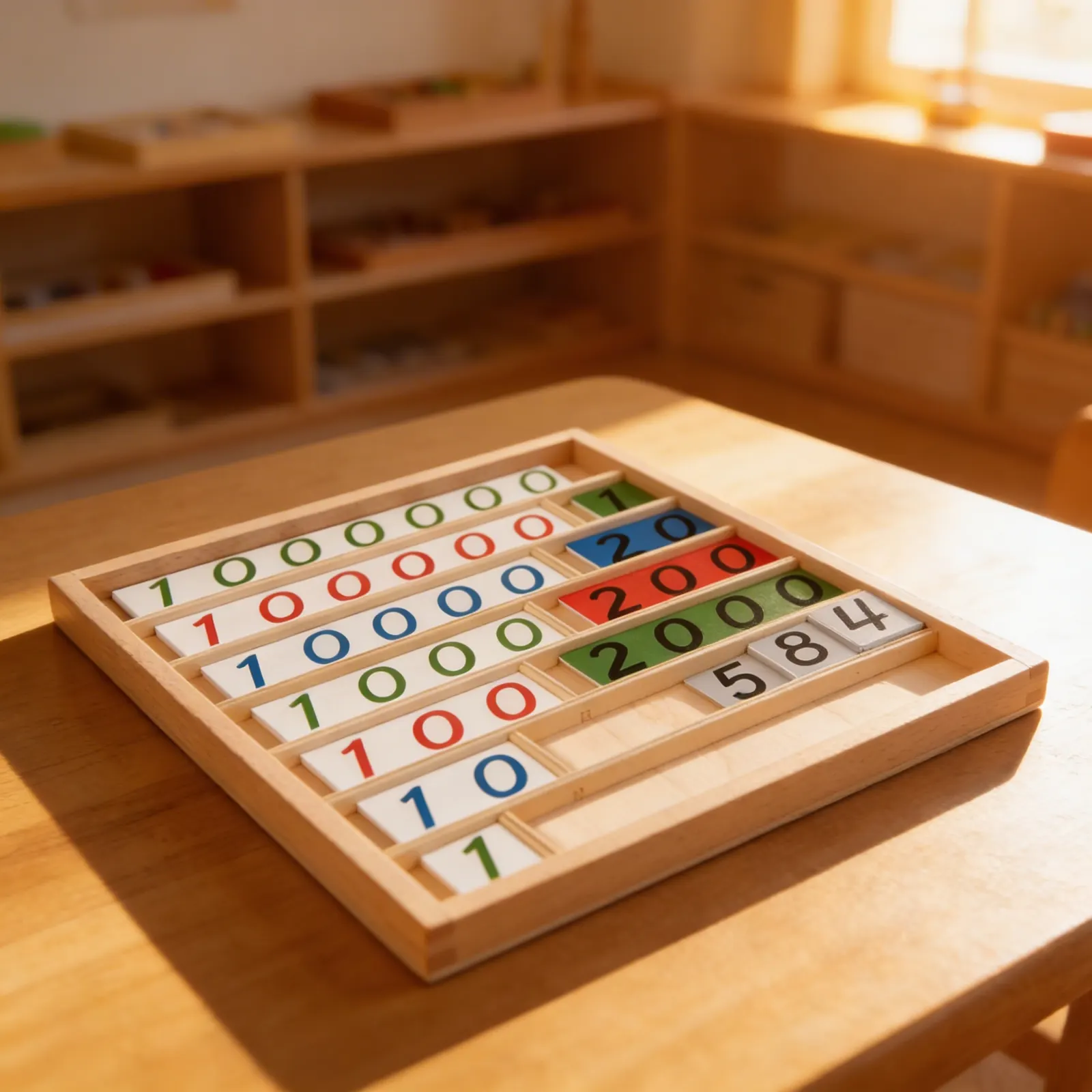
Bank Game in a child's hands
Long multiplication turned into a game with roles, where children take on parts and trade quantities as a bank would. The roles are what make it work: a child who is the banker has a reason to check another child's arithmetic, and being checked by a peer lands differently from being checked by an adult. Includes number cards, role designator cards and a box built for the game. Best with a small group rather than alone. Wood and plastic, for ages 6 to 12.
Place Value Understanding
Color-coded cards provide visual and tactile representation of the decimal system, making abstract concepts concrete and manipulable.
Mathematical Operations
Supports long multiplication with large numbers through hands-on manipulation.
Abstract Thinking
Bridges the gap between concrete golden bead material and abstract mathematical notation.
How to present it
3 tips for parents
- Practice skip counting by 10s, 100s, and 1000s at home to reinforce place value patterns
- Use real money to demonstrate similar exchange concepts, 10 pennies for 1 dime mirrors the Bank Game
- Avoid rushing toward paperwork, the physical card manipulation builds essential understanding

If you are not sure it suits your child, we answer in person.
Norbert Kovalčín, founder of Faborino · write to him
There is no review here yet. We will ask you for one after you buy. Write the first review
What's in the Box
- Number cards: Plastic; 1s (green), 10s (blue), 100s (red), 1000s (green)
- Role designator cards: For the roles the children take on in the game
- Box with lid: Specially designed for the game
Size and material
| Packaging | 25 × 23 × 2 cm |
| Box | Birch plywood and beech |
| Number Cards | Plastic (PVC) |
| Recommended Age | 6-12 years |
Care
Wipe the wooden box with a damp cloth
Frequently Asked Questions
What mathematical concepts does the Bank Game teach?
The Bank Game reinforces long multiplication with multi-digit numbers, building on place value and the decimal system. It helps children understand exchanging between units, tens, hundreds, and thousands while building a concrete foundation for abstract mathematical operations.
How does the Bank Game differ from the Golden Bead Material?
While both teach the decimal system, the Bank Game uses color-coded number cards instead of physical beads, allowing for work with larger numbers and more complex operations. It serves as a bridge between the concrete Golden Beads and abstract written mathematics.
What age is most appropriate for introducing the Bank Game?
The Bank Game is typically introduced around age 6-7, after children have mastered the Golden Bead Material and understand basic place value concepts. Children continue using it through ages 10-12 for increasingly complex operations.
What materials are included in the Bank Game set?
The set includes plastic number cards in the place value colours (green units, blue tens, red hundreds, green thousands), role designator cards and a specially designed box with a lid.
Can the Bank Game be used for group activities?
Yes, the Bank Game is excellent for collaborative learning. Children can work in groups of 2-4, with roles like banker, customer, and recorder. This social aspect reinforces mathematical concepts while developing communication and teamwork skills.
Product safety
Manufacturer: Nienhuis Montessori, Anders Celsiusstraat 15, 7442 PB Nijverdal, Netherlands
Bank Game