
Bead Houses for Place Value
The first photo is the maker's own. The other shots are illustrative.
Inv. no. NIE-008800
- Maker
- Nienhuis Montessori, since 1929
- Approval
- AMI
- Storage Box
- Natural wood with sliding lid
- House Templates
- Transparent colored acrylic
- EAN
- 8719924005191
Final price incl. VAT. Delivery €5.90, €62.10 to go for free delivery.
Advice, warranty and returns are handled by us.
Why it costs €86.90
Behind the price of the original are things you can check yourself.
AMI approval
The material is approved by the Association Montessori Internationale (AMI). Nienhuis has made Montessori materials since 1929.
A verifiable original
The EAN 8719924005191 is on the box. It is the maker's number, not ours.
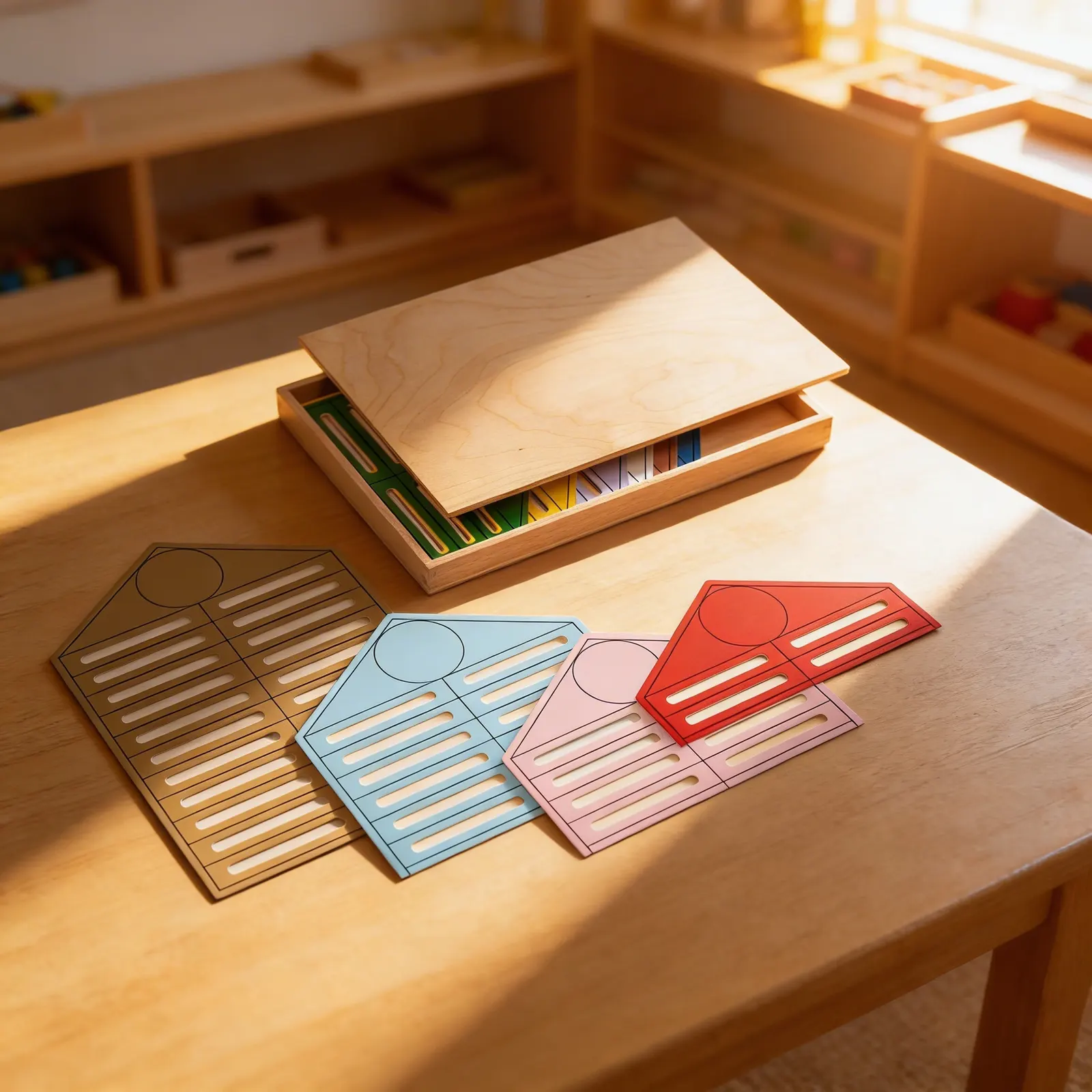
Bead Houses for Place Value in a child's hands
Ten house shaped cards in durable plastic, colour coded to match the bead bars, used to isolate every way a number from one to ten can be made. Each house holds one number, and the child fills it with the pairs that add to it, so five is not a word but a set: four and one, three and two, and their reverses. Working with the coloured bead bars and the cut out numerals, both sold separately. Ten cards and a wooden box with lid. Wood with plastic, for ages 3 to 6.
Place Value Understanding
Visual organization of beads into houses creates concrete understanding of units, tens, hundreds, and thousands in our decimal system.
Mathematical Order
Color-coded system reinforces the hierarchical nature of numbers and prepares for complex operations like exchanging and regrouping.
Abstract to Concrete
Bridges the gap between physical golden beads and abstract number symbols through systematic visual organization.
Preparation for Operations
Establishes foundation for understanding addition, subtraction, multiplication, and division with large numbers.
How to present it
Place the four Bead Houses in a row from right to left: units (green), tens (blue), hundreds (red), thousands (green). Have golden bead material ready: unit beads, ten bars, hundred squares, and thousand cube.
- 1Introduce each house by its color and place value, placing one corresponding golden bead in each template
- 2Build a number like 2,543 by placing beads in their houses: 2 thousand cubes, 5 hundred squares, 4 ten bars, 3 unit beads
- 3Practice reading the number by pointing to each house from left to right
- 4Invite the child to build their own numbers using the houses as guides
3 tips for parents
- Notice place value in everyday numbers like addresses or prices, relating back to the colored houses
- When your child mentions the Bead Houses, ask them to show you a number using objects at home
- Avoid rushing to written numerals, the physical organization in houses builds deeper understanding

If you are not sure it suits your child, we answer in person.
Norbert Kovalčín, founder of Faborino · write to him
There is no review here yet. We will ask you for one after you buy. Write the first review
What's in the Box
- Wooden Storage Box: With sliding lid
- Unit House: Green transparent template
- Ten House: Blue transparent template
- Hundred House: Red transparent template
- Thousand House: Green transparent template (larger)
Size and material
| Packaging | 32 × 23 × 3 cm |
| Storage Box | Natural wood with sliding lid |
| House Templates | Transparent colored acrylic |
| Recommended Age | 3-6 years |
Care
Wipe templates with damp cloth, dry wooden box thoroughly
Frequently Asked Questions
What are Bead Houses and how do they work?
Bead Houses are transparent templates with color-coded compartments that organize golden beads into place value categories (units, tens, hundreds, thousands). Children place the appropriate beads in each 'house' to visually understand how our number system is organized hierarchically.
What age group is this material designed for?
The Bead Houses are designed for children ages 3-6 years old, aligning with the Montessori early childhood curriculum when children are developing their foundational understanding of mathematics and place value.
Do I need to purchase golden beads separately?
Yes, golden beads are typically purchased separately. The Bead Houses are templates that work alongside the golden bead material to provide organization and visual structure for place value work.
How does this material support mathematical understanding?
The Bead Houses make abstract place value concepts concrete by providing distinct visual compartments for each category. This helps children physically see and understand that 10 units equal 1 ten, 10 tens equal 1 hundred, and 10 hundreds equal 1 thousand.
What activities can children do with the Bead Houses?
Children can sort golden beads by place value, build numbers by filling the appropriate houses, practice exchanging (10 units for 1 ten), perform addition and subtraction operations, and explore the decimal system's base-ten structure.
Product safety
Manufacturer: Nienhuis Montessori, Anders Celsiusstraat 15, 7442 PB Nijverdal, Netherlands
Bead Houses for Place Value