
Binomial Cube: Algebraic Concepts Through Sensorial Exploration
Made by Nienhuis Montessori · shipped by Heutink International (Netherlands) About the maker
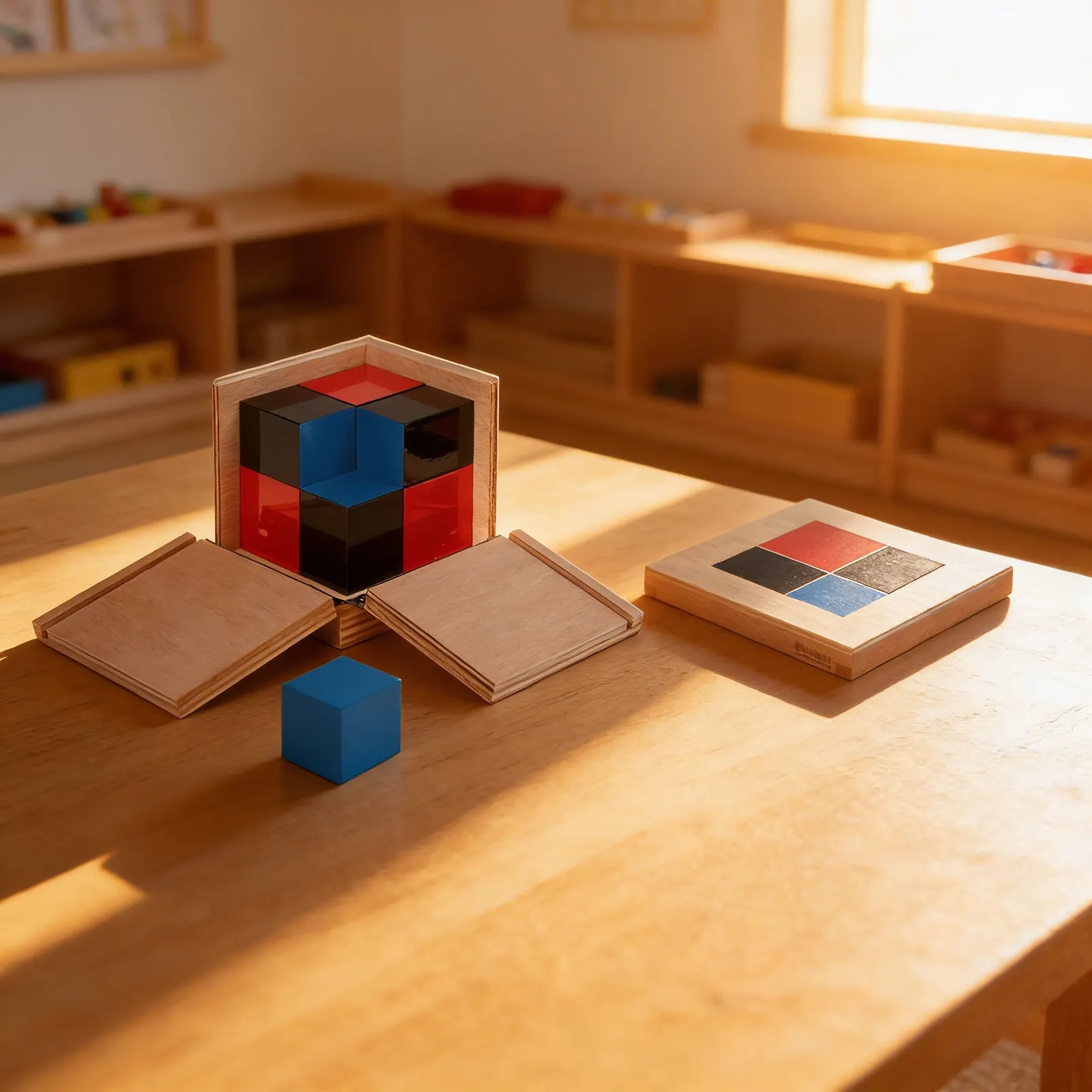
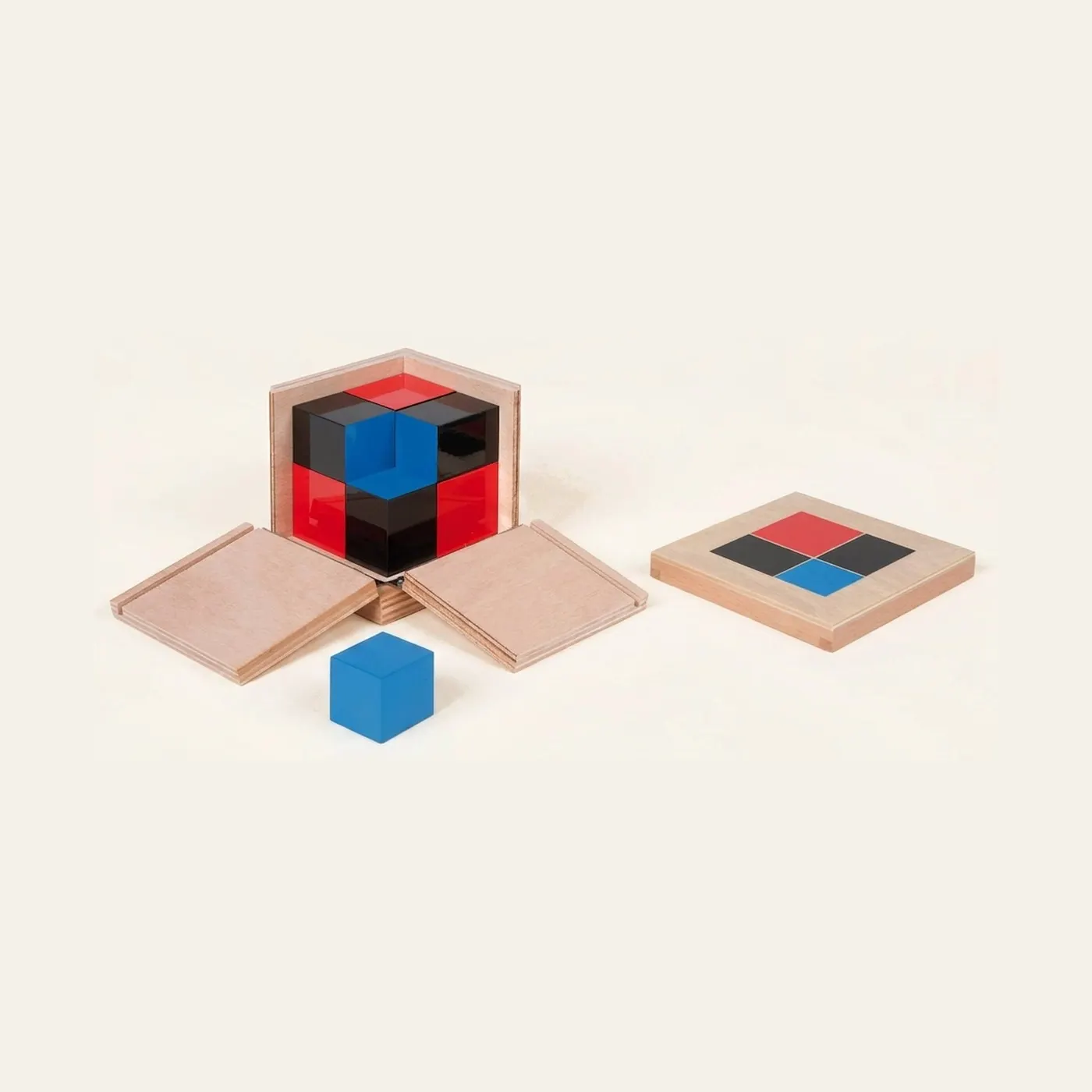
The Binomial Cube is a fundamental Montessori sensorial material that brings children face-to-face with algebraic concepts through concrete manipulation. This carefully proportioned wooden puzzle consists of eight color-coded blocks that, when correctly assembled, form a perfect cube representing the algebraic equation (a+b)³. The hinged storage box serves as both a work surface and organizational tool, supporting the child's natural order and concentration.
“The senses, being explorers of the world, open the way to knowledge.”
The Binomial Cube embodies Dr. Montessori's principle of indirect preparation, where children absorb complex mathematical concepts through sensorial exploration years before formal instruction.
- Develops visual discrimination of color and dimension through systematic cube assembly
- Strengthens spatial reasoning and three-dimensional problem-solving abilities
- Indirectly prepares for algebraic concepts of binomial expansion (a+b)³
- Refines fine motor control and hand-eye coordination through precise block placement
Read More
This material respects the child's mathematical mind, the human tendency to think in patterns, relationships, and order. Through self-correcting design, it honors the child's need for independence and intrinsic motivation. The cube's visual and tactile qualities engage multiple senses simultaneously, creating neural pathways that support later abstract thinking. By manipulating concrete objects that represent algebraic relationships, children build a sensorial impression of mathematical laws, demonstrating Montessori's belief that the hand is the instrument of the mind. This material bridges the sensorial and mathematical areas, revealing the interconnectedness of the Montessori curriculum.
How to present it
Follow the Montessori method of presentation for optimal child development.
Place the closed Binomial Cube box on a mat at the child's dominant side. Ensure adequate workspace for laying out all pieces. The hinged box should open smoothly, revealing the completed cube inside.
- 1
Carefully open the box and remove blocks one by one, placing them randomly on the mat
Move slowly and deliberately to model careful handling of materials - 2
Begin reconstruction by finding the largest red cube (a³) and placing it in the corner of the box
Point out how the box's painted pattern guides placement - 3
Add the three red and black rectangular prisms (3a²b) adjacent to the red cube
Note how each face matches the color it touches - 4
Place the three black and red rectangular prisms (3ab²) in their positions
Encourage the child to verify color matching on all visible faces - 5
Complete with the small black cube (b³) in the remaining corner
Demonstrate checking the top pattern matches the box lid - 6
Close the box to verify correct assembly, then invite the child to try
Step back and observe without intervening unless invited
Every Child Is a Little Creator

Heritage
Since 1929

In classrooms
Around the world

European brands
Nienhuis, GAM, Educo

AMI approved
To the association standard
Binomial Cube: Algebraic Concepts Through Sensorial Exploration
