
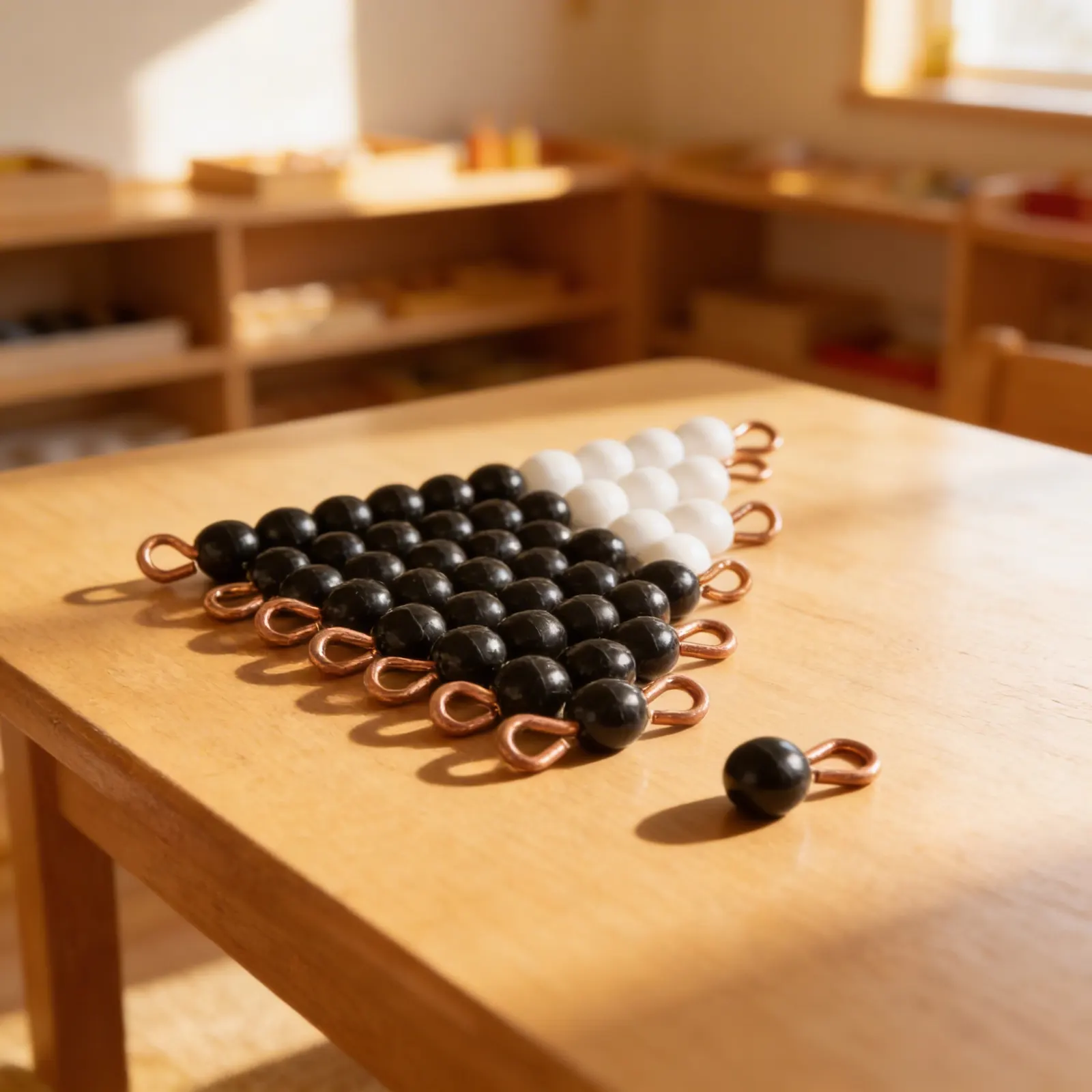
Black And White Bead Stairs - Individual Beads Nylon1 Set
The first photo is the maker's own. The other shots are illustrative.
Inv. no. NIE-0091AM
- Maker
- Nienhuis Montessori, since 1929
- Approval
- AMI
- Beads
- Plastic/nylon
- Wire
- Metal with copper-colored ends
- EAN
- 8719924005429
Final price incl. VAT. Delivery €5.90, €138.30 to go for free delivery.
Advice, warranty and returns are handled by us.
Why it costs €10.70
Behind the price of the original are things you can check yourself.
AMI approval
The material is approved by the Association Montessori Internationale (AMI). Nienhuis has made Montessori materials since 1929.
A verifiable original
The EAN 8719924005429 is on the box. It is the maker's number, not ours.
Black And White Bead Stairs - Individual Beads Nylon in a child's hands
One set of black and white bead stairs in the nylon bead type, used in addition and subtraction work. The coloured bead stair gives every quantity its own colour, which is a help right up to the moment it becomes a crutch: a child can read nine off the dark blue without counting anything. These stairs repeat the same quantities in two colours only, so the number has to come from the beads themselves. Order in the type you own, since the glass set is a separate item.
Number Concept Formation
Children develop concrete understanding of quantities 1-9 through visual and tactile exploration of the bead bars.
Mathematical Preparation
Establishes foundation for skip counting, addition, and understanding of the decimal system through hands-on manipulation.
Visual Discrimination
The alternating black and white pattern helps children clearly distinguish individual units within each quantity.
Sequential Thinking
Arranging beads in stair formation reinforces understanding of numerical order and progression.
How to present it
Place the bead bars on a neutral-colored mat in random order. Ensure adequate space for the child to arrange and rearrange the bars freely.
- 1Invite the child to arrange the bead bars from shortest to longest, creating a stair formation
- 2Count each bar together, touching each bead as you count
- 3Select two bars and count their combined beads
- 4Ask the child to close their eyes while you remove one bar, then identify which is missing
3 tips for parents
- Practice counting everyday objects at home using the same touching-while-counting method used with bead bars
- When your child mentions the bead stairs, ask them to show you quantities using their fingers
- Support mathematical language by using terms like 'more than,' 'less than,' and 'equal to' during daily activities

If you are not sure it suits your child, we answer in person.
Norbert Kovalčín, founder of Faborino · write to him
There is no review here yet. We will ask you for one after you buy. Write the first review
What's in the Box
- Bead bars: 9 pieces representing quantities 1-9
Size and material
| Packaging | 8 × 5 × 2 cm |
| Beads | Plastic/nylon |
| Wire | Metal with copper-colored ends |
| Recommended Age | 3-6 years |
Care
Wipe with damp cloth, air dry completely
Frequently Asked Questions
What's included in this Black and White Bead Stairs set?
This set includes 9 bead bars representing numbers 1 through 9. Each bar contains the corresponding number of alternating black and white plastic beads strung on durable wire. The beads are made from nylon material for longevity and repeated classroom use.
How do these differ from colored bead stairs?
Unlike traditional colored bead stairs where each number has a specific color, these use alternating black and white beads throughout all bars. This design helps children focus purely on quantity without color associations, making it easier to see odd/even patterns and count individual units.
What mathematical concepts can children learn with these beads?
Children develop understanding of quantities 1-9, one-to-one correspondence, number sequence, skip counting, odd and even numbers, and early addition/subtraction. The alternating colors make it easy to count and verify quantities, preparing children for more advanced mathematical work.
At what age should children start using these bead stairs?
These beads are designed for ages 3-6. Younger children (3-4) typically begin by matching quantities and learning number names, while older children (5-6) use them for skip counting, composing numbers, and understanding number relationships within the decimal system.
How durable are these nylon beads for classroom use?
The nylon beads are specifically chosen for their durability and resistance to wear. They maintain their shape and color contrast even with frequent handling by multiple children. The wire construction prevents beads from coming loose, ensuring the materials remain intact for years of classroom use.
Product safety
Manufacturer: Nienhuis Montessori, Anders Celsiusstraat 15, 7442 PB Nijverdal, Netherlands
Black And White Bead Stairs - Individual Beads Nylon