
Pink Tower Extension Cubes273 Wooden Cubes in Storage Box
€42.90In Stock. Delivery in 5 to 9 working days.
The first photo is the maker's own. The other shots are illustrative.
Inv. no. NIE-002420
- Maker
- Nienhuis Montessori, since 1929
- Approval
- AMI
- Box Construction
- Beechwood
- Cubes
- Beechwood, natural finish
- EAN
- 8719924001131
€42.90
Final price incl. VAT. Delivery €5.90, €106.10 to go for free delivery.
✓ In StockDelivery in 5 to 9 working days.
1
30 daysto return
Advicebefore and after
Invoicefor companies
Advice, warranty and returns are handled by us.
The original
Why it costs €42.90
Behind the price of the original are things you can check yourself.
AMI approval
The material is approved by the Association Montessori Internationale (AMI). Nienhuis has made Montessori materials since 1929.
A verifiable original
The EAN 8719924001131 is on the box. It is the maker's number, not ours.
What the child does
Pink Tower Extension Cubes in a child's hands
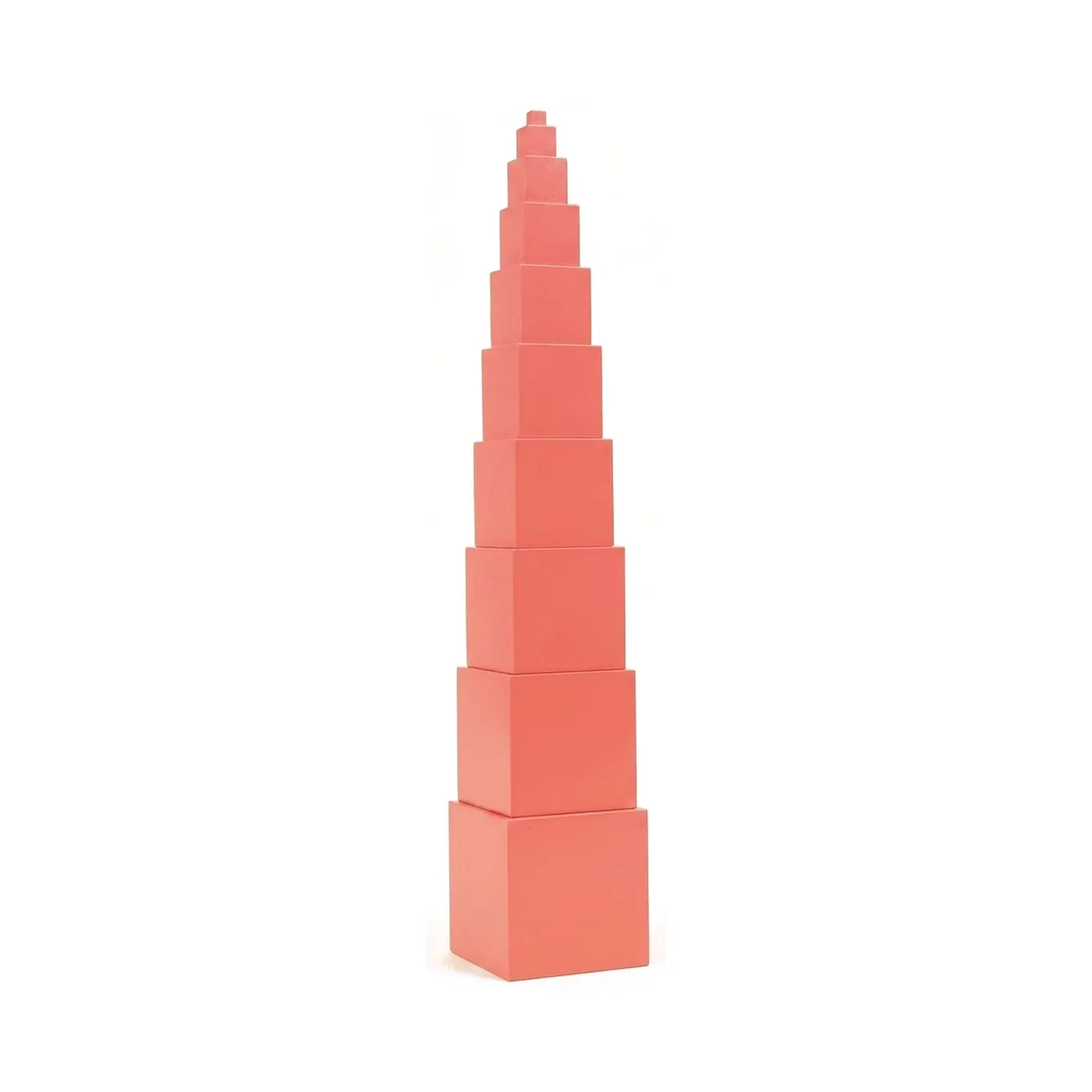
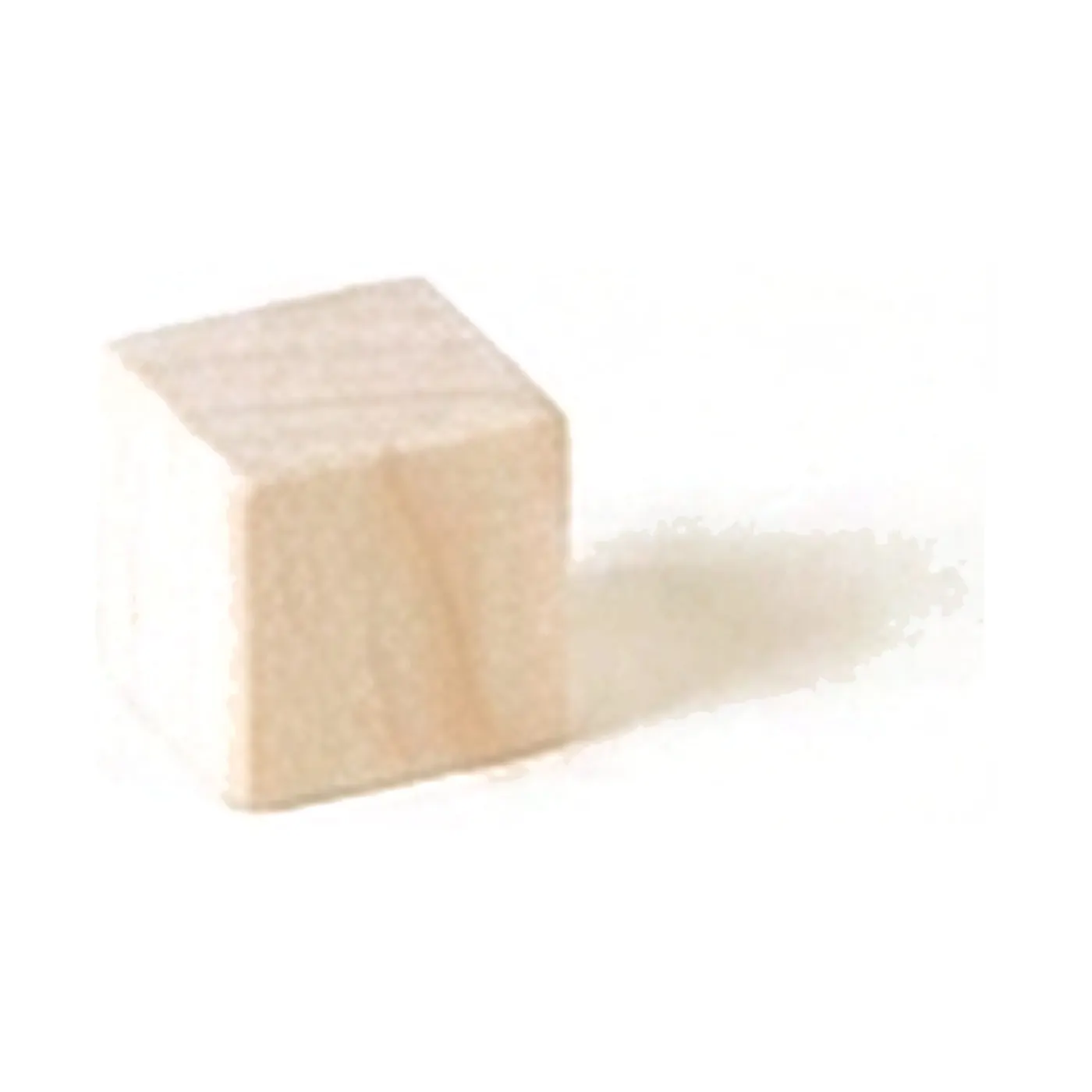
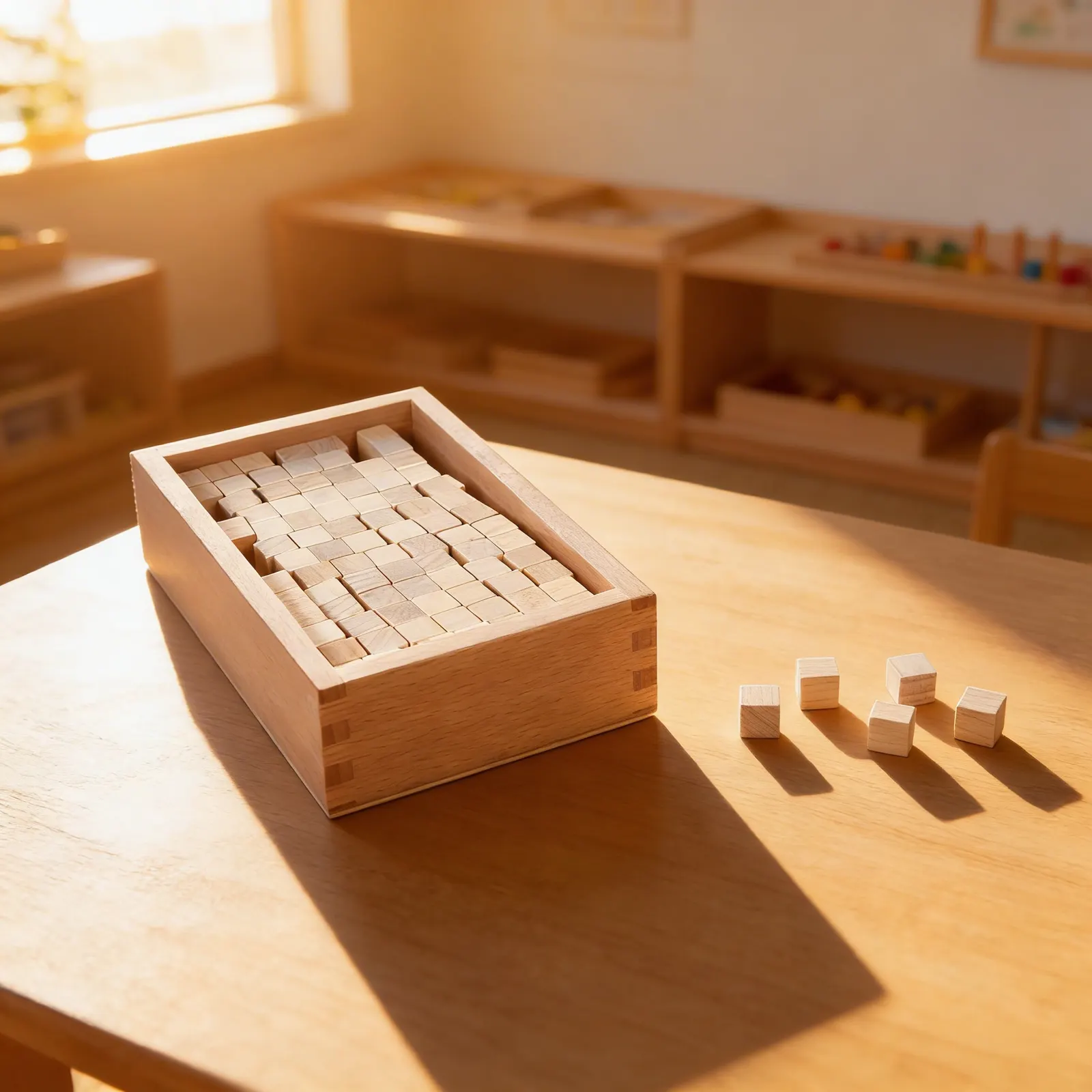
Extension cubes for the Nienhuis Pink Tower: a wooden box with 273 beechwood cubes in a natural finish, each 1 × 1 × 1 cm (box 17 × 11 × 7 cm). They are used to compare and calculate the volume of the cubes of the Pink Tower: 8 of them fill the second cube of the tower, 27 the third and 64 the fourth. The child moves from seeing size to measuring and counting it. After the work the cubes go back into the box they are kept in. This is not the Pink Tower, which is sold separately. For children aged 3 to 6.
Visual Discrimination
Rebuilding the steps of the tower from loose cubes refines the child's ability to perceive subtle dimensional differences, essential for mathematical thinking.
Pattern Recognition
Creating sequences and patterns with the small cubes develops logical thinking and prepares for algebraic concepts.
Fine Motor Control
Precise placement of small cubes strengthens pincer grip and hand-eye coordination necessary for writing.
Activity Guide
How to present it
Place the box on a mat to the right of the workspace. Open it carefully, demonstrating respect for the material. Ensure the Pink Tower is nearby for reference.
- 1Invite the child to build each cube of the Pink Tower using the small cubes, starting with the smallest
- 2Continue building: 8 cubes for the second, 27 for the third, observing the pattern
- 3Arrange the constructed cubes in order, comparing with the Pink Tower
- 4Explore pattern work: create designs, borders, or symmetrical arrangements
- 5Return cubes systematically to the box, counting if desired
3 tips for parents
- At home, use sugar cubes or small blocks to explore similar concepts of building and counting
- When your child works with this material at school, ask them to teach you what they discovered
- Support mathematical language development by using terms like 'cube,' 'dimension,' and 'pattern' in everyday contexts
From the same makerNienhuis
Spare parts
Why it is in our selection
If you are not sure it suits your child, we answer in person.
Norbert Kovalčín, founder of Faborino · write to him
There is no review here yet. We will ask you for one after you buy. Write the first review
Details
What's in the Box
- Wooden Storage Box: Beechwood construction
- Wooden Cubes: 273 cubes, 1 × 1 × 1 cm, natural finish
Size and material
| Product size | 17 × 11 × 7 cm |
| Packaging | 17 × 11 × 7 cm |
| Box Construction | Beechwood |
| Cubes | Beechwood, natural finish |
| Recommended Age | 3-6 years |
Care
Dust with soft, dry cloth; avoid moisture
Frequently Asked Questions
How many cubes come in this set and what sizes are they?
The box holds 273 wooden cubes, each 1 × 1 × 1 cm, in a natural finish. They are used to compare and calculate the volume of the Pink Tower cubes: the second cube holds 8 of them, the third 27.
Do I need to have the Pink Tower to use this material?
Yes, this is an auxiliary material designed specifically to complement and extend work with the Pink Tower. The cubes are sized to match the Pink Tower's dimensions, making them ideal for pattern work, dimension comparison, and advanced exercises that build upon the foundational concepts introduced by the Pink Tower.
What additional activities can children do with these cubes?
Children can create horizontal and vertical patterns, build the Pink Tower in different orientations, explore volume relationships, practice seriation with multiple sets, create geometric designs, and discover mathematical concepts like squared and cubed numbers through hands-on manipulation.
What is the storage box made of?
The cubes are beechwood in a natural finish and are kept in a wooden box. The child puts them back in the box after work, which teaches careful handling of materials.
At what point in the Montessori sequence should this extension be introduced?
This material is typically introduced after the child has mastered the basic Pink Tower exercises and can build it accurately. Usually around ages 4-5, when children show readiness for more complex dimension work and pattern exploration, though some advanced 3-year-olds may be ready earlier.
Product safety
Manufacturer: Nienhuis Montessori, Anders Celsiusstraat 15, 7442 PB Nijverdal, Netherlands
Pink Tower Extension Cubes
€42.90