
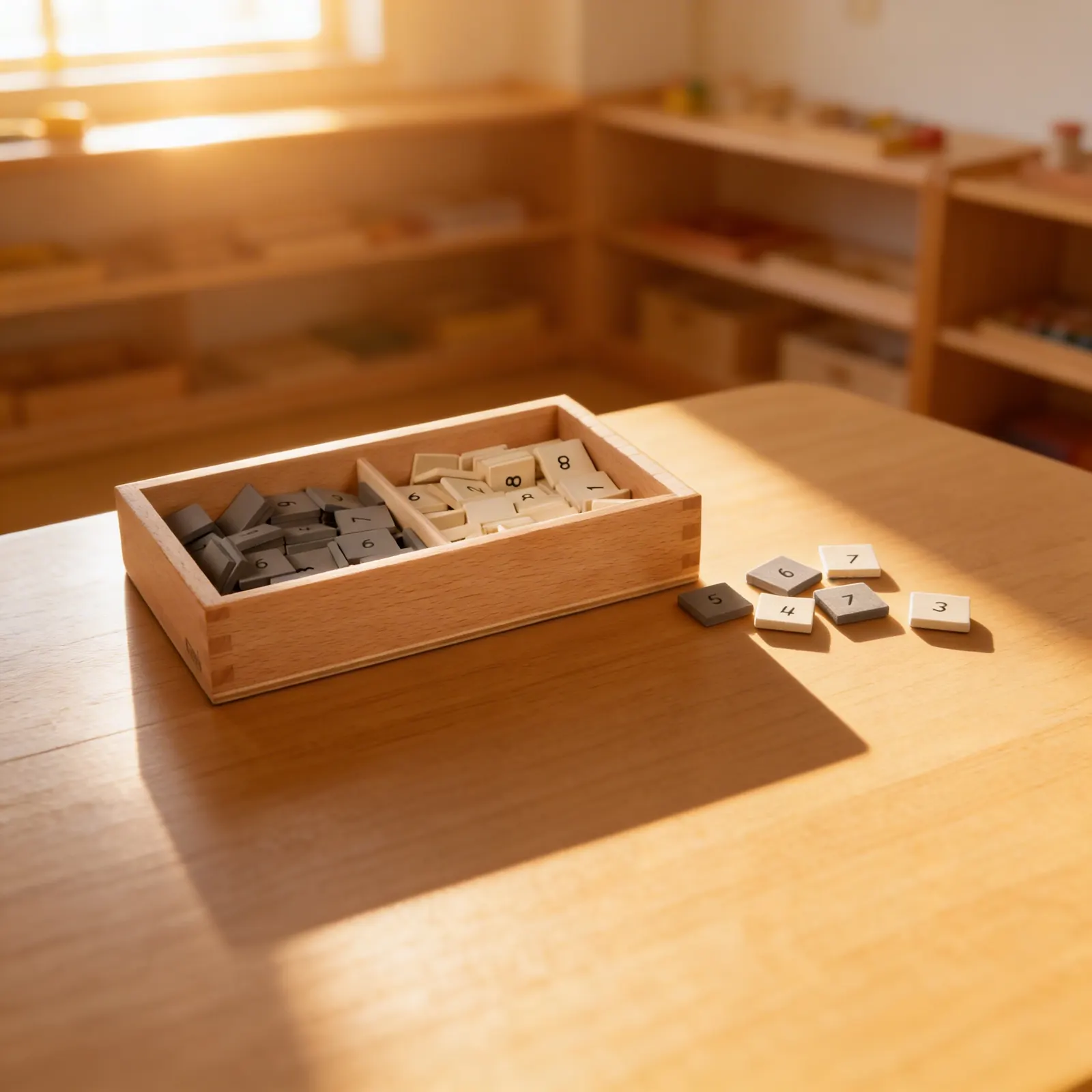
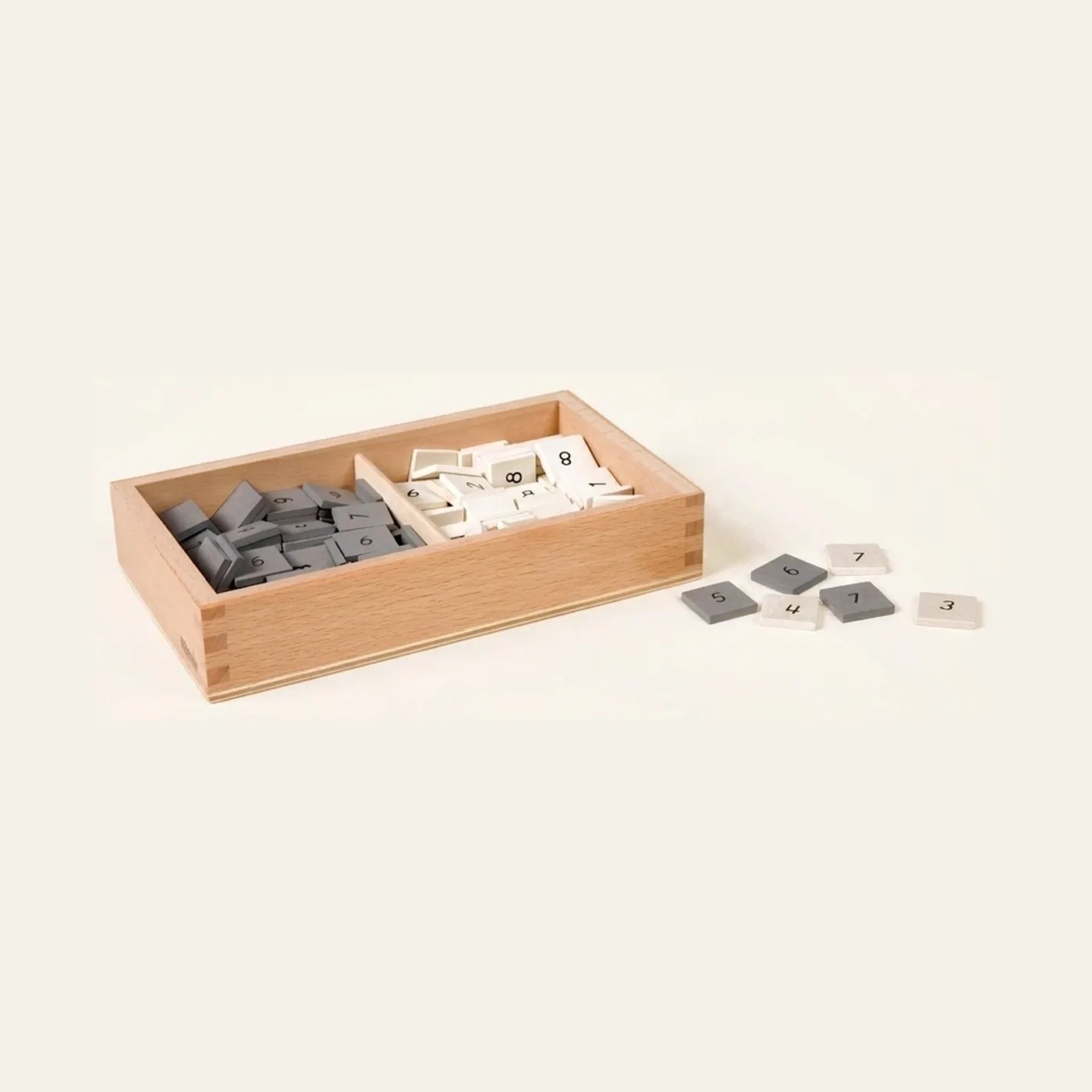
Number Tiles Box: Grey and White, Black Numerals
Made by Nienhuis Montessori · shipped by Heutink International (Netherlands) About the maker
The advanced set of acrylic number tiles for the checker board, the decimal checker board, the flat bead frame and the bead material, in grey and white with the numerals printed in black. Black is the point: the ordinary tiles carry the hierarchy colours, and a child reading colour can place a figure without ever thinking about which category it belongs to. Take the colour away and the move from one category to the next has to be understood, which is exactly what these are for. Acrylic and wood, for ages 6 to 12.
“The child is both a hope and a promise for mankind.”
This material embodies Maria Montessori's principle of isolation of difficulty by presenting numbers through contrasting colors and tactile experiences. The gray and white tiles create visual discrimination opportunities while supporting the mathematical mind's development through concrete manipulation.
- Visual discrimination between contrasting gray and white elements
- Sequential ordering and understanding of numerical progression 1-8
- Fine motor control and pincer grip refinement through tile manipulation
- Development of mathematical mind through concrete number representation
Read More
Following the sensorial-to-abstract progression, children internalize numerical sequences through repeated handling and ordering. The material respects the child's need for repetition and self-correction, as the visual contrast provides immediate feedback. By engaging multiple senses, visual discrimination through color contrast, tactile exploration through tile manipulation, and kinesthetic learning through sorting, this material prepares the mathematical mind while refining sensorial perception. The limited number range (1-8) allows for mastery without overwhelming the child, honoring Montessori's principle of presenting just enough challenge to maintain engagement while ensuring success.
How to present it
Follow the Montessori method of presentation for optimal child development.
Place the box on a work mat with all tiles mixed inside. Ensure adequate lighting to highlight the color contrast. Work from left to right to establish directionality for later reading and writing.
- 1
Remove all tiles and place them randomly on the mat
Use slow, deliberate movements to model careful handling - 2
Begin sorting tiles by color into two distinct groups
Work silently to encourage visual focus rather than verbal processing - 3
Arrange gray tiles in numerical sequence from 1-8
Place tiles with consistent spacing to emphasize order - 4
Arrange white tiles in numerical sequence below the gray tiles
Align tiles vertically to create visual correspondence - 5
Return tiles to box in alternating color pattern
This creates a new challenge and maintains interest in repetition
Every Child Is a Little Creator

Heritage
Since 1929

In classrooms
Around the world

European brands
Nienhuis, GAM, Educo

AMI approved
To the association standard
Number Tiles Box: Grey and White, Black Numerals
