
Sliding Lid Box: Object Permanence & Fine Motor Control
Made by Nienhuis Montessori · shipped by Heutink International (Netherlands) About the maker
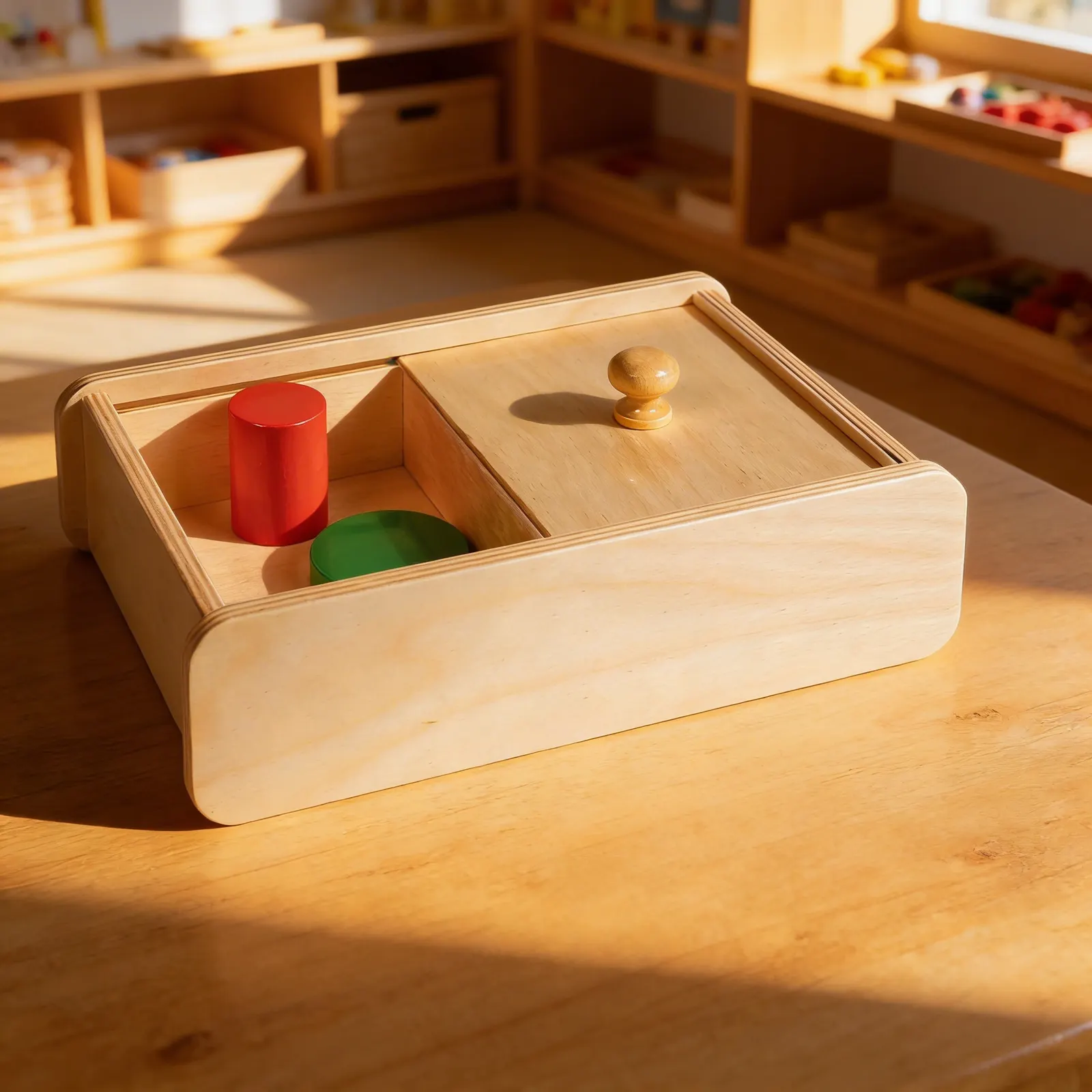
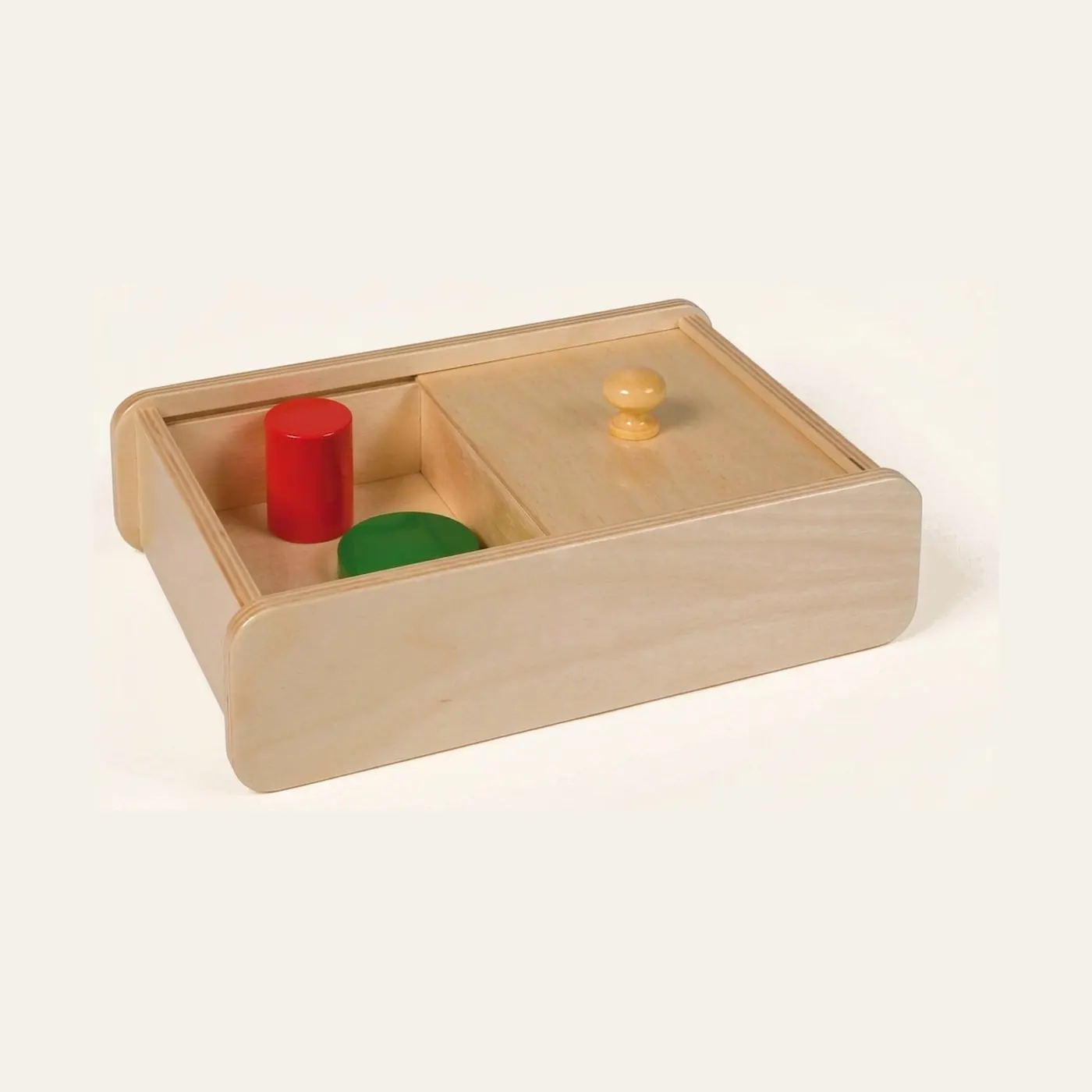
A wooden box with two compartments and a lid that slides across to cover or uncover them. Unlike a posting box, the child chooses what goes in: a stone, a shell, whatever is on the shelf that day, and then makes it vanish and return at their own pace. Being the one who controls the disappearing is what separates this from a game an adult plays with a baby, and it is why the sliding is slow rather than sprung. Objects not included. Solid wood, for ages 0 to 3.
“The greatest sign of success for a teacher is to be able to say, 'The children are now working as if I did not exist.'”
The Box with Sliding Lid embodies Maria Montessori's principle that the hand is the instrument of intelligence.
- Development of object permanence through hiding and revealing objects
- Refinement of pincer grasp and bilateral hand coordination
- Introduction to geometric shape discrimination and matching
- Enhancement of cause-and-effect understanding through sliding mechanism
Read More
This material respects the infant's need to explore through manipulation while supporting the development of object permanence - the understanding that objects exist even when out of sight. The sliding mechanism offers just the right amount of resistance to challenge without frustrating the young child, promoting what Montessori called 'purposeful repetition.' The compartmented design with geometric shapes introduces early classification skills, allowing the child to create order from their sensorial experiences. This material bridges the gap between simple grasping toys and more complex manipulative work, honoring the child's developmental need for increasingly refined hand movements while maintaining the isolation of difficulty principle.
How to present it
Follow the Montessori method of presentation for optimal child development.
Place the box on a low table or mat at the child's eye level when seated. Ensure the sliding lid moves smoothly. Have 2-3 simple geometric shapes ready inside the compartments.
- 1
Sit beside the child and slowly slide the lid open using thumb and index finger
Exaggerate the pincer grasp movement to make it visible - 2
Express wonder at discovering the shapes inside, naming them simply
Use minimal language: 'Circle' rather than 'Look at this round circle' - 3
Remove one shape, examine it briefly, then return it to its compartment
Move slowly and deliberately to allow the child to track your movements - 4
Slide the lid closed with the same careful pincer grasp
Pause before closing to build anticipation - 5
Offer the box to the child with both hands
Step back to allow independent exploration without hovering
Every Child Is a Little Creator

Heritage
Since 1929

In classrooms
Around the world

European brands
Nienhuis, GAM, Educo

AMI approved
To the association standard
Sliding Lid Box: Object Permanence & Fine Motor Control
