
Braiding BoardFine Motor Skills
The first photo is the maker's own. The other shots are illustrative.
Inv. no. NIE-040700
- Maker
- Nienhuis Montessori, since 1929
- Approval
- AMI
- Board
- Natural wood with smooth finish
- Ropes
- Twisted cotton in three colors
- EAN
- 8719924012434
Final price incl. VAT. Delivery €5.90, €102.10 to go for free delivery.
Advice, warranty and returns are handled by us.
Why it costs €46.90
Behind the price of the original are things you can check yourself.
AMI approval
The material is approved by the Association Montessori Internationale (AMI). Nienhuis has made Montessori materials since 1929.
A verifiable original
The EAN 8719924012434 is on the box. It is the maker's number, not ours.
Braiding Board in a child's hands
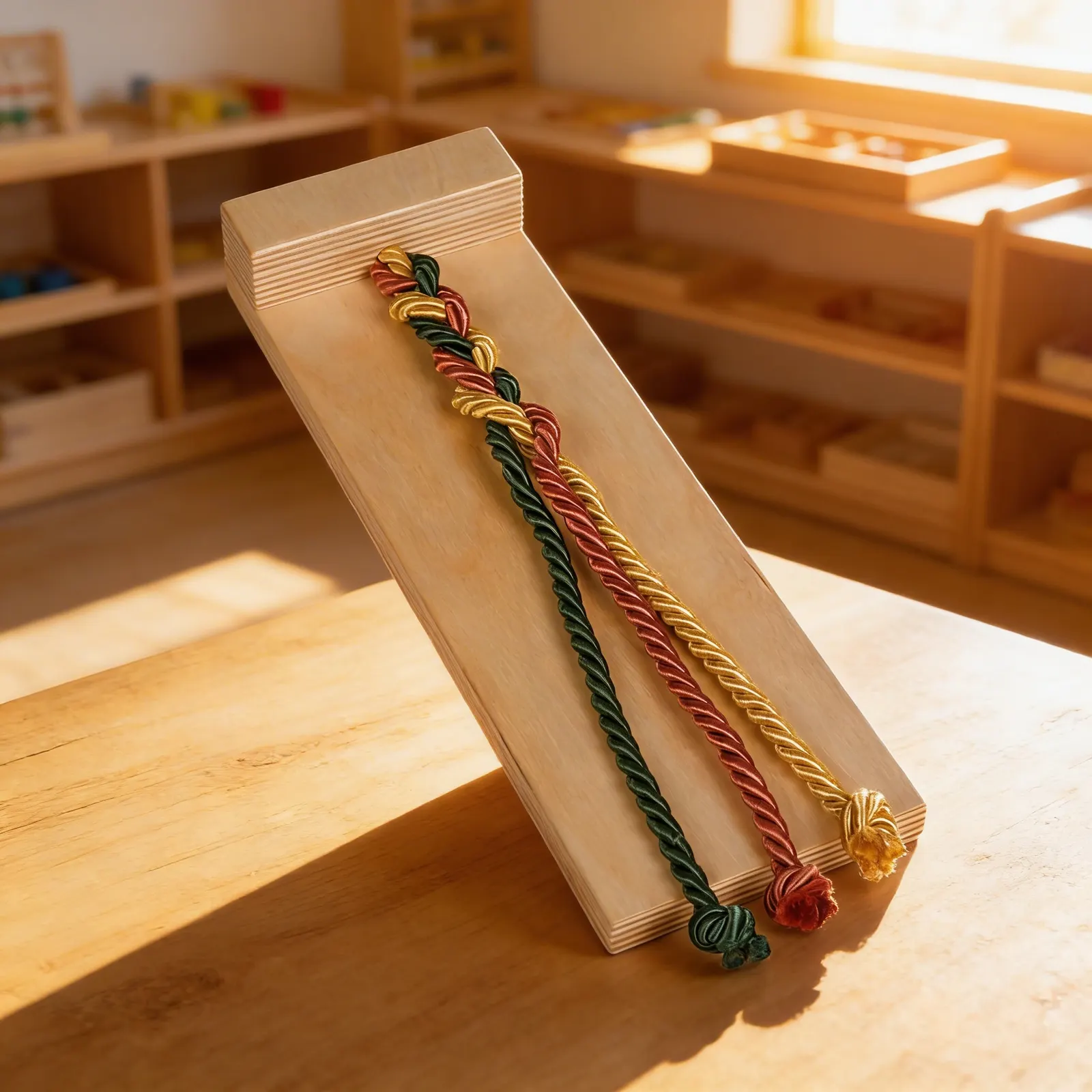
Three rope like strings in three colours fastened to a wooden board, for learning to braid. Braiding is genuinely difficult to learn from a person doing it, because the hands move too fast and the strands look identical in motion. Three colours and a fixed top solve both problems at once: the strand can be followed by eye, and it stays where it was put while the child works out what happens next. Wood with cotton rope, for ages 3 to 6.
Fine Motor Refinement
The precise over-under movements of braiding strengthen finger muscles and develop the pincer grasp essential for writing.
Sequential Thinking
Following the braiding pattern builds logical thinking and the ability to follow multi-step processes.
Bilateral Coordination
Using both hands in alternating movements develops cross-body coordination and brain hemisphere integration.
Concentration Development
The repetitive, rhythmic nature of braiding promotes sustained focus and mindful attention to detail.
How to present it
Place the Braiding Board on a mat with the three cotton ropes extended straight. Ensure ropes are untangled and lying parallel within the raised wooden edge. Position yourself to the child's right if right-handed, left if left-handed.
- 1Demonstrate lifting the right rope over the middle rope with slow, deliberate movements
- 2Show how the left rope crosses over what is now the new middle rope
- 3Continue the pattern for 3-4 crosses, then invite the child to continue
- 4When braid is complete, demonstrate how to carefully undo it from bottom to top
3 tips for parents
- Practice braiding during calm moments, not when rushing to style hair for school
- Let your child braid bread dough or play dough to transfer skills to different contexts
- Celebrate the process rather than the final product - uneven braids show learning in action

If you are not sure it suits your child, we answer in person.
Norbert Kovalčín, founder of Faborino · write to him
There is no review here yet. We will ask you for one after you buy. Write the first review
What's in the Box
- Braiding board: With raised edge barrier
- Three cotton ropes: Pre-attached in different colors
- Sample braid: Shows finished pattern
Size and material
| Packaging | 31 × 11 × 5 cm |
| Board | Natural wood with smooth finish |
| Ropes | Twisted cotton in three colors |
| Recommended Age | 3-6 years |
Care
Wipe board with damp cloth, air dry cotton ropes
Frequently Asked Questions
What age is the Braiding Board most suitable for?
The Braiding Board is designed for children ages 3-6 years old. Children should have developed basic pincer grip and hand-eye coordination before beginning braiding work. Younger children may start with simpler twisting activities.
How does the raised wooden edge help children learn braiding?
The raised wooden edge securely holds three cotton ropes in place at the top, preventing them from sliding or tangling while children work. This stable foundation allows children to focus entirely on the braiding movements without managing loose rope ends.
What skills does braiding develop in young children?
Braiding develops fine motor control, hand-eye coordination, concentration, and sequential thinking. It also strengthens finger muscles needed for writing, teaches pattern recognition, and builds patience through completing a multi-step process.
Should I demonstrate braiding technique before the child uses the board?
Yes, give a slow, silent demonstration showing the over-under pattern of braiding. Use exaggerated movements so the child can clearly see each step. Allow the child to observe multiple times before attempting independently.
How can children use their completed braids?
Completed braids can become bookmarks, friendship bracelets, hair accessories, or decorative elements for other projects. This gives purpose to the work and encourages repetition of the skill while creating meaningful items.
Product safety
Manufacturer: Nienhuis Montessori, Anders Celsiusstraat 15, 7442 PB Nijverdal, Netherlands
Braiding Board