
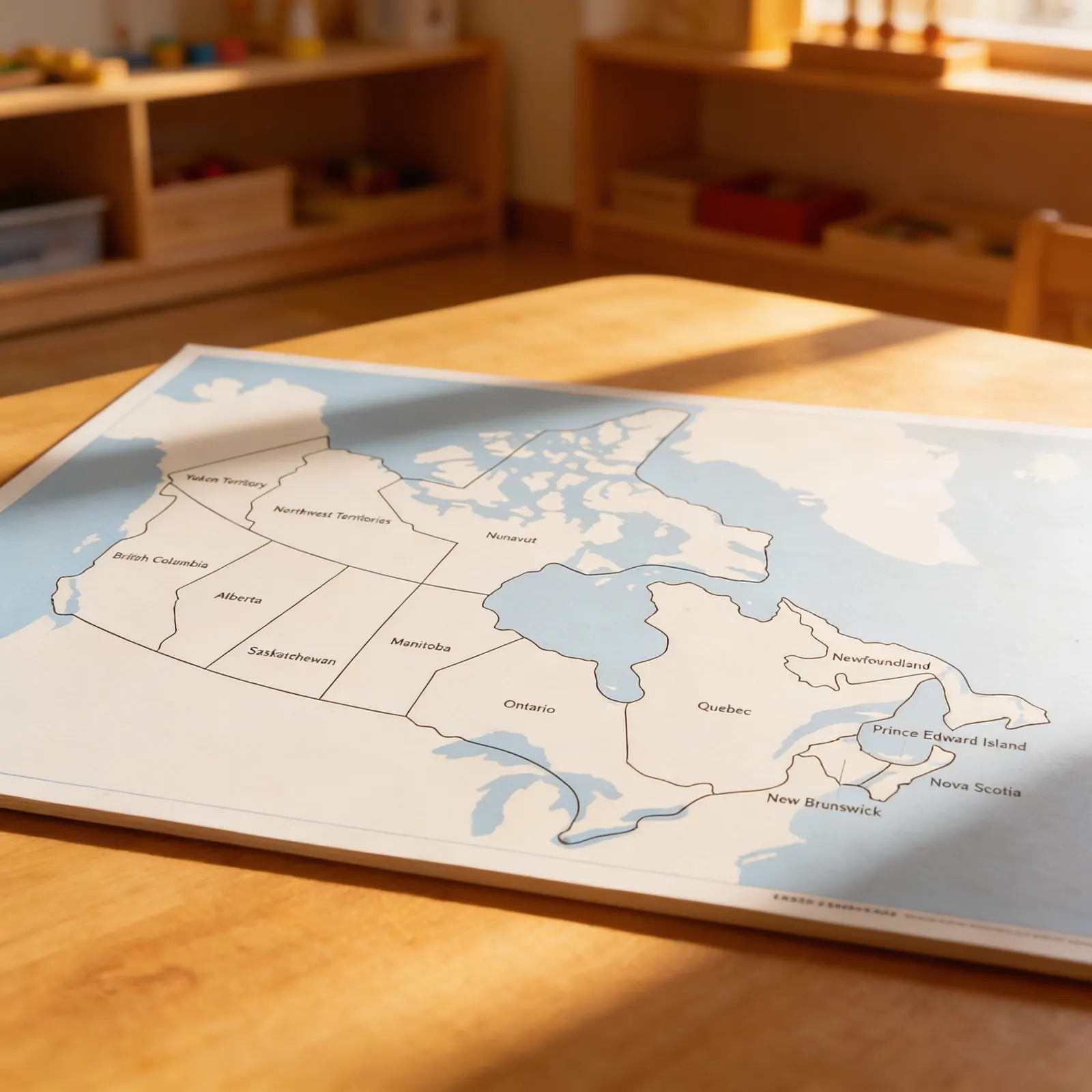
Canada Control MapLabeled
The first photo is the maker's own. The other shots are illustrative.
Inv. no. NIE-555010
- Maker
- Nienhuis Montessori, since 1929
- Approval
- AMI
- Base Material
- Paper
- Surface
- Laminated coating
- EAN
- 8719924029463
Final price incl. VAT. Delivery €5.90, €128.10 to go for free delivery.
Advice, warranty and returns are handled by us.
Why it costs €20.90
Behind the price of the original are things you can check yourself.
AMI approval
The material is approved by the Association Montessori Internationale (AMI). Nienhuis has made Montessori materials since 1929.
A verifiable original
The EAN 8719924029463 is on the box. It is the maker's number, not ours.
Canada Control Map in a child's hands
The labeled control map for Canada: the printed reference a child checks their own work against after laying out the puzzle map. It is one of three sheets that make the map self correcting, with the unlabeled control map and the printed labels sold separately, and the puzzle map itself separately again. What a control map buys is independence, since the child places the names, turns to the map and finds out for themselves whether they were right. Laminated print.
Geographic Knowledge
Builds understanding of Canadian provinces, territories, and their relative positions while developing spatial reasoning skills.
Reading Practice
Supports early literacy as children match province names on the control map to puzzle pieces.
Visual Discrimination
Enhances ability to distinguish shapes and boundaries while recognizing geographic features.
Cultural Awareness
Introduces children to their country's political divisions, fostering connection to their broader community.
How to present it
Place the Canada Control Map flat on a table mat beside the Canada puzzle map. Ensure good lighting for clear visibility of the labels.
- 1Invite the child to remove a puzzle piece and find its match on the control map
- 2Show how to trace the outline on the control map with one finger while holding the puzzle piece
- 3Point to the label and sound out the province name together
- 4Return the puzzle piece to its place, using the control map to verify correct placement
3 tips for parents
- Keep the control map accessible during homework time for geography reference
- Point out provinces on the map when discussing family trips or relatives' locations
- Let your child be the 'teacher' and show you how to check puzzle pieces against the map

If you are not sure it suits your child, we answer in person.
Norbert Kovalčín, founder of Faborino · write to him
There is no review here yet. We will ask you for one after you buy. Write the first review
What's in the Box
- Canada Control Map: Labeled, laminated
Size and material
| Packaging | 43 × 56 × 0 cm |
| Base Material | Paper |
| Surface | Laminated coating |
| Recommended Age | 3-6 years |
Care
Wipe with damp cloth, dry immediately
Frequently Asked Questions
What is the difference between this control map and the Canada puzzle map?
This control map is a flat, laminated reference chart with all provinces and territories labeled, used alongside the puzzle map. The child uses this map to check their work and learn the names of regions while working with the physical puzzle pieces.
How durable is the laminated surface for classroom use?
The laminated surface is designed for repeated daily use in Montessori environments. It resists tears, spills, and frequent handling by young children, making it ideal for both individual work and small group activities.
What size is this control map?
The control map is sized to complement standard Montessori puzzle maps, typically measuring approximately 50cm x 40cm, making it easy for children to reference while working at a table or on a work mat.
Can children trace or write on the laminated surface?
Yes, the laminated surface allows children to trace boundaries or practice writing province names with dry-erase markers, which can be easily wiped clean for repeated practice, extending the material's learning possibilities.
Is this suitable for children who cannot read yet?
Yes, pre-readers benefit from visual matching between the puzzle pieces and map shapes, while the clear labels support emerging readers. Teachers often use this for three-period lessons, introducing geographical vocabulary gradually.
Product safety
Manufacturer: Nienhuis Montessori, Anders Celsiusstraat 15, 7442 PB Nijverdal, Netherlands
Canada Control Map