
Carnivores, Herbivores & Omnivores
The first photo is the maker's own. The other shots are illustrative.
Inv. no. NIE-EC0485
- Maker
- Nienhuis Montessori, since 1929
- Material
- Durable plastic
- Finish
- Pre-cut with rounded corners
- EAN
- 8719924042950
Final price incl. VAT.
This material is no longer made
The manufacturer has withdrawn it, so we cannot order it in. The page stays here because the material itself is still worth knowing about.
Would you buy it if we could source it or make it ourselves? Enough people saying yes is what makes the attempt worth it.
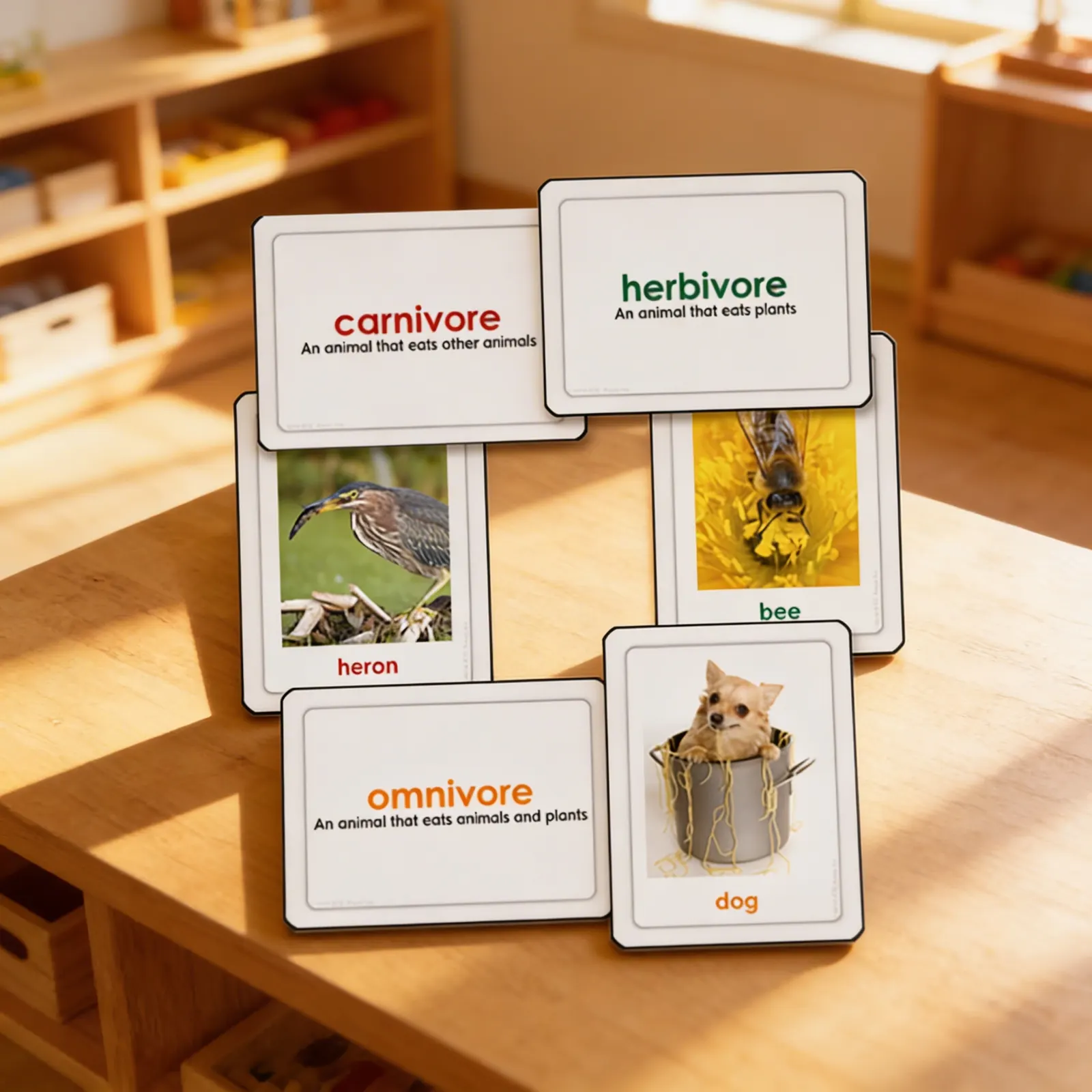
Carnivores, Herbivores & Omnivores in a child's hands
A complete teaching aid, this classification card set lays the groundwork for understanding the dietary habits of animals through clear photographic imagery and color-coded definition cards. Each animal is categorized as carnivore (red), herbivore (green), or omnivore (blue), supporting the Montessori approach to zoology studies. The durable plastic cards withstand repeated handling while children develop their understanding of animal nutrition and ecological relationships.
Scientific Classification
Develops understanding of animal dietary categories and introduces biological classification systems.
Visual Discrimination
Strengthens ability to categorize and sort based on defining characteristics.
Vocabulary Development
Introduces scientific terminology through concrete examples and visual associations.
Ecological Understanding
Builds foundational knowledge of food chains and animal relationships in nature.
How to present it
Place the laminated cards in a basket on a low shelf. Include a work mat. Ensure the red (carnivore), green (herbivore), and blue (omnivore) definition cards are clearly visible.
- 1Invite the child to bring the basket and mat to a workspace
- 2Lay out the three color-coded definition cards across the top of the mat
- 3Select one animal card and examine the photograph together
- 4Read the information on the card and place it under the appropriate category
- 5Continue sorting all cards into the three dietary categories
- 6Review each column, naming the animals and their diet type
3 tips for parents
- During meals, discuss which category your family's food comes from
- At the zoo or park, practice identifying animals and predicting their diet types
- Create a photo collection of pets and local animals to classify at home

If you are not sure it suits your child, we answer in person.
Norbert Kovalčín, founder of Faborino · write to him
There is no review here yet. We will ask you for one after you buy. Write the first review
What's in the Box
- Definition Cards: 3 color-coded category cards
- Animal Photo Cards: Multiple example cards per category
- Classification Labels: Carnivore, herbivore, omnivore headers
Size and material
| Packaging | 15 × 15 × 1 cm |
| Material | Durable plastic |
| Finish | Pre-cut with rounded corners |
| Recommended Age | 3-6 years |
Care
Wipe clean with damp cloth, dry immediately
Frequently Asked Questions
How many animal cards are included in this set?
While the exact number varies by manufacturer, typical sets include 18-24 animals (6-8 from each category). Each animal has both a picture card and a corresponding definition card with the color-coded border.
What is the recommended presentation method for these cards?
Begin by introducing one category at a time using the three-period lesson. Start with familiar animals, then progress to sorting activities where children classify animals into the three dietary groups using the color-coded system.
Are the cards suitable for non-readers?
Yes, the photographic images and color-coding system allow pre-readers to work independently. The red (carnivore), green (herbivore), and blue (omnivore) borders provide visual cues for sorting without requiring reading skills.
How do these cards support the Montessori curriculum?
These cards align with the Cultural Studies area, specifically zoology. They support classification skills, vocabulary development, and understanding of interdependence in nature - key concepts in the Montessori elementary cosmic curriculum.
Can these cards be used for extensions beyond sorting?
Absolutely! Extensions include creating food chains, discussing animal habitats, exploring teeth types, making animal diet books, and connecting to practical life through discussions about human nutrition and dietary choices.
Product safety
Manufacturer: Nienhuis Montessori, Anders Celsiusstraat 15, 7442 PB Nijverdal, Netherlands
Carnivores, Herbivores & Omnivores