
Chart For Multibase Material
The first photo is the maker's own. The other shots are illustrative.
Inv. no. NIE-027101
- Maker
- Nienhuis Montessori, since 1929
- Approval
- AMI
- Base Material
- Heavy-duty cardstock
- Finish
- Laminated surface
- EAN
- 8719924012205
Final price incl. VAT. Delivery €5.90, €72.10 to go for free delivery.
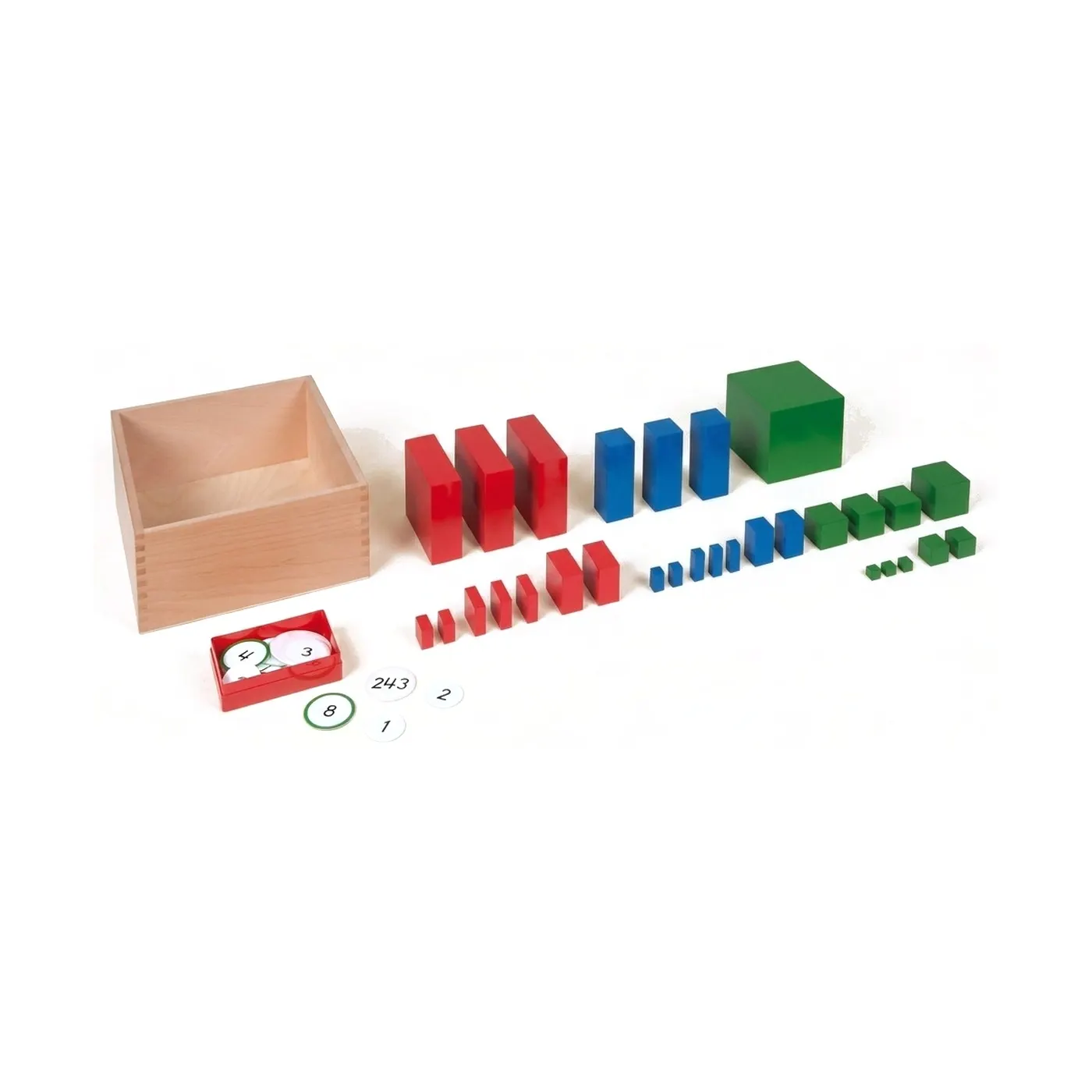 Multibase Material €399.90
Advice, warranty and returns are handled by us.
Why it costs €76.90
Behind the price of the original are things you can check yourself.
AMI approval
The material is approved by the Association Montessori Internationale (AMI). Nienhuis has made Montessori materials since 1929.
A verifiable original
The EAN 8719924012205 is on the box. It is the maker's number, not ours.
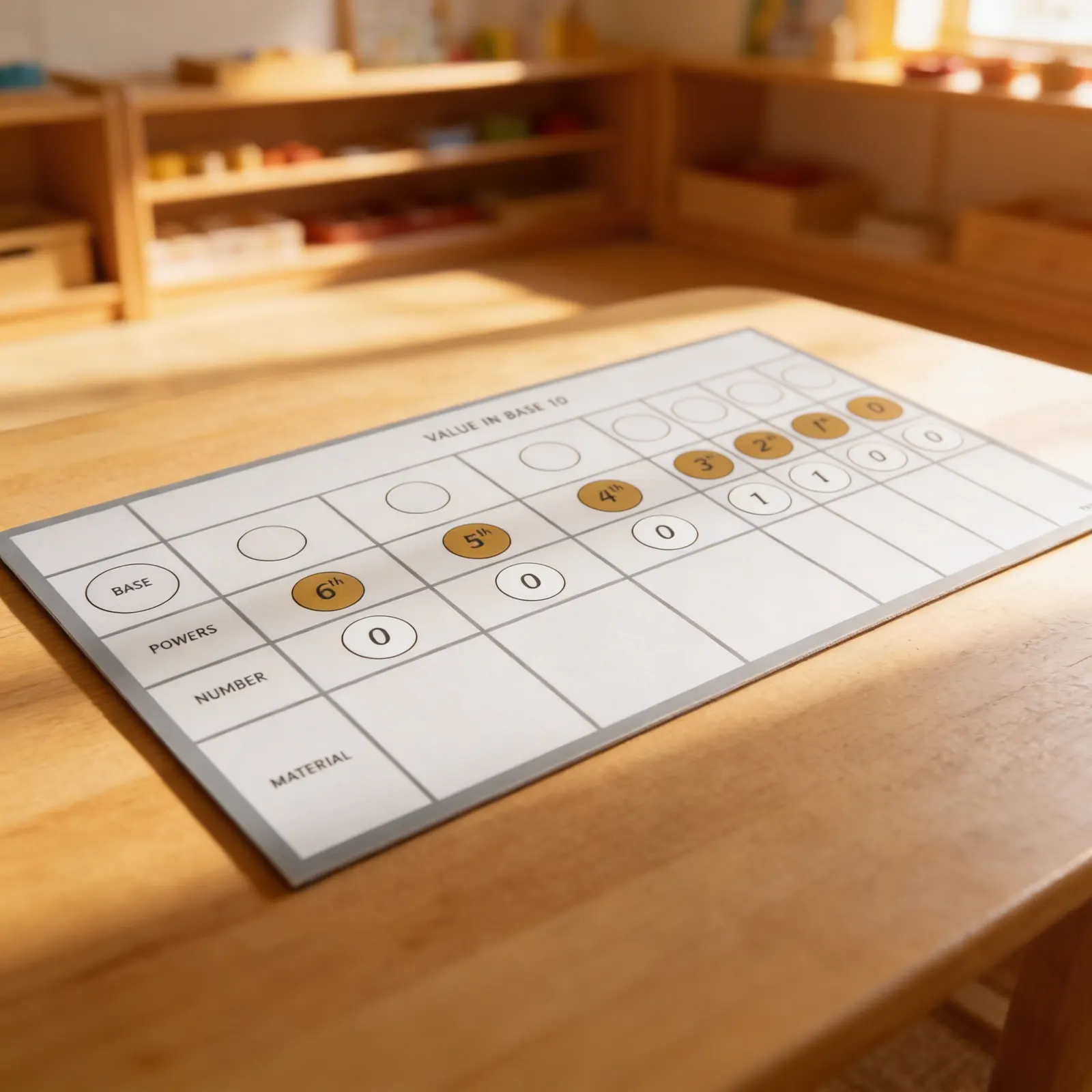
Chart For Multibase Material in a child's hands
A control chart for the multibase material, the work in which a child builds quantities in bases other than ten and discovers that the decimal system is a choice rather than a law of nature. A chart is what makes that work possible alone: the child can check a base four grouping without asking, which matters because base four is exactly where an adult's confident answer would end the enquiry. Laminated cardstock, for ages 6 to 12.
Mathematical Understanding
Develops concrete understanding of place value concepts and number systems through visual organization.
Abstract Thinking
Bridges the gap between concrete manipulatives and abstract numerical concepts.
Pattern Recognition
Helps children identify patterns in number systems and mathematical relationships.
Independent Learning
Serves as a self-correcting reference tool that promotes autonomous mathematical exploration.
How to present it
Place the laminated chart on a work mat with multibase materials organized by type. Ensure numbered circles 0-6 are clearly visible and columns are accessible for placing materials.
- 1Begin with base-10 materials, placing units in the rightmost column and organizing quantities according to the chart's grid system
- 2Introduce base-2 materials, demonstrating how only circles 0 and 1 are used in each column position
- 3Build the same quantity in different bases, using the chart to organize and compare the representations
- 4Practice conversions by moving materials between base representations while tracking changes on the chart
3 tips for parents
- Ask your child to show you how the same number looks different in various bases using their classroom chart
- Practice skip counting in different bases (2, 4, 6, 10 in base-2 becomes 10, 100, 110, 1000)
- Connect to real-world base systems like time (base-60) or computer binary (base-2) when opportunities arise

If you are not sure it suits your child, we answer in person.
Norbert Kovalčín, founder of Faborino · write to him
There is no review here yet. We will ask you for one after you buy. Write the first review
What's in the Box
- Multibase Chart: Laminated reference chart with place value grid
Size and material
| Packaging | 62 × 37 × 0 cm |
| Base Material | Heavy-duty cardstock |
| Finish | Laminated surface |
| Recommended Age | 6-12 years |
Care
Wipe with damp cloth, dry immediately
Frequently Asked Questions
What is included with the Chart for Multibase Material?
The chart is a single laminated reference sheet featuring a comprehensive grid system with numbered circles (0-6) and clearly labeled columns for organizing place value work. The multibase materials themselves are sold separately.
How does this chart support learning different number bases?
The chart's grid system allows children to organize and visualize numbers in various bases (binary, ternary, etc.) by using the numbered circles 0-6. Students can track place values from units through millions, making abstract base concepts concrete and understandable.
Is this chart durable enough for classroom use?
Yes, the chart is professionally laminated for durability, making it resistant to spills, tears, and frequent handling. It's designed to withstand daily classroom use by multiple students throughout the school year.
What age group benefits most from this material?
This chart is ideal for elementary students ages 6-12 who are exploring place value and number bases. It's particularly valuable for upper elementary students (9-12) working with advanced mathematical concepts in the Montessori curriculum.
Can this chart be used without other Montessori materials?
While designed to complement Montessori multibase materials, the chart can serve as a standalone reference for place value work. However, it's most effective when used alongside concrete manipulatives that allow children to physically represent the numbers they're charting.
Product safety
Manufacturer: Nienhuis Montessori, Anders Celsiusstraat 15, 7442 PB Nijverdal, Netherlands
Chart For Multibase Material