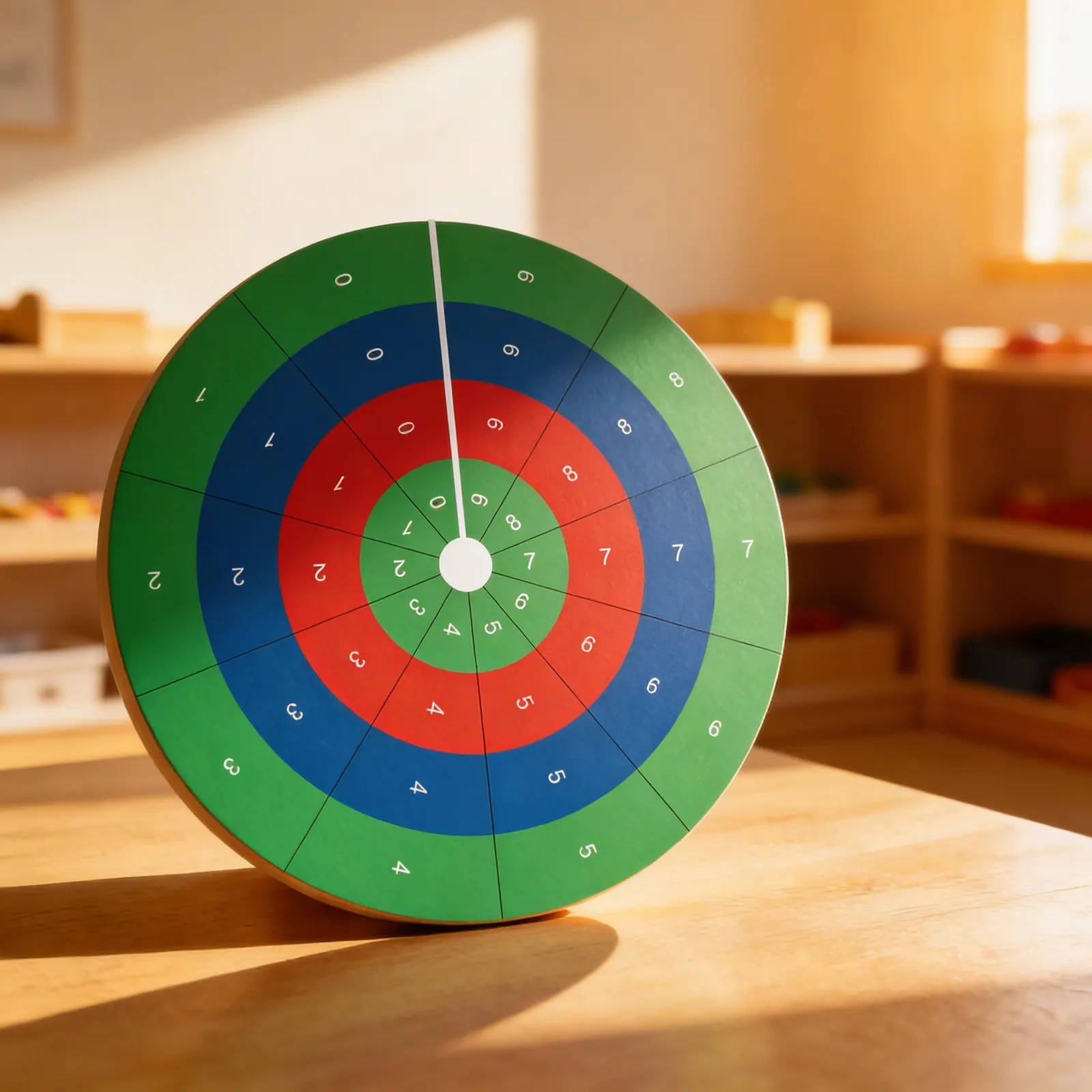
The Circle of Operations is an innovative mathematical material featuring four concentric colored rings divided into radial segments, each containing the numbers 0-9. This circular format allows children to explore number relationships, skip counting, and mathematical patterns through a unique visual and tactile approach that differs from traditional linear number lines.
“Free the child's potential, and you will transform him into the world.”— Maria MontessoriTo Educate the Human Potential
The Circle of Operations transforms mathematical exploration through its four concentric colored rings, each divided into segments containing numbers 0-9. This circular design reveals number patterns that linear arrangements cannot show, allowing children to physically trace skip counting paths and discover mathematical relationships through movement. The Circle of Operations addresses the child's need to understand that numbers exist in multiple dimensions and relationships, not just sequential order. By rotating the rings and aligning numbers, children experience mathematics as a dynamic system rather than static symbols. The concentric circles create visual groupings that make multiplication patterns visible - when counting by twos on the second ring, children see how these numbers align with specific positions on other rings. This material exists because young children need concrete experiences with number relationships before abstracting to written equations. The radial segments invite finger tracing, satisfying the child's need for tactile learning while building neural pathways for mathematical thinking.

Move slowly, allowing the child to predict which number comes next based on the pattern
Use consistent language like 'jump' or 'skip' to reinforce the concept
Ask 'What do you notice about where the 5s appear?' to encourage pattern recognition
This demonstrates that mathematical relationships can shift and transform
Move slowly, allowing the child to predict which number comes next based on the pattern
Use consistent language like 'jump' or 'skip' to reinforce the concept
Ask 'What do you notice about where the 5s appear?' to encourage pattern recognition
This demonstrates that mathematical relationships can shift and transform

Heritage
Since 1929

Trusted by
Schools Worldwide

Handcrafted
in Europe

AMI
Endorsed

The circular arrangement helps children visualize number relationships and discover patterns in skip counting and multiplication.
The concentric ring design develops spatial reasoning while connecting numerical concepts to geometric forms.
Transitions children from concrete counting to understanding abstract mathematical operations through visual representation.
Use the circles during group lessons to demonstrate how different children might find different patterns in the same material
Connect the circular format to clock reading, reinforcing how numbers can represent different concepts
Document the patterns children discover independently - these observations often reveal sophisticated mathematical thinking
“Present one ring at a time initially, adding complexity as the child shows readiness for multiple ring relationships”
Everything you need to know about this material.
Contact Our ExpertsThe Circle of Operations teaches skip counting, number patterns, multiplication foundations, addition sequences, and number relationships. The four concentric rings allow children to explore counting by 1s, 2s, 5s, and 10s while visualizing how numbers relate to each other in a circular pattern rather than a linear sequence.
Each ring represents a different counting pattern. Children rotate the rings to align numbers and discover patterns. For example, they might align all the 5s to see skip counting by 5s, or rotate rings to add numbers in different positions. The tactile manipulation helps children internalize mathematical relationships through hands-on exploration.
The circular format shows that number patterns are continuous and cyclical, helping children understand concepts like remainders and modular arithmetic intuitively. Unlike linear number lines that have endpoints, the circle demonstrates how patterns repeat and continue infinitely, making it easier to visualize number relationships and patterns.
Three-year-olds can start with simple number recognition and matching. Four to five-year-olds can explore skip counting and simple patterns. Six-year-olds can discover multiplication relationships, create addition equations by combining rings, and explore more complex number patterns. The material grows with the child's mathematical understanding.
The Circle of Operations builds foundational understanding for multiplication tables, division with remainders, modular arithmetic, and algebraic thinking. By manipulating the rings, children develop intuitive understanding of number relationships that will support learning fractions, factors, multiples, and cyclical patterns in later mathematics.
Share your experience with this material and help other educators and parents.
Trusted Worldwide
Premium educational materials, trusted by Montessori educators and families across Europe.

Faborino quality
Montessori-aligned