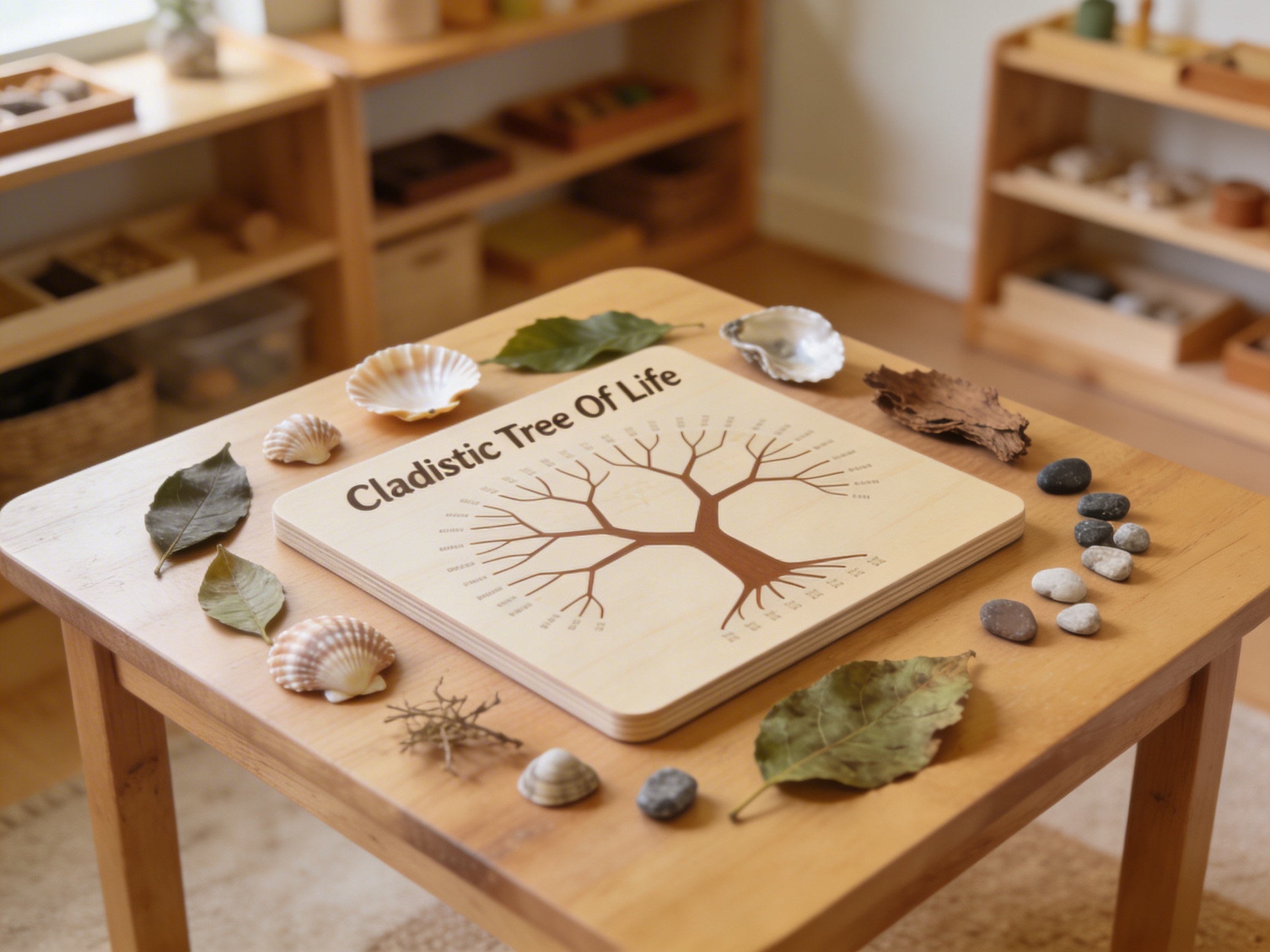
The Cladistic Tree Of Life is a category.biology Montessori material designed for children aged 3-6, crafted by Nienhuis Montessori to AMI standards.
This sophisticated Cladistic Tree of Life presents evolutionary relationships through a beautifully illustrated branching diagram, helping children understand how different life forms are connected through common ancestry. The material introduces complex biological concepts through visual organization, allowing young learners to trace the development of life from simple organisms to complex species while developing classification skills essential for scientific thinking.
“Education is a natural process spontaneously carried out by the human individual, and is acquired not by listening to words but by experiences upon the environment.”— Maria MontessoriEducation for a New World
“The child is both a hope and a promise for mankind.”
— Maria Montessori, Education and Peace
The Cladistic Tree of Life transforms abstract evolutionary concepts into concrete visual relationships that young children can trace with their fingers. This branching diagram addresses the child's natural tendency to classify and organize their world by presenting life forms in a logical, interconnected structure. Each illustrated branch of the Cladistic Tree represents millions of years of evolution, yet the visual presentation makes these vast timescales accessible to the young mind. The material's sophisticated branching pattern mirrors the child's own developing ability to understand relationships and connections between different elements in their environment. By presenting evolutionary relationships through clear visual pathways, the Cladistic Tree satisfies the child's need for order while introducing scientific classification systems. The illustrated organisms on each branch provide concrete examples that anchor abstract evolutionary concepts in recognizable life forms, bridging the child's immediate experience with scientific understanding.
Each order includes everything needed for proper presentation and long-term use.
Follow the Montessori method of presentation for optimal child development.
Begin at the base of the tree, introducing the concept of common ancestors
Trace one branch upward with your finger, naming organisms as you go
Compare two related branches, identifying similarities between organisms
Invite the child to choose a favorite organism and trace its evolutionary path
Introduce scientific group names as the child shows readiness
Every material is carefully selected for durability, safety, and authentic Montessori experience.
Sourced from sustainably managed European forests. Beechwood is chosen for its exceptional durability, smooth grain, and natural warmth that invites touch.
Natural, unbleached cotton in child-friendly colors. The fabric provides the right amount of friction for developing fingers while being gentle on sensitive skin.
Water-based, child-safe finish that meets the strictest European safety standards. Designed to withstand years of daily use without chipping or peeling.
Each material supports multiple areas of child development simultaneously.
Develops understanding of how scientists organize and categorize living things based on shared characteristics and evolutionary relationships.
Strengthens ability to interpret complex diagrams and trace relationships through branching patterns, essential for scientific literacy.
Introduces the concept of common ancestry and species diversity in an age-appropriate way that builds foundation for advanced biology studies.
Encourages logical thinking about relationships between organisms and understanding of hierarchical classification systems.
Designed for child-sized hands
Professional tips from AMI-trained guides to maximize the educational value of this material.
“Present the tree horizontally on the floor for group lessons, allowing multiple children to explore different branches simultaneously”
Create simplified vocabulary cards for major groups, introducing scientific terms gradually as children show readiness
Use the tree as a reference during nature walks, connecting observed organisms to their place on the diagram
Prepare stories about specific evolutionary transitions to make abstract concepts more concrete and memorable
Everything you need to know about this material.
Yes, the Cladistic Tree of Life is specifically designed for young children using Montessori principles. It presents evolutionary relationships through visual, concrete representations that children can explore with their hands and eyes, making abstract concepts accessible through beautiful illustrations and branching patterns that appeal to their natural curiosity.
Unlike linear timelines, this cladistic tree shows evolutionary relationships through branching patterns that demonstrate common ancestry. Children can visually trace how different organisms share ancestors and understand that evolution isn't a straight line but a branching process, introducing fundamental concepts of biological classification and relationships.
Children develop scientific classification skills, visual discrimination, pattern recognition, and logical thinking. They learn to identify relationships between organisms, understand concepts of similarity and difference, practice tracing connections, and build vocabulary related to living things while developing an appreciation for biodiversity.
Begin with simple observations about familiar animals, then gradually introduce the concept of relationships. Use concrete language like 'cousins' or 'family groups' to explain connections. Focus on visual exploration first, allowing children to trace branches with their fingers, before introducing scientific terminology appropriate to each child's readiness.
Pair with animal classification cards, continent materials, and habitat studies. Create sorting activities with animal figures, explore characteristics that connect different species, investigate local biodiversity, and use art activities to create children's own simple branching diagrams of familiar animals or plants.
Can't find what you're looking for?
Contact Our Experts
Share your experience with this material and help other educators and parents.


