
Clock With Movable Numbers
The first photo is the maker's own. The other shots are illustrative.
Inv. no. NIE-310000
- Maker
- Nienhuis Montessori, since 1929
- Approval
- AMI
- Base & Stand
- Plywood
- Number Tokens
- Durable plastic
- EAN
- 8719924023782
Final price incl. VAT. Delivery €5.90, €71.10 to go for free delivery.
Advice, warranty and returns are handled by us.
Why it costs €77.90
Behind the price of the original are things you can check yourself.
AMI approval
The material is approved by the Association Montessori Internationale (AMI). Nienhuis has made Montessori materials since 1929.
A verifiable original
The EAN 8719924023782 is on the box. It is the maker's number, not ours.
Clock With Movable Numbers in a child's hands
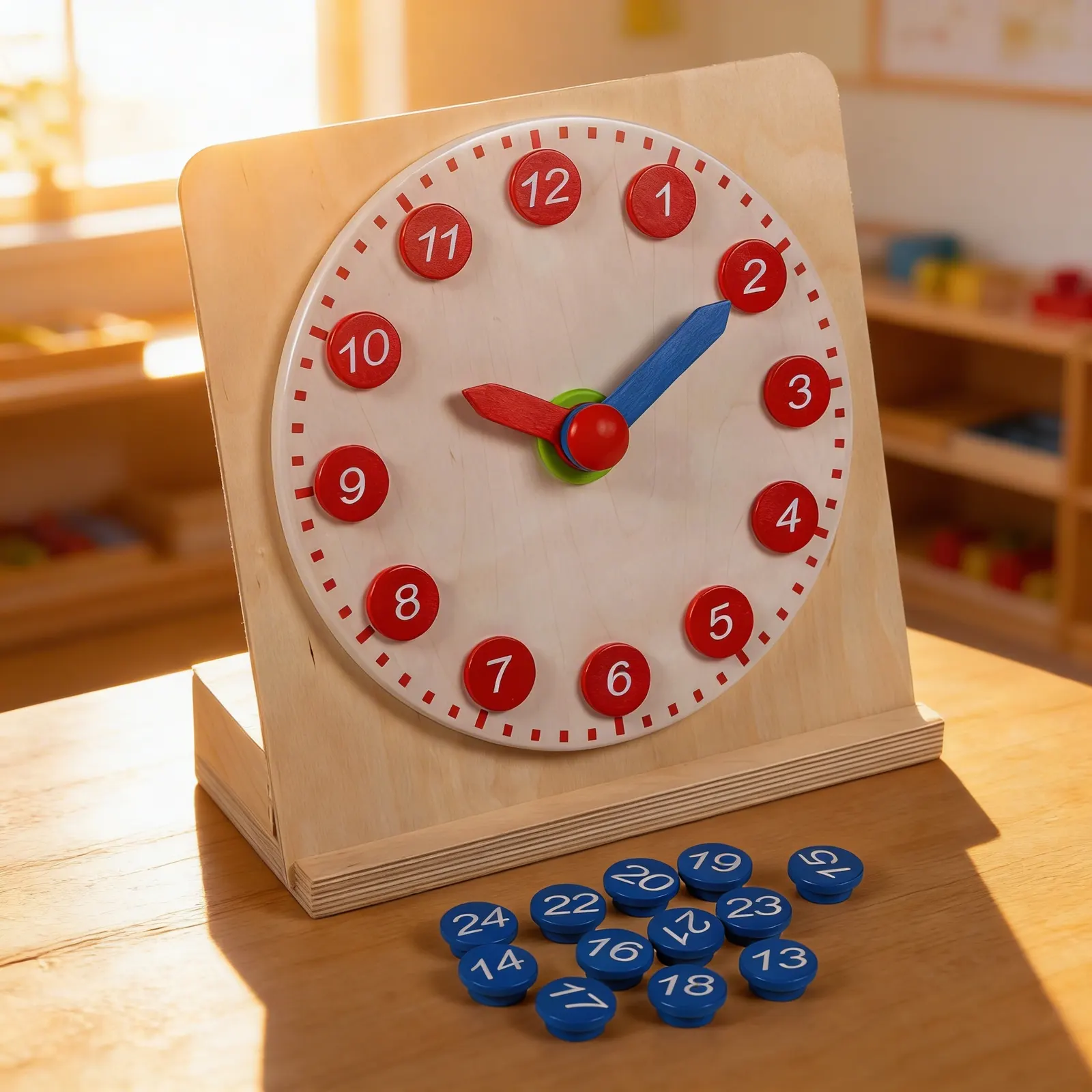
A freestanding clock with movable hands and removable numbers, one to twelve in red and thirteen to twenty four in blue, on a stand with a storage tray and lid. The face is 28 cm across. Two sets of numbers in two colours is the part that does the teaching: a child who has placed thirteen next to one and eighteen next to six has built the twenty four hour clock themselves rather than being told that afternoon hours have a second name. Plywood and plastic, for ages 3 to 12.
Time Concept Mastery
Manipulating the movable hands helps children understand the relationship between hours and minutes while building concrete time-telling skills.
Mathematical Sequencing
Arranging removable number tokens reinforces number order and introduces the concept of 24-hour time notation.
Fine Motor Refinement
Placing tokens and adjusting clock hands develops pincer grip and hand-eye coordination essential for writing preparation.
Abstract Thinking Development
Transitioning between 12-hour and 24-hour systems builds flexibility in mathematical thinking and real-world application.
How to present it
Place the clock on a table at the child's eye level. Arrange the red tokens (1-12) and blue tokens (13-24) in separate containers. Ensure both clock hands move smoothly.
- 1Invite the child to place the red tokens 1-12 around the clock face, starting at the top with 12
- 2Once comfortable with 12-hour format, introduce the blue tokens, explaining these represent afternoon and evening hours
- 3Demonstrate moving the hour hand slowly while counting the hours it passes
- 4Show how the minute hand moves faster, completing a full circle each hour
- 5Set the clock to show current time and relate it to present activity
3 tips for parents
- Reference your child's clock work when discussing time at home: 'Remember how you showed 3:00 on your school clock?'
- Let your child set a kitchen timer to match times they've practiced with the classroom clock
- Use consistent vocabulary between home and school - avoid switching between digital and analog time descriptions

If you are not sure it suits your child, we answer in person.
Norbert Kovalčín, founder of Faborino · write to him
There is no review here yet. We will ask you for one after you buy. Write the first review
What's in the Box
- Plywood clock face with stand: with minute markings
- Red number tokens: numbers 1-12
- Blue number tokens: numbers 13-24
- Movable clock hands: hour and minute hands
Size and material
| Packaging | 52 × 33 × 7 cm |
| Base & Stand | Plywood |
| Number Tokens | Durable plastic |
| Recommended Age | 6-12 years |
Care
Wipe wooden surfaces with slightly damp cloth; clean tokens with mild soap solution
Frequently Asked Questions
What age is this clock suitable for?
This clock is designed for children ages 3-6 years old, aligning with the sensitive period for order and mathematical concepts in Montessori education.
How does this clock teach both 12-hour and 24-hour time?
The clock includes two sets of removable number tokens - red numbers for hours 1-12 and blue numbers for 24-hour notation (13-24), allowing children to physically exchange numbers to explore both time formats.
What materials is this clock made from?
The clock features a durable plywood clock face with removable number tokens and movable hands, all mounted on a stable wooden stand for easy manipulation during lessons.
How do the movable numbers benefit learning?
The removable number tokens allow children to physically manipulate the numbers, reinforcing number recognition, sequencing, and the relationship between 12-hour and 24-hour time through hands-on exploration.
Can children use this clock independently?
Yes, once introduced to the material, children can work independently with the clock, arranging numbers, setting times, and exploring time concepts at their own pace, following the Montessori principle of self-directed learning.
Product safety
Manufacturer: Nienhuis Montessori, Anders Celsiusstraat 15, 7442 PB Nijverdal, Netherlands
Clock With Movable Numbers