
Coloured Bead Stairs: 10 Sets of Glass Beads 1-10
Made by Nienhuis Montessori · shipped by Heutink International (Netherlands) About the maker
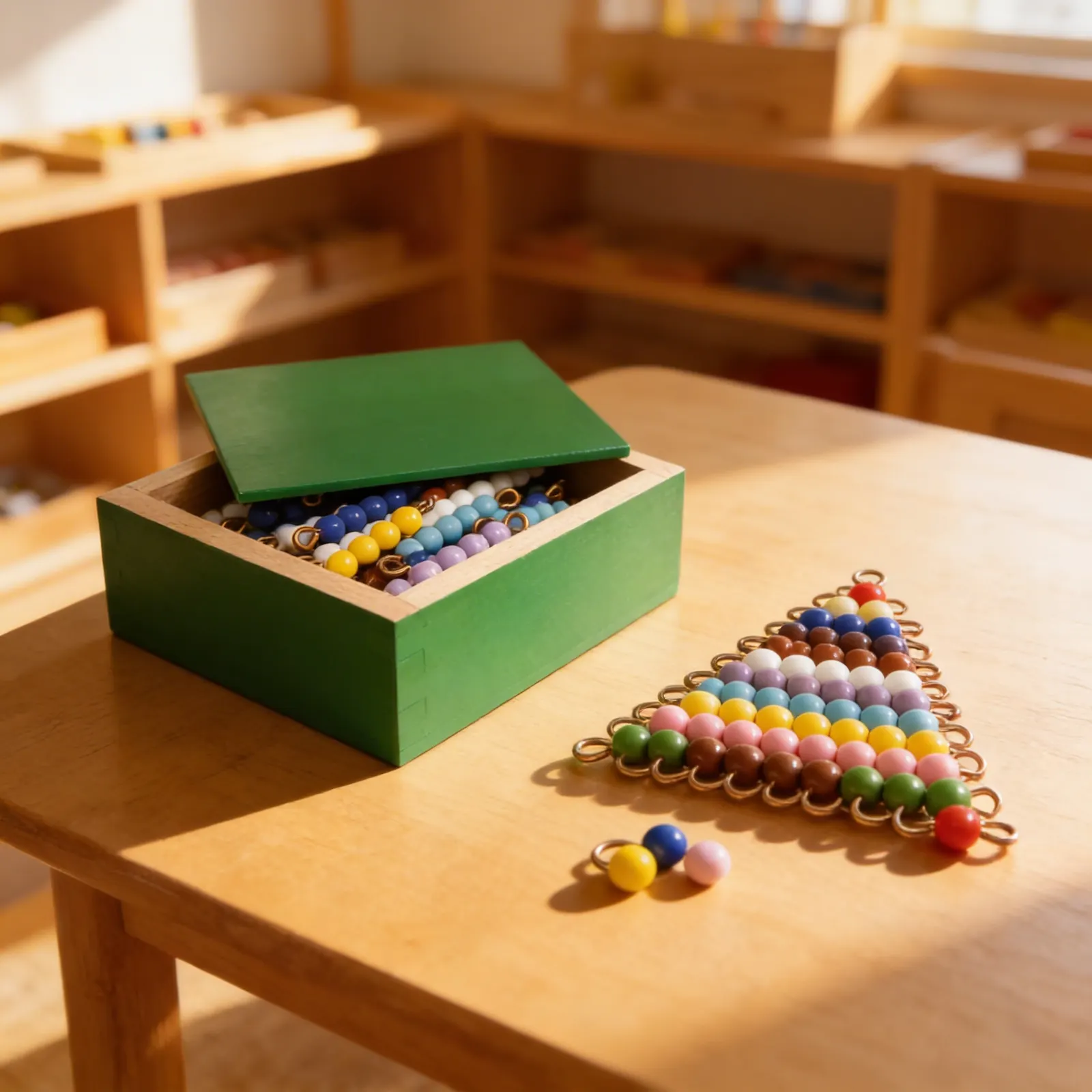
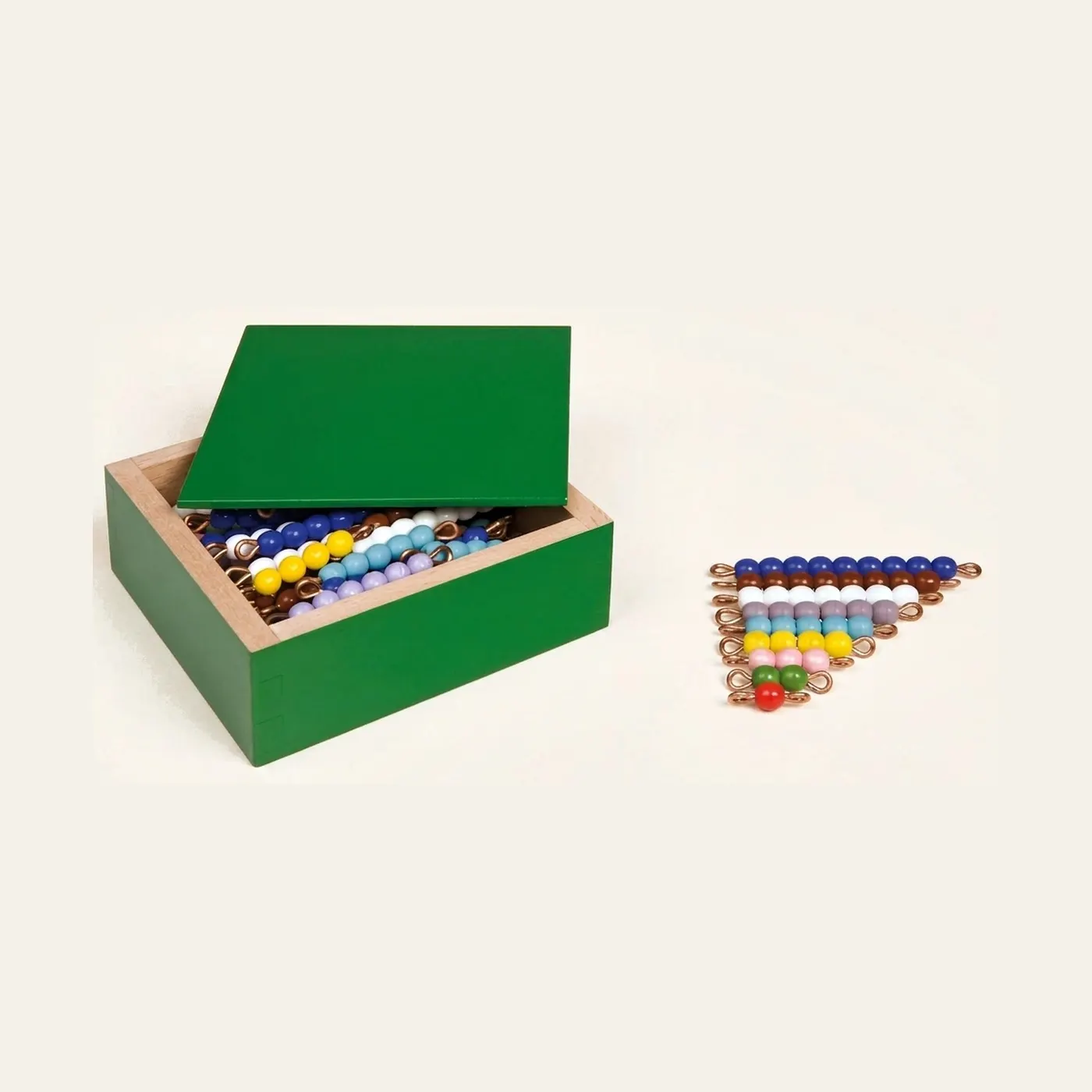
Ten sets of coloured bead stairs in glass, in a hardwood box with a lid, used across addition, subtraction and multiplication. Ten sets is what makes group work possible: one set is enough for a single child doing one operation, and every classroom discovers within a month that the bead stairs are the bottleneck everything else queues behind. Colour identifies quantity at a glance, which is what lets a child work quickly once the facts are known. Glass beads on wire, for ages 3 to 6.
“The senses, being explorers of the world, open the way to knowledge.”
The Colored Bead Stairs embody Dr. Montessori's principle of indirect preparation for mathematics through sensorial experience.
- Visual discrimination of quantities from 1-10 through color association
- Tactile understanding of increasing quantity through weight and length
- Preparation for skip counting and multiplication through bead groupings
- Development of one-to-one correspondence through counting individual beads
Read More
This material bridges the sensorial and mathematical areas, allowing children to internalize quantity through color association before formal number work begins. The glass beads provide weight and texture that enhance the child's sensorial impression of quantity - one red bead feels distinctly different from ten golden beads. Through repeated handling and visual discrimination, children build a concrete, embodied understanding of numerical relationships. The beauty and precision of the glass beads inspire repetition and concentration, while the color coding creates a visual memory that supports later work with the golden bead material and linear counting. This material demonstrates Montessori's genius in recognizing that mathematical abstraction must be built upon a foundation of concrete, sensorial experiences.
How to present it
Follow the Montessori method of presentation for optimal child development.
Place the box on a mat. Ensure beads are organized correctly: 1-red, 2-green, 3-pink, 4-yellow, 5-light blue, 6-violet, 7-white, 8-brown, 9-dark blue, 10-golden.
- 1
Remove each bead bar starting with one, placing them randomly on the mat
Handle the beads gently, demonstrating care for the material - 2
Select the one-bead bar, count 'one' while touching it, place at top left of mat
Use slow, deliberate movements to allow the child to absorb the process - 3
Find the two-bead bar, count 'one, two' touching each bead, place below the one
Emphasize the increasing length with your hand gesture - 4
Continue building the stair formation from 1-10, counting each bar
Pause between bars to allow the child to predict the next number - 5
When complete, run your finger down the diagonal to show the stair pattern
This movement prepares for understanding numerical relationships - 6
Invite the child to build the stairs independently
Observe without correcting - errors are part of the learning process
Every Child Is a Little Creator

Heritage
Since 1929

In classrooms
Around the world

European brands
Nienhuis, GAM, Educo

AMI approved
To the association standard
Coloured Bead Stairs: 10 Sets of Glass Beads 1-10
