
Coloured Counting Bars: Ten Graduated Wooden Mathematical Bars
Made by Nienhuis Montessori · shipped by Heutink International (Netherlands) About the maker
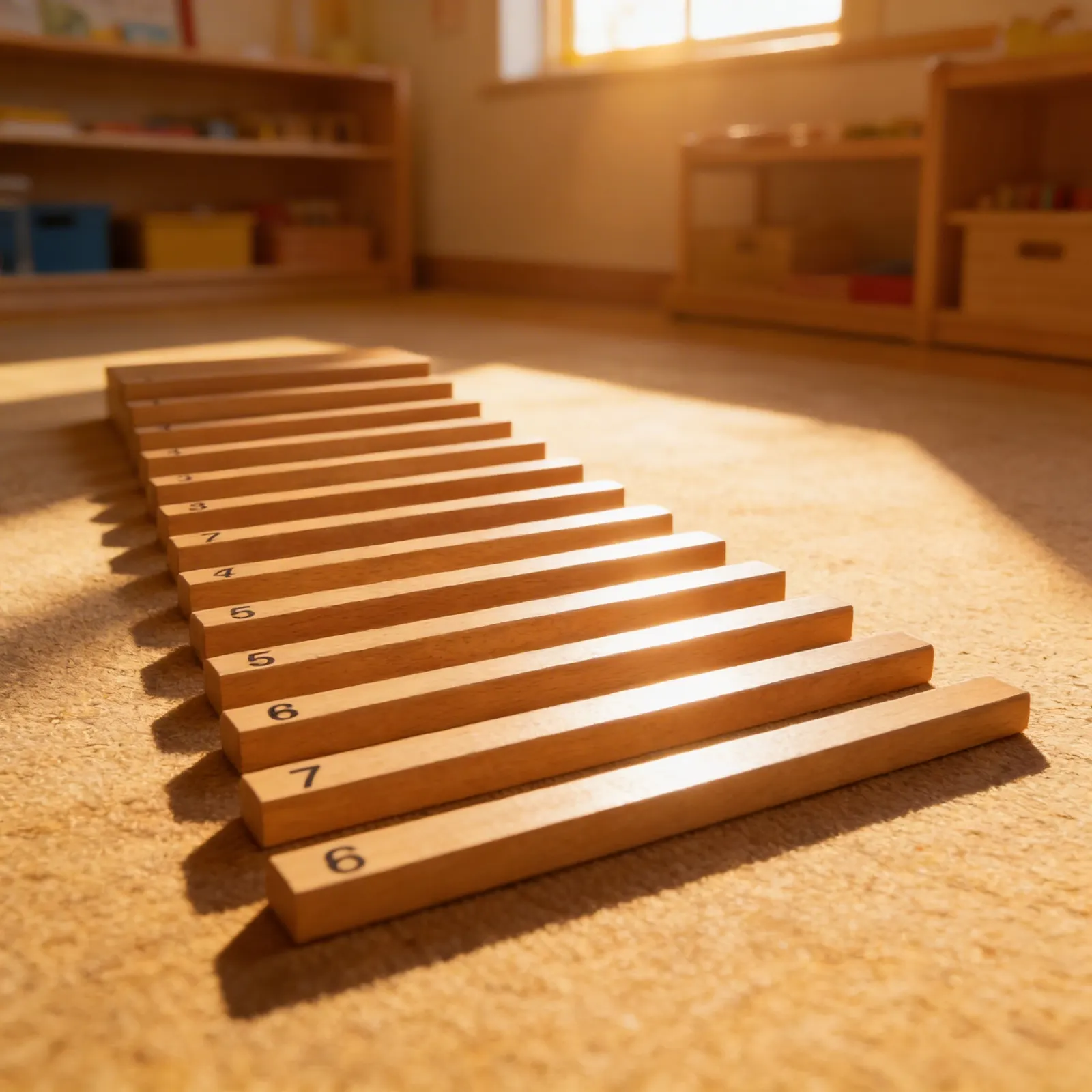
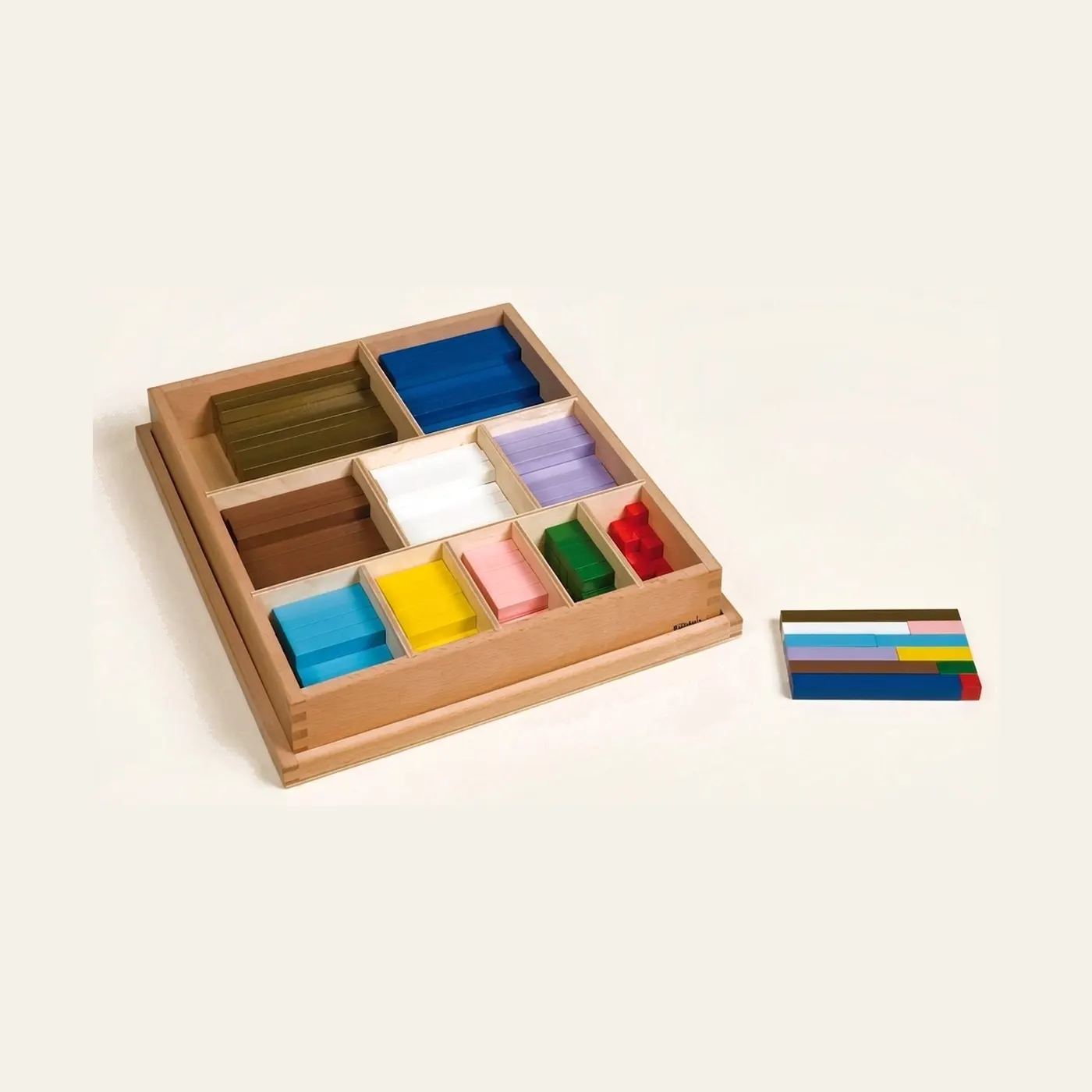
Ten wooden bars in graduated lengths, each a different colour, so a quantity can be recognised two ways at once: by how long it is and by which colour it is. The child lays them in a stair, sees that each bar is exactly one unit longer than the last, and meets the idea of a number line as a physical object before ever drawing one. Because the bars are separate, they also handle early addition: put the three and the seven end to end and the ten is right there to check against. Painted and natural wood, for ages 3 to 6.
“The hands are the instruments of man's intelligence.”
The Colored Counting Bars embody Montessori's principle of isolating difficulty while integrating multiple concepts through sensorial experience.
- Visual discrimination of length and proportional relationships
- One-to-one correspondence between quantity and numerical value
- Sequential ordering and seriation skills
- Foundation for understanding the decimal system
Read More
By assigning each quantity a distinct color, the material creates a concrete, visual representation of abstract numerical concepts. This follows Maria Montessori's observation that children absorb mathematical relationships through their senses before developing abstract understanding. The bars serve as a bridge between the sensorial and mathematical areas, allowing the child to physically manipulate quantities while unconsciously absorbing mathematical relationships. The material respects the child's need for repetition and self-correction, as the graduated lengths provide immediate visual feedback. Through this work, children develop mathematical mind characteristics: precision, order, and abstraction, while building the foundation for later work with the number rods and numerical operations.
How to present it
Follow the Montessori method of presentation for optimal child development.
Place the bars on a large work mat in random order. Ensure adequate space for the child to arrange the bars horizontally with clear spacing between each.
- 1
Invite the child to carry the smallest bar with two hands, placing it at the top left of the mat
Model slow, deliberate movements to emphasize care and precision - 2
Select the next shortest bar, comparing it visually and physically to the first
Run your finger along the length difference to highlight the unit variation - 3
Continue building the stair pattern from shortest to longest, aligning left edges precisely
Use the language 'shorter than' and 'longer than' consistently - 4
Once complete, verify the sequence by running a finger along the diagonal created by the right edges
This creates a sensorial impression of regular incrementation - 5
Count each bar by pointing to it and naming its quantity, associating color with number
Initially focus on 1-3, gradually extending to 10 as the child shows readiness
Every Child Is a Little Creator

Heritage
Since 1929

In classrooms
Around the world

European brands
Nienhuis, GAM, Educo

AMI approved
To the association standard
Coloured Counting Bars: Ten Graduated Wooden Mathematical Bars
