
Counting Chips: 100 Yellow Plastic Chips for Mathematics
Made by Educo · shipped by Heutink International (Netherlands)
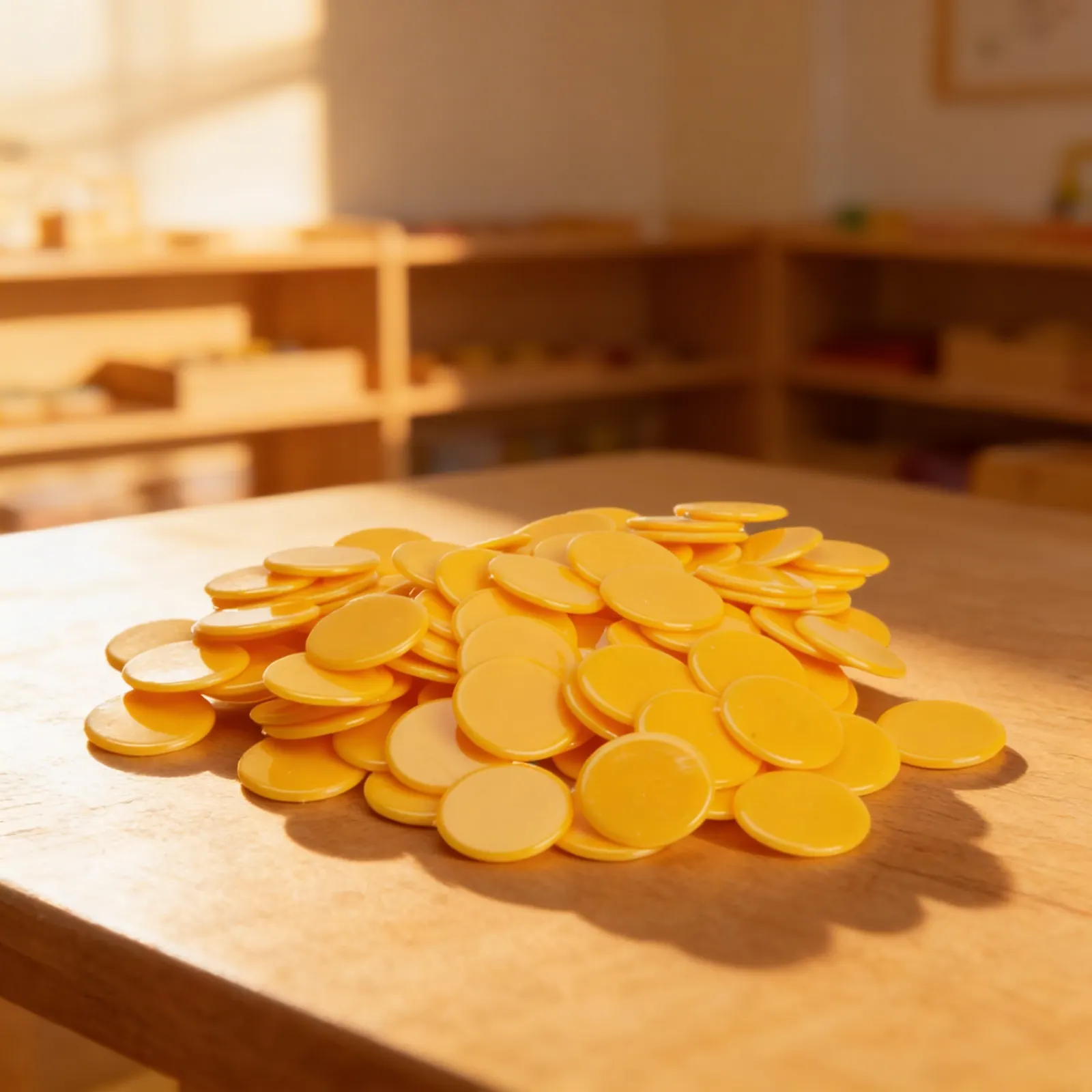
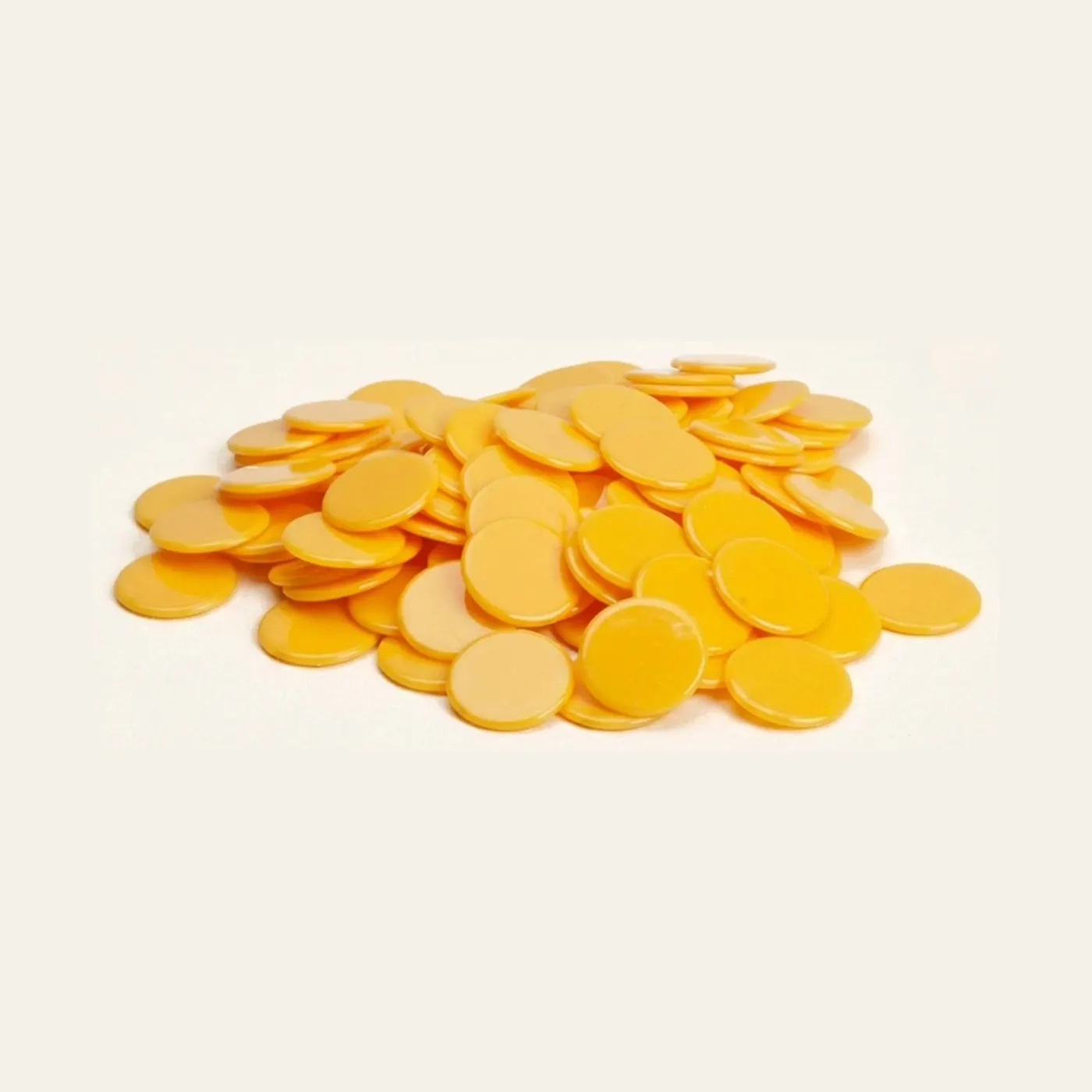
One hundred yellow counting chips, two centimetres across. A chip that size is big enough to be moved one at a time by fingers that are still learning and small enough that a hundred of them fit on a table, which is the whole requirement for counting work. One solid colour is deliberate: with nothing to look at on the chip, what the child sees is the arrangement, so quantities can be built into rows, pairs and groups. Also used for addition and subtraction.
“Children display a universal love of mathematics, which is par excellence the science of precision, order, and intelligence.”
In Montessori mathematics, the journey from concrete to abstract is fundamental.
- Counting and one-to-one correspondence
- Addition and subtraction with concrete materials
- Grouping and sorting by quantity
- Visual pattern recognition
Read More
These counting chips serve as one of the earliest mathematical manipulatives, allowing children to physically touch and move individual units of quantity. When a child places 7 chips in a row and then adds 3 more, they are not memorizing an equation, they are experiencing addition with their hands. The uniform yellow color is intentional: it removes the distraction of color variety, focusing attention purely on quantity. Maria Montessori observed that children who work extensively with concrete materials develop a deep, intuitive number sense that transfers naturally to abstract computation. These chips support that bridge, one yellow circle at a time.
How to present it
Follow the Montessori method of presentation for optimal child development.
Place the counting chips in a small tray or bowl on the left side of the work mat. Ensure the child has enough workspace to spread chips out.
- 1
Invite the child to count out a specific number of chips, placing them one by one in a row from left to right.
Start with small quantities (1-5) and increase as the child shows readiness. - 2
Ask the child to create two groups of chips and combine them to practice addition.
Use language like 'put together' rather than technical math terms initially. - 3
Introduce subtraction by removing chips from a group and counting what remains.
Let the child physically move chips away, the sensory experience reinforces the concept. - 4
Encourage the child to create patterns or arrangements independently.
Step back and observe. The child's self-directed exploration deepens understanding.
Every Child Is a Little Creator

Heritage
Since 1929

In classrooms
Around the world

European brands
Nienhuis, GAM, Educo
Counting Chips: 100 Yellow Plastic Chips for Mathematics
