
Cube Up!: 3D Building Challenge with White Cubes
Made by Nienhuis Montessori · shipped by Heutink International (Netherlands) About the maker
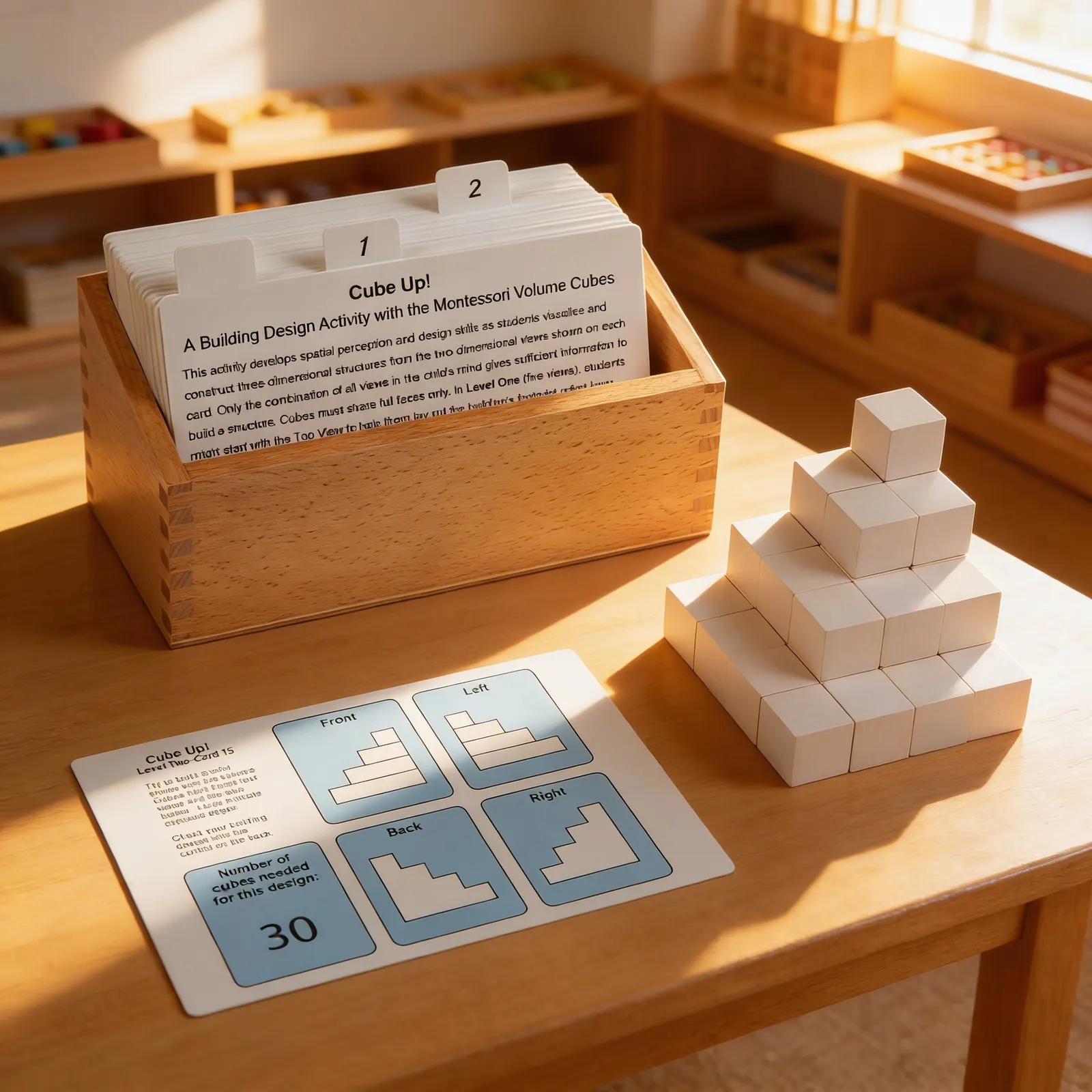
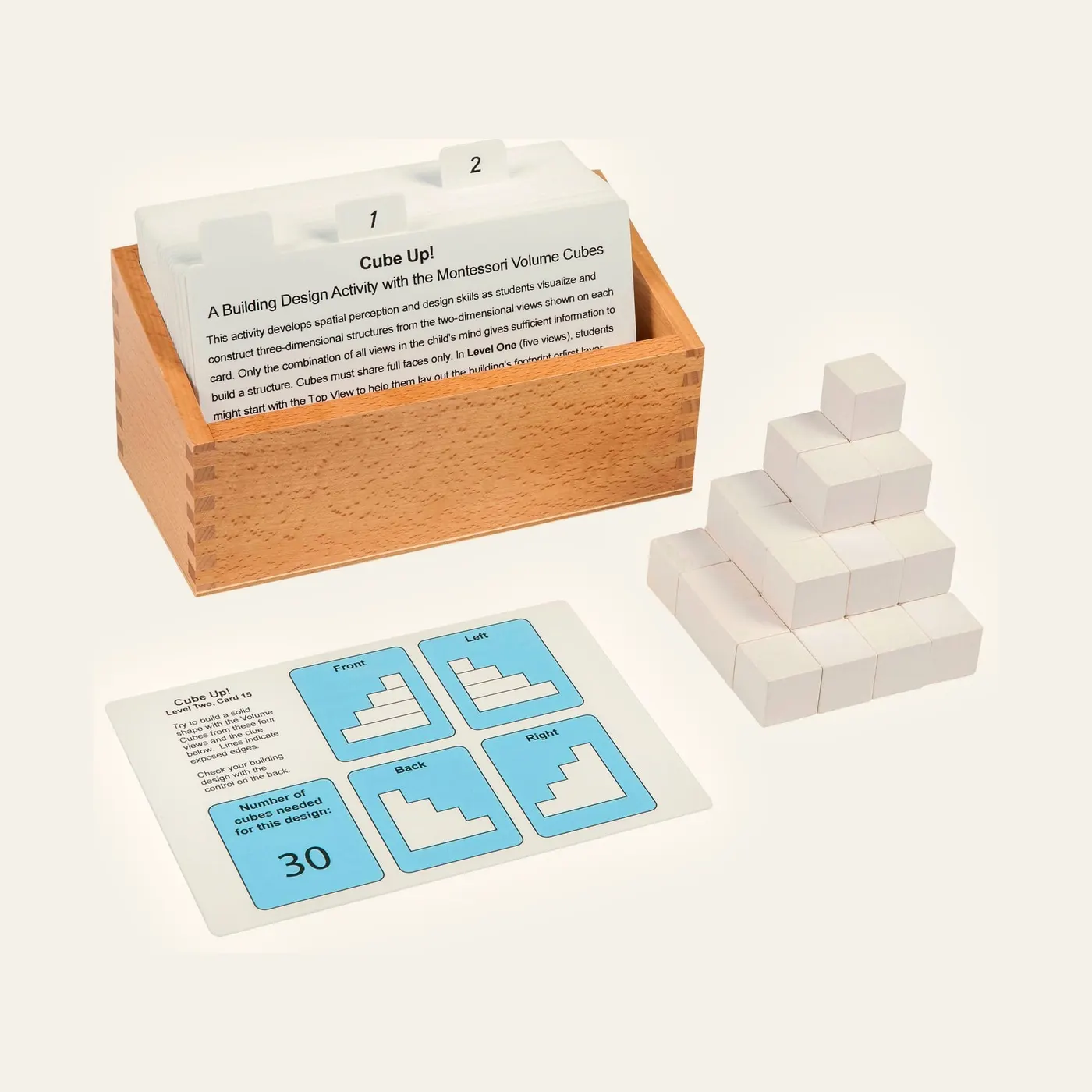
The Cube Up! challenges children to recreate three-dimensional structures using uniform white cubes, developing spatial reasoning and visual perception. Progressive challenge cards guide learners from simple arrangements to complex pyramidal forms, while the multi-perspective reference card teaches children to analyze structures from different viewpoints. This material bridges concrete manipulation with abstract spatial thinking, essential for later geometry work.
“The child is both a hope and a promise for mankind.”
The Cube Up!
- Development of spatial visualization and three-dimensional thinking
- Refinement of visual perception and ability to analyze structures from multiple perspectives
- Preparation for geometry through understanding of how shapes occupy space
- Strengthening of concentration through complex problem-solving sequences
Read More
embodies Montessori's principle of indirect preparation for abstraction through concrete manipulation. As a Sensorial material, it isolates the concept of three-dimensional spatial relationships, allowing children to explore how individual units combine to create complex forms. This material follows the Montessori progression from concrete to abstract, enabling children to physically construct what they visually perceive. The uniform white cubes eliminate distractions of color or pattern, focusing the child's attention purely on spatial relationships. The self-correcting nature of the challenge cards provides the control of error essential to Montessori materials, allowing children to independently verify their work. Through repeated manipulation, children internalize geometric principles that will later support mathematical understanding, particularly in areas of volume, area, and geometric solids.
How to present it
Follow the Montessori method of presentation for optimal child development.
Place the material on a work mat. Arrange challenge cards in order of difficulty. Set the multi-perspective reference card to the side. Count cubes to ensure complete set. Invite the child with slow, deliberate movements.
- 1
Select the first challenge card and study it carefully from all angles
Model how to rotate the card to see different perspectives before beginning - 2
Begin building from the bottom layer, placing each cube precisely
Emphasize exact alignment - cubes should touch completely on adjoining faces - 3
Continue building upward, referring to the challenge card frequently
Encourage the child to walk around their structure to compare with the card - 4
Use the multi-perspective reference card to check the structure from different viewpoints
Teach the child to systematically check front, back, sides, and top views - 5
If incorrect, carefully dismantle and rebuild rather than adjusting
This reinforces the importance of precision and careful observation
Every Child Is a Little Creator

Heritage
Since 1929

In classrooms
Around the world

European brands
Nienhuis, GAM, Educo

AMI approved
To the association standard
Cube Up!: 3D Building Challenge with White Cubes
