
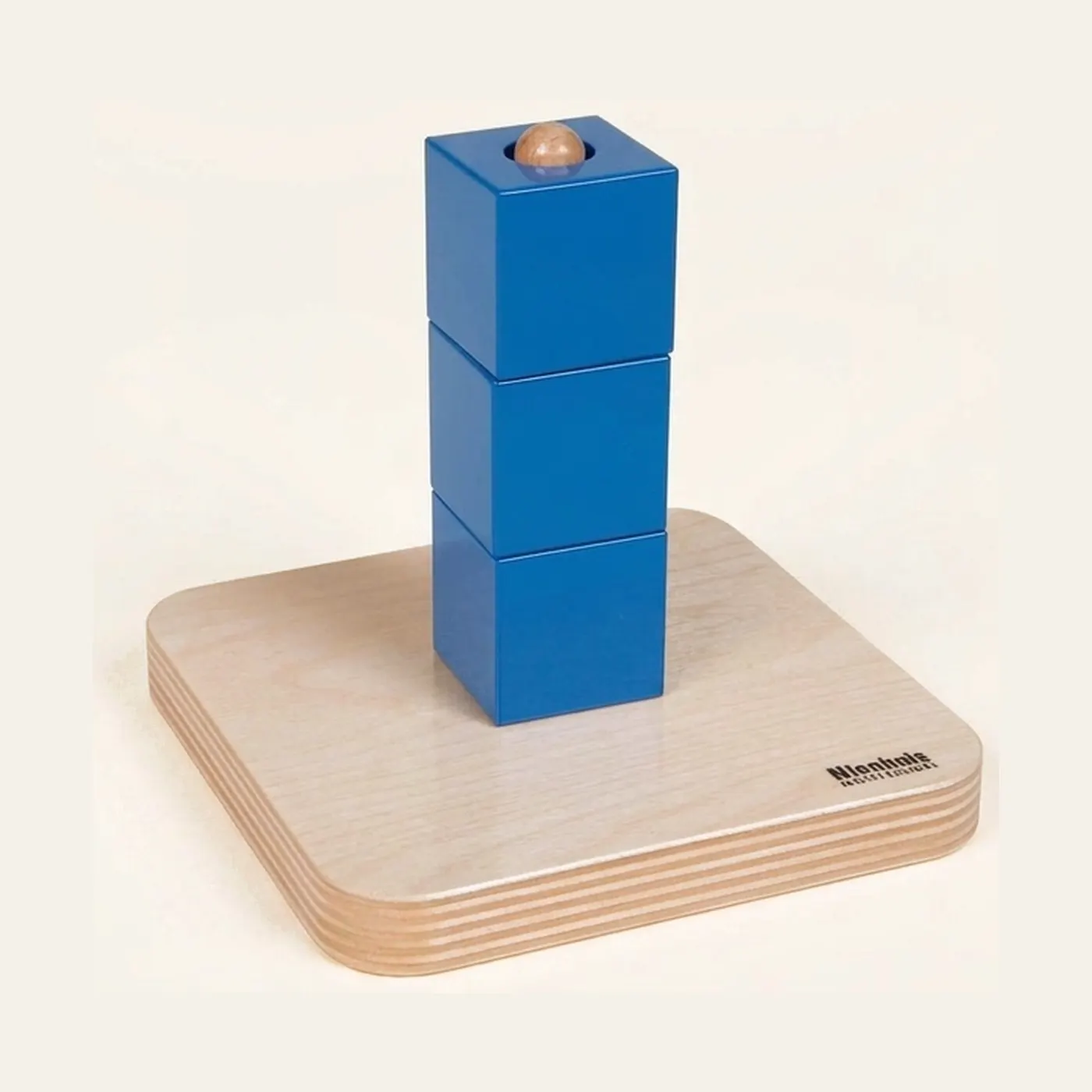
Cube Stacking Dowel: Three Blue Cubes with Wooden Sphere
Made by Nienhuis Montessori · shipped by Heutink International (Netherlands) About the maker
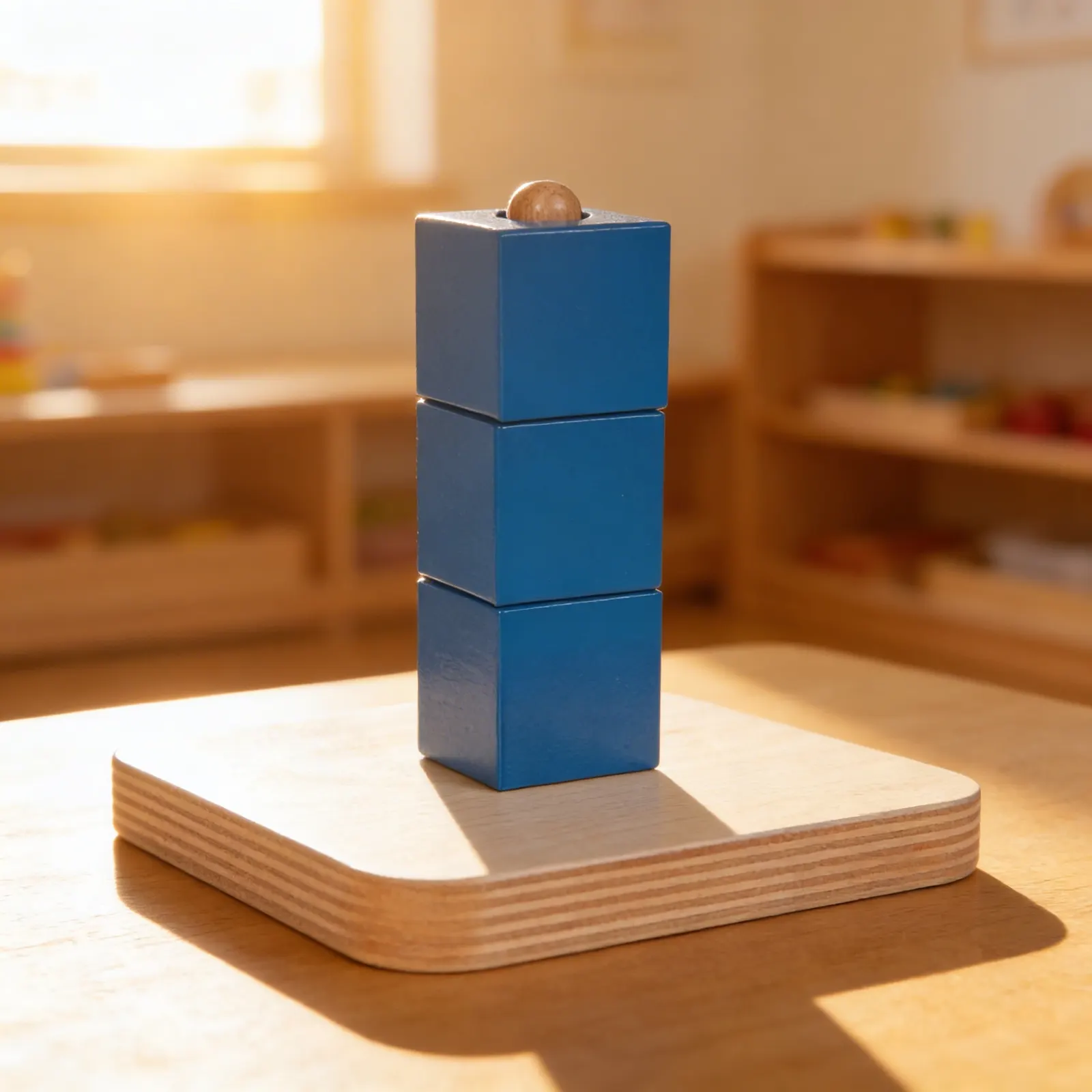
Cubes to be lifted onto a vertical dowel, one at a time. A vertical dowel is harder than a horizontal one because gravity offers no help with the aim: the hole has to arrive over the tip before the hand lets go, and until it does the cube simply sits on top. Lining up two things that a child cannot see at the same moment is the real work, and a stack that stays up is proof it happened. Solid wood with non toxic paint, for ages 0 to 3.
“Education is a natural process spontaneously carried out by the human individual, and is acquired not by listening to words but by experiences upon the environment.”
The Cubes on Vertical Dowel embodies Maria Montessori's principle of isolation of difficulty, presenting one challenge at a time - vertical stacking.
- Refinement of hand-eye coordination through precise vertical movements
- Development of wrist rotation and finger grasp control
- Understanding of spatial relationships and vertical alignment
- Concentration through repetitive, purposeful activity
Read More
This material respects the child's need for repetition and perfection of movement during the critical period for order and refinement of motor skills. The uniform blue cubes eliminate distractions, allowing complete focus on the precise hand movements required. Following the Montessori principle of control of error, the material provides immediate feedback - cubes either slide smoothly onto the dowel or resist if misaligned. This self-correcting nature fosters independence and builds the child's confidence through successful repetition. The material's simplicity honors the young child's tendency toward maximum effort with minimal complexity.
How to present it
Follow the Montessori method of presentation for optimal child development.
Place the material on a low shelf at the child's eye level. Use a small mat or tray to define the workspace. Ensure the cubes are stacked on the dowel with the sphere on top.
- 1
Sit to the child's right. Slowly grasp the sphere with thumb and two fingers, lift vertically, and place gently to the right
Exaggerate the precision of your movements to highlight the careful control needed - 2
Remove the top cube using the same three-finger grasp, lifting straight up before placing it down
Pause at the top of the lift to emphasize the vertical movement - 3
Continue removing each cube with deliberate, identical movements
Maintain consistent speed throughout - slow and purposeful - 4
Replace cubes one at a time, aligning the hole with the dowel before sliding down
Let the child see you visually check alignment before releasing - 5
Finish by replacing the sphere, then invite the child to try
Step back completely to give the child full ownership of the activity
Every Child Is a Little Creator

Heritage
Since 1929

In classrooms
Around the world

European brands
Nienhuis, GAM, Educo

AMI approved
To the association standard
Cube Stacking Dowel: Three Blue Cubes with Wooden Sphere
