
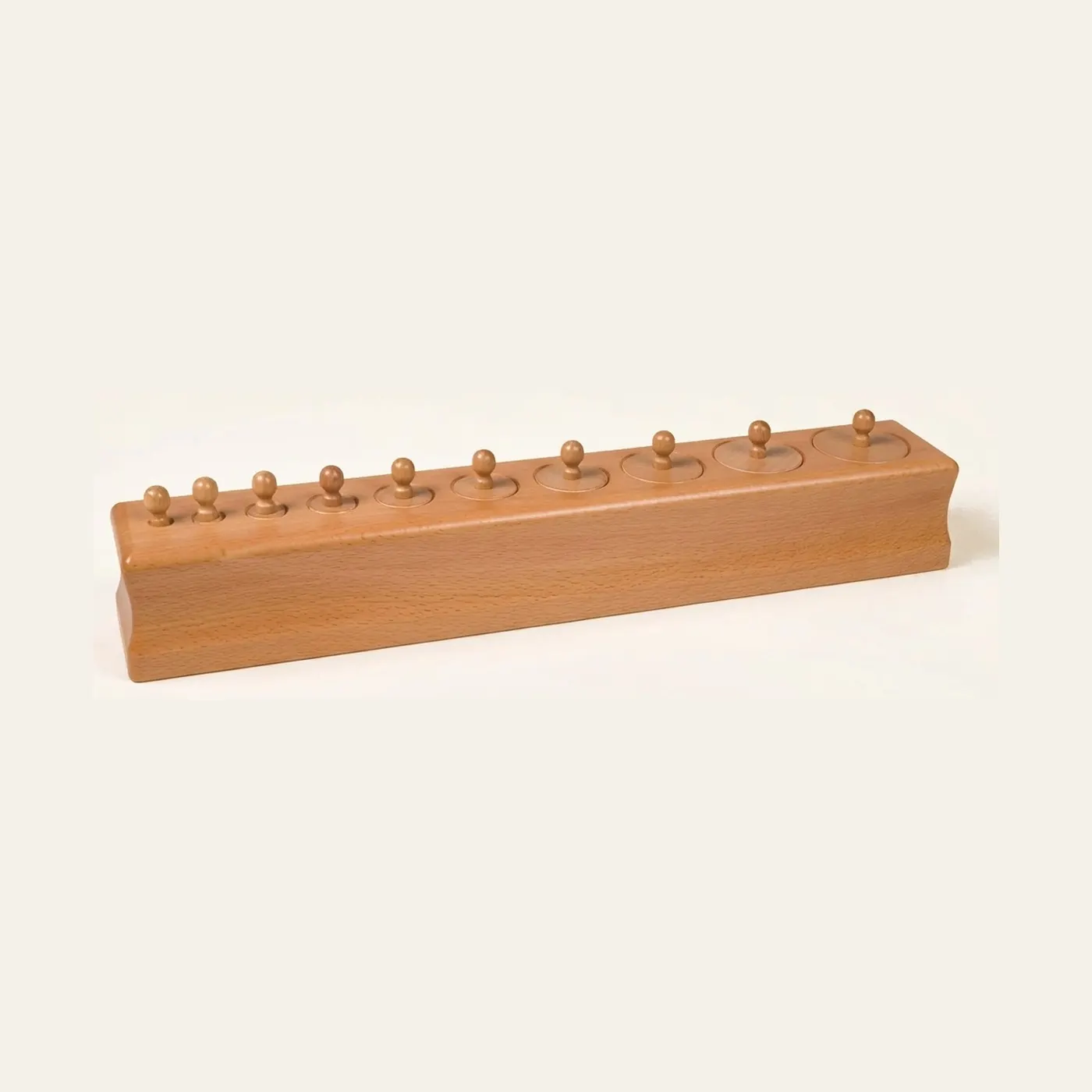
Cylinder Block No. 1: Height and Diameter Increase Together
Made by Nienhuis Montessori · shipped by Heutink International (Netherlands) About the maker
The Cylinder Block No. 1 introduces dimensional variations through cylinders that differ in diameter while maintaining constant height. This fundamental Sensorial material develops visual discrimination, fine motor control, and prepares the hand for writing through the precise three-finger grip of the cylinder knobs. Part of the classic Montessori cylinder block series, it isolates the concept of thickness for focused exploration.
“The hands are the instruments of man's intelligence.”
The Cylinder Block No.
- Visual discrimination of diameter differences from thick to thin
- Refinement of the pincer grasp and hand strength for writing preparation
- Development of concentration through focused, repetitive work
- Mathematical preparation through serialization and gradation concepts
Read More
1 embodies Maria Montessori's principle of isolation of difficulty by presenting only one variable, diameter, while height remains constant. This material represents the child's first encounter with dimensional discrimination in the Sensorial curriculum, offering concrete experiences that build the foundation for mathematical thinking. Through repeated manipulation of these cylinders, children develop what Montessori called the 'muscular memory' of dimension, while simultaneously refining their pincer grasp essential for writing. The material's self-correcting nature honors the child's inner teacher, as each cylinder fits perfectly in only one socket, allowing for immediate feedback without adult intervention. This fosters independence and builds the child's confidence in their own judgment, while the aesthetic precision of the material calls to the child's natural sense of order during the sensitive period for refinement of the senses.

How to present it
Follow the Montessori method of presentation for optimal child development.
Place the cylinder block on a table mat at the child's dominant hand side. Ensure adequate workspace and good lighting. Sit beside the child, not across from them.
- 1
Using your dominant hand, grasp the knob of the thickest cylinder with three fingers (thumb, index, middle). Lift it slowly and deliberately from its socket.
Exaggerate the three-finger grip to emphasize the correct hold for writing preparation. - 2
Place the cylinder gently on the mat in front of the block. Continue removing all cylinders one by one, mixing their order on the mat.
Create deliberate disorder to increase the challenge and engagement. - 3
Select one cylinder, lift it carefully, and hover it over each socket until finding where it fits perfectly. Lower it slowly into place.
Model visual scanning from left to right to prepare for reading patterns. - 4
Continue replacing cylinders one by one. If a cylinder doesn't fit, try another socket without forcing it.
Allow the child to discover errors naturally, the material is self-correcting. - 5
When all cylinders are replaced, run your finger along the tops to check they're flush with the block surface.
This final check provides sensorial feedback and a sense of completion.
Every Child Is a Little Creator

Heritage
Since 1929

In classrooms
Around the world

European brands
Nienhuis, GAM, Educo

AMI approved
To the association standard
Cylinder Block No. 1: Height and Diameter Increase Together
