
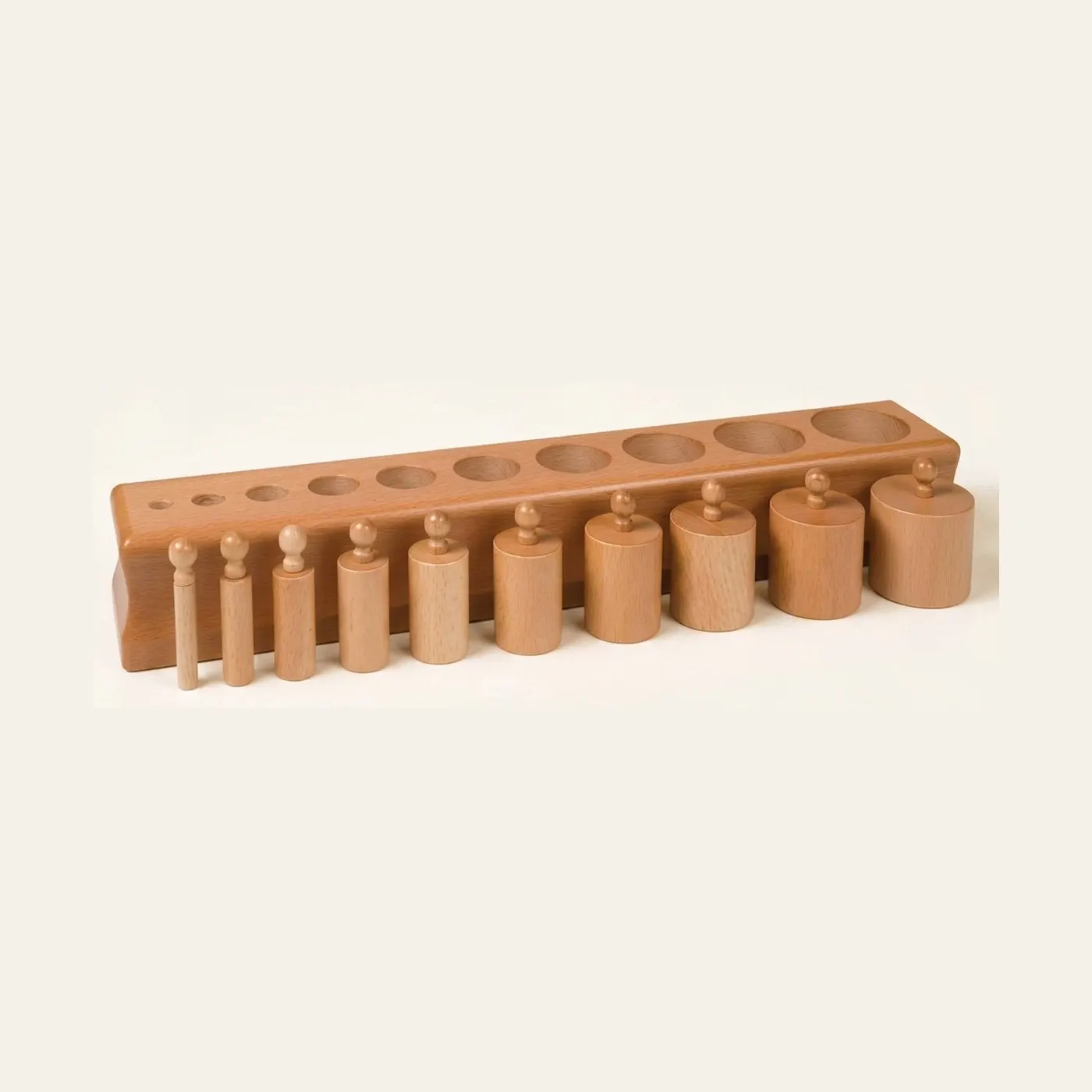
Cylinder Block No. 2: Varying Diameter, Constant Height
Made by Nienhuis Montessori · shipped by Heutink International (Netherlands) About the maker
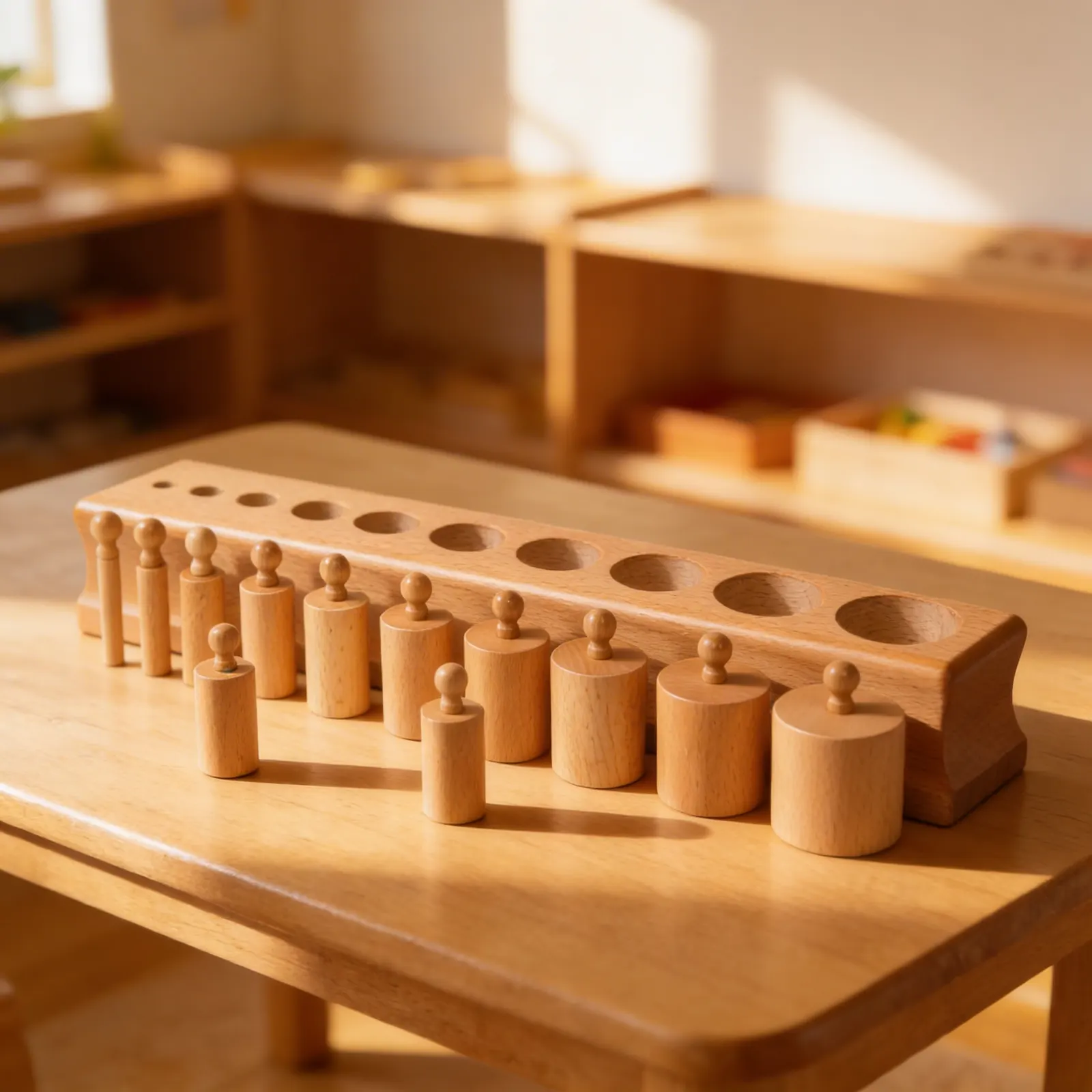
Ten cylinders that are all 55 mm tall and run from 10 mm to 55 mm across, so only the thickness changes. Holding one dimension still is what makes the block teachable: a child comparing two cylinders here has nothing to weigh up except width, and the socket confirms the judgement without an adult saying anything. The knob is held in the writing grip, which is why this sits in the sensorial area and pays off in the language area. Solid beechwood with a satin lacquer finish, for ages 3 to 6.
“Education is a natural process spontaneously carried out by the human individual, and is acquired not by listening to words but by experiences upon the environment.”
The Cylinder Block No.
- Visual discrimination of diameter differences while height remains constant
- Refinement of pincer grip essential for pencil holding
- Development of order, sequence, and gradation concepts
- Preparation for mathematical concepts of dimension and measurement
Read More
2 embodies Montessori's principle of isolating difficulty by presenting only one varying dimension, diameter, while height remains constant. This material respects the child's sensitive period for order and refinement of the senses, particularly visual discrimination. Through repeated manipulation of the cylinders, children develop what Dr. Montessori called the 'mathematical mind,' unconsciously absorbing concepts of gradation and dimension. The material's self-correcting nature allows children to work independently, building concentration and confidence. The precise fitting of cylinders into their corresponding sockets provides immediate feedback, eliminating the need for adult correction and preserving the child's dignity. This work prepares the hand for writing through the three-finger grip used to grasp the knobs, while simultaneously developing visual perception essential for later mathematical work with dimensions and measurements.
How to present it
Follow the Montessori method of presentation for optimal child development.
Place the cylinder block on a table mat at the child's dominant hand side. Ensure adequate workspace for removing all cylinders. Sit beside the child, not opposite.
- 1
Using thumb, index, and middle finger, grasp the knob of the thickest cylinder and slowly remove it
Demonstrate the pincer grip clearly, moving deliberately to allow the child to absorb the movement - 2
Place the cylinder in front of its socket, continuing left to right until all cylinders are removed
Maintain left-to-right progression to support later reading preparation - 3
Pause and visually scan the empty sockets and cylinders
This moment of observation is crucial for visual discrimination development - 4
Select the thickest cylinder and slowly return it to its socket, feeling for the perfect fit
If it doesn't fit, try another socket without forcing, let the material teach - 5
Continue replacing cylinders one at a time, using visual and tactile discrimination
Work silently to maintain concentration and allow the child to focus on the sensorial experience
Every Child Is a Little Creator

Heritage
Since 1929

In classrooms
Around the world

European brands
Nienhuis, GAM, Educo

AMI approved
To the association standard
Cylinder Block No. 2: Varying Diameter, Constant Height
