
Cylinder Block No. 4: Constant Diameter, Increasing Height
Made by Nienhuis Montessori · shipped by Heutink International (Netherlands) About the maker
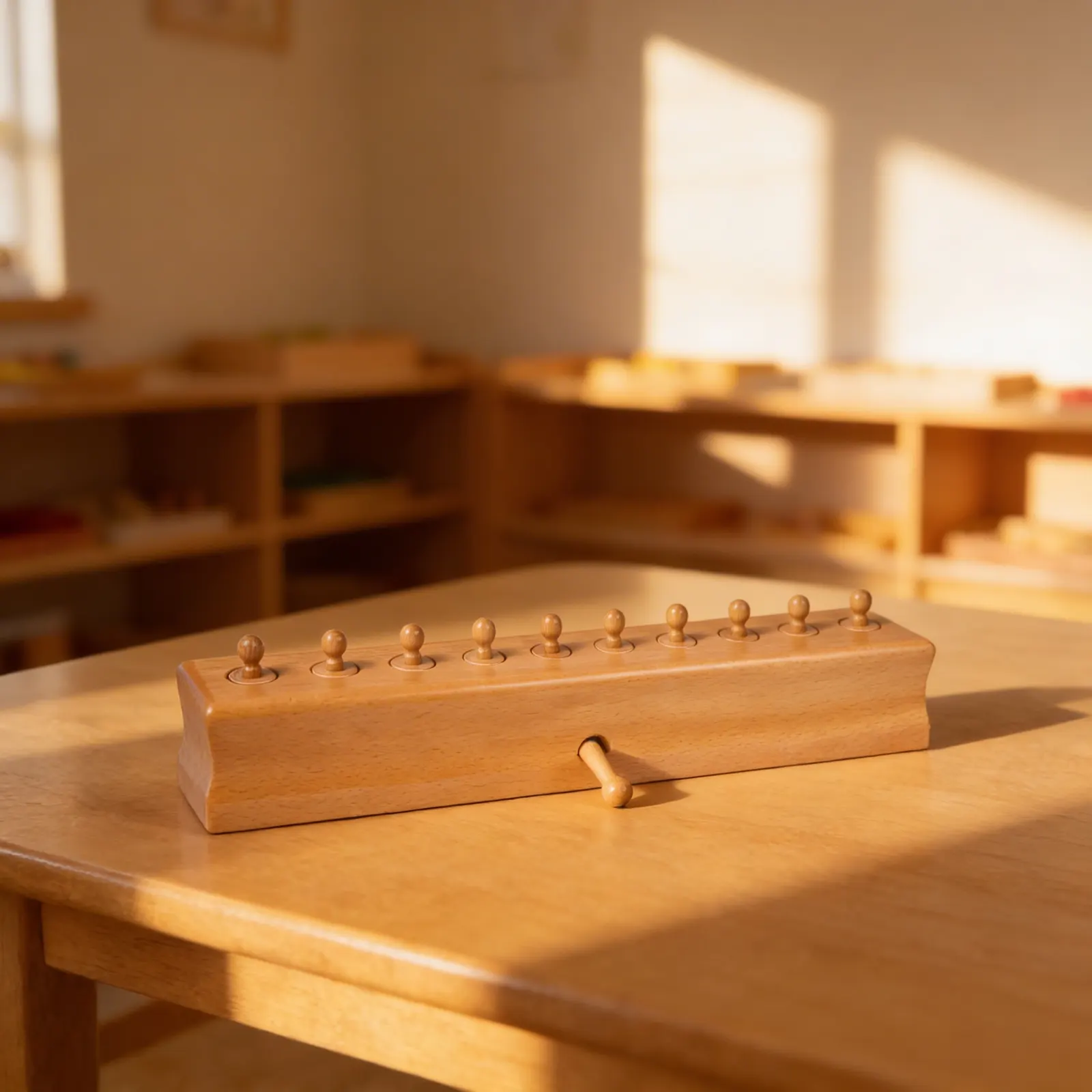
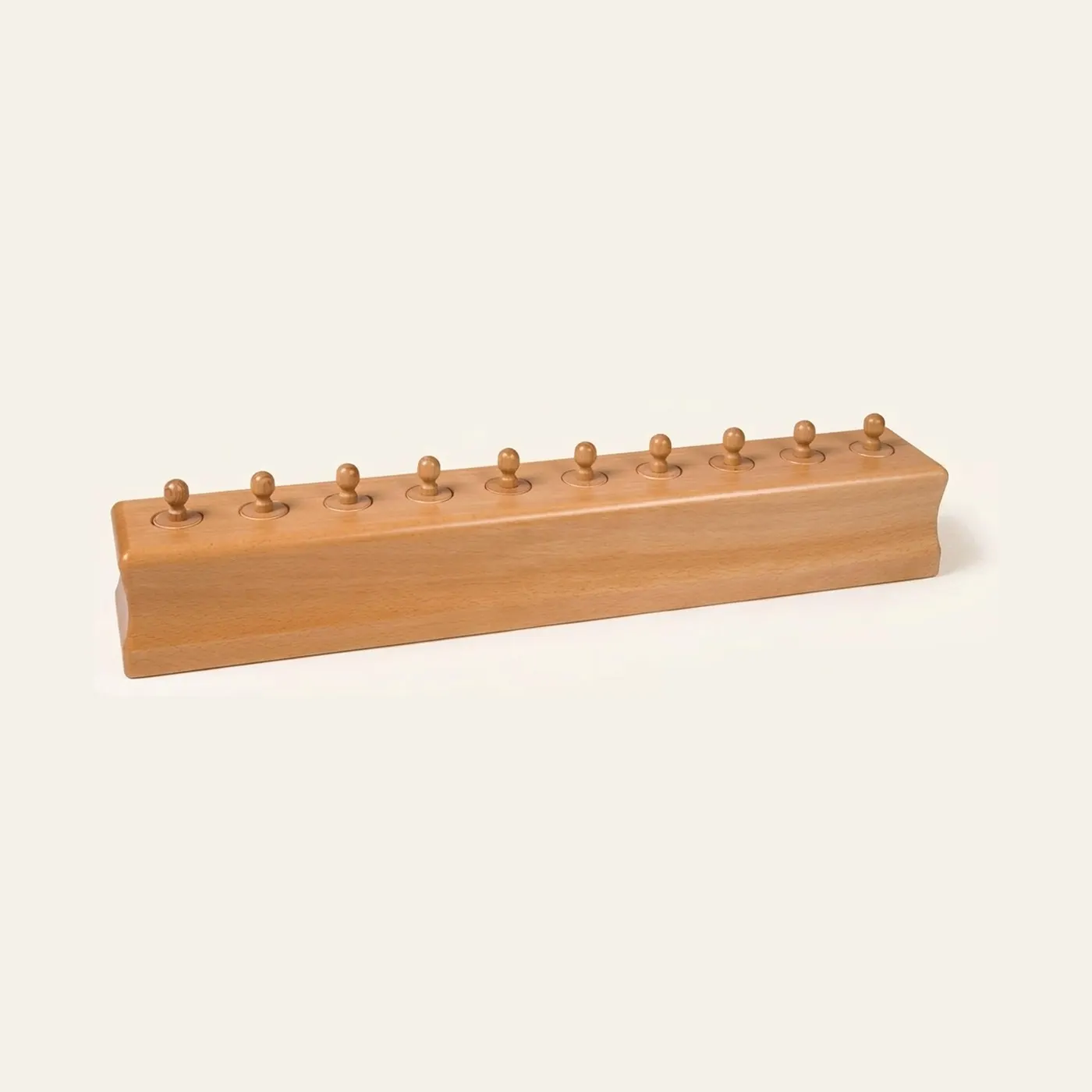
Ten cylinders that are all 25 mm across and run from 10 mm to 55 mm tall, so only the height changes. This is the harder of the single dimension blocks, because height read from above is nearly invisible: a child has to lift each cylinder to see what they are comparing, and that is the whole exercise. Working it after the diameter block means the eye already trusts the socket to settle a disagreement. Solid beechwood with a satin lacquer finish, for ages 3 to 6.
“The greatest sign of success for a teacher is to be able to say, 'The children are now working as if I did not exist.'”
Cylinder Block No.
- Visual discrimination of combined dimensional changes
- Development of pincer grip and fine motor control
- Preparation for mathematical concepts of proportion and ratio
- Concentration and focus through purposeful repetition
Read More
4 embodies Montessori's principle of isolation of difficulty by presenting two varying dimensions simultaneously. This material respects the child's mathematical mind, offering concrete experiences with abstract concepts of dimension and proportion. Through repeated manipulation, the child develops visual discrimination and muscular memory, building neural pathways essential for later mathematical understanding. The self-correcting nature of the cylinders supports the child's independence and intrinsic motivation. As each cylinder has only one correct socket, the material provides immediate, non-judgmental feedback, allowing the child to perfect their movements and perceptions through repetition. This work satisfies the child's need for order during the sensitive period for refinement of the senses, while the precise gradation from thick-and-tall to thin-and-short creates a visual and tactile impression of mathematical relationships that will later support understanding of measurement, seriation, and algebraic thinking.
How to present it
Follow the Montessori method of presentation for optimal child development.
Place the cylinder block on a table mat at the child's dominant hand side. Ensure adequate workspace and good lighting. Sit beside the child, not across from them.
- 1
Using thumb and two fingers, grasp the largest cylinder by its knob and slowly remove it, placing it in front of its socket
Demonstrate deliberate, graceful movements to model careful handling - 2
Continue removing cylinders randomly, not in order, placing each in front of its socket
Random removal increases the challenge and prevents mechanical matching - 3
Select any cylinder and slowly lower it into various sockets until finding the correct fit
Allow the cylinder to 'tell' you if it fits - don't force it - 4
Continue until all cylinders are replaced, then run fingers along the tops to check they're level
This final check provides sensory feedback and closure to the work - 5
Invite the child to repeat the exercise
Step back and observe without intervening unless invited
Every Child Is a Little Creator

Heritage
Since 1929

In classrooms
Around the world

European brands
Nienhuis, GAM, Educo

AMI approved
To the association standard
Cylinder Block No. 4: Constant Diameter, Increasing Height
