
Decanomial Bead Bar Box: Complete Nylon Bead Set 1-10
Made by Nienhuis Montessori · shipped by Heutink International (Netherlands) About the maker
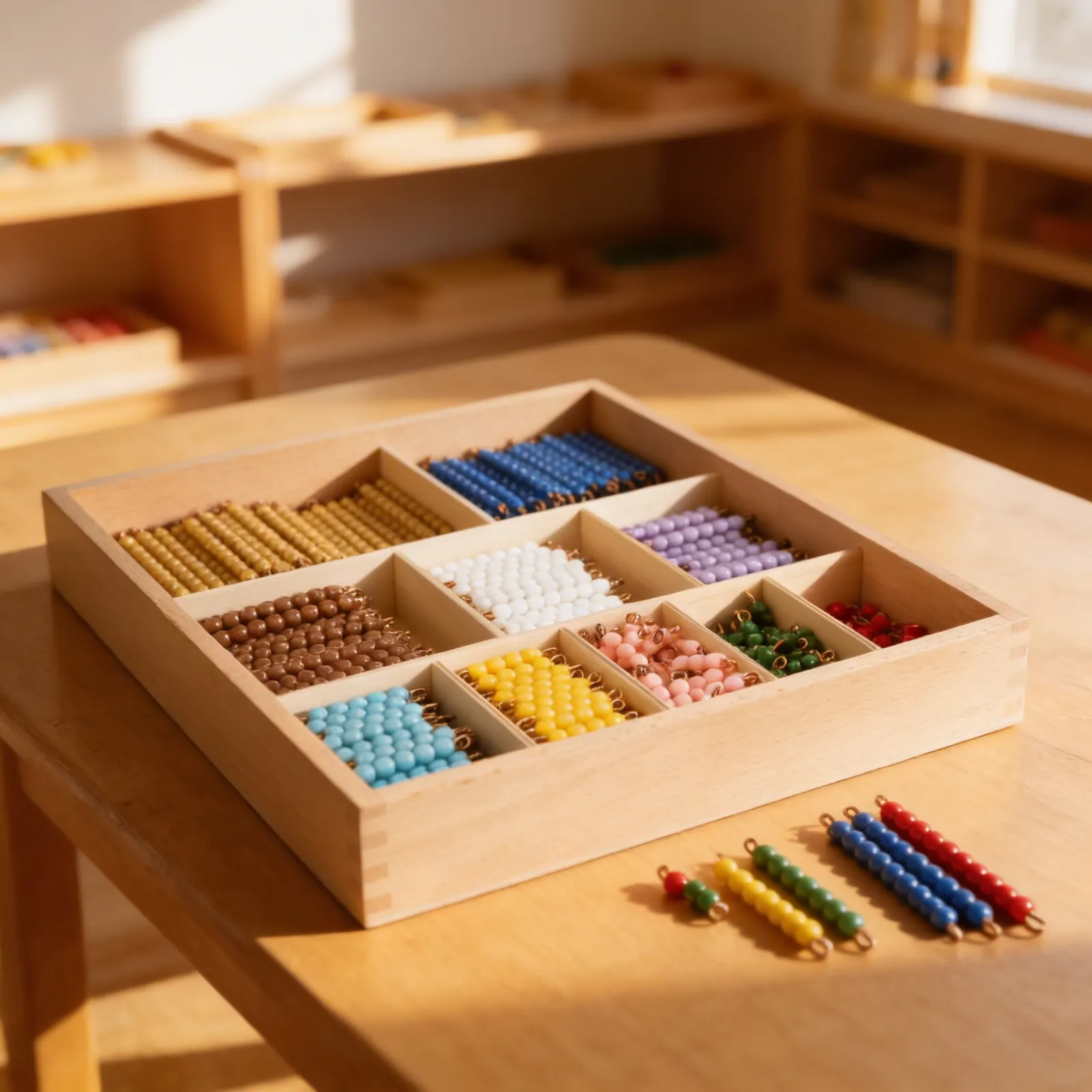
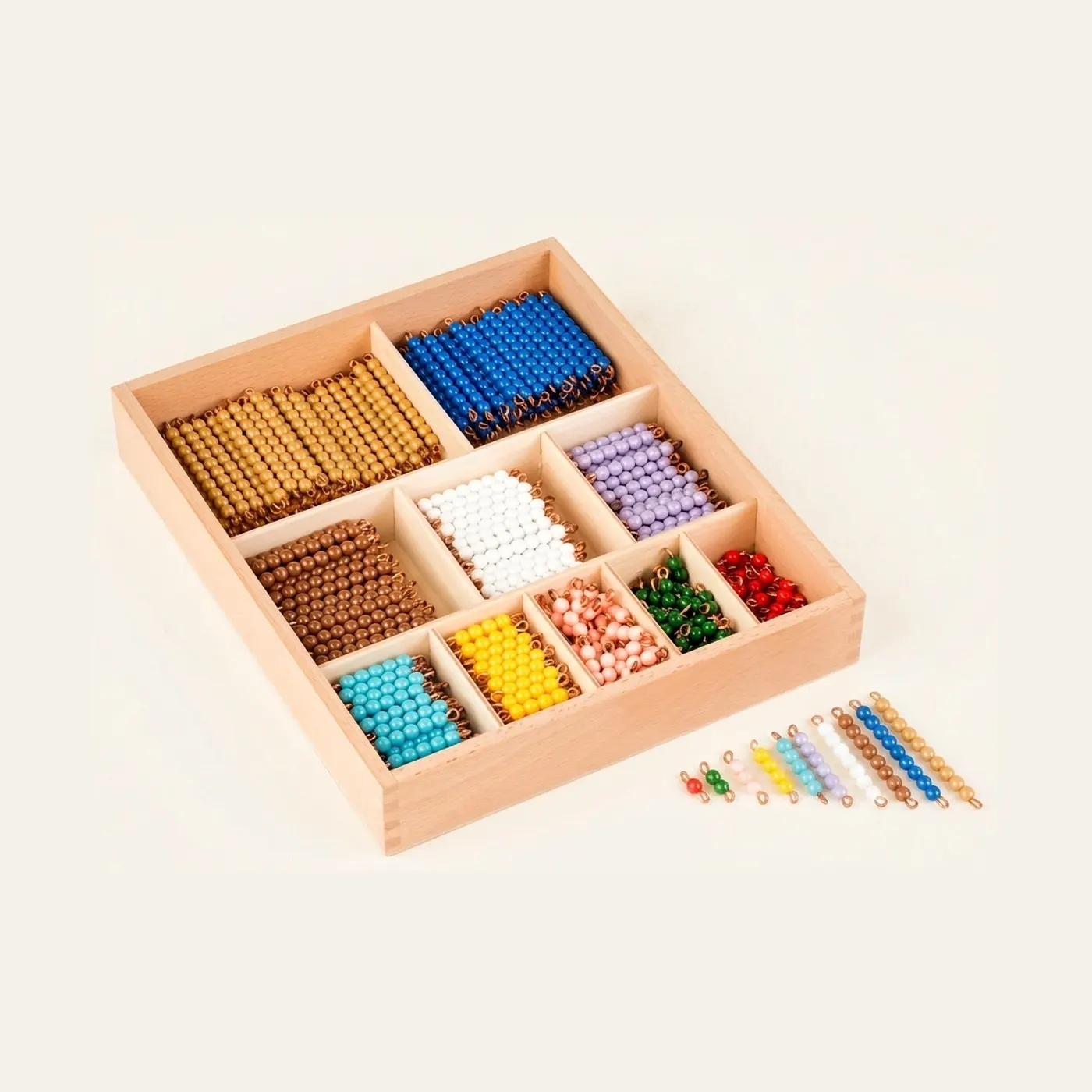
Fifty five bead bars of each length from one to ten, in nylon, which is what the decanomial takes: the whole multiplication table built as a square of squares and rectangles. Laid out, it is large enough that its symmetry reads from across the room, and the child who built it can point to where seven eights and eight sevens meet. Taking it apart along the diagonal leaves the square numbers standing alone, which is usually the moment squaring stops being a rule. Nylon bead bars in a wooden storage box, for ages 6 to 12.
“The hands are the instruments of man's intelligence.”
The Decanomial Bead Bar Box embodies Montessori's principle of materialized abstraction, where complex mathematical concepts are made concrete through manipulative materials. This material bridges the sensorial experience of quantity with abstract algebraic thinking, allowing children to physically construct and deconstruct mathematical relationships. The color-coding system provides a visual memory aid that supports the child's natural mathematical mind, while the precise organization satisfies their need for order during the second plane of development.
- Master multiplication facts through 10x10 with concrete manipulation
- Develop understanding of commutative property through physical arrangement
- Build foundation for squaring and algebraic concepts (a+b)²
- Strengthen visual discrimination and pattern recognition through color-coded system
Read More
By manipulating these bead bars, children discover mathematical patterns independently, building what Montessori called 'the passage to abstraction' through repeated concrete experiences that lead to sudden insights and deep understanding.
How to present it
Follow the Montessori method of presentation for optimal child development.
Place the Decanomial Box on a large work mat. Ensure ample floor space for laying out the complete decanomial square. Have a smaller mat ready for initial presentations.
- 1
Begin by removing all bead bars systematically, starting with unit beads, laying them in columns by quantity
Allow child to feel the weight difference between quantities - 2
Build the multiplication table concretely: start with 1x1 through 1x10, then 2x1 through 2x10, continuing systematically
Point out the diagonal of squares using matching colored bars - 3
Transform the multiplication table into the decanomial square by rearranging bars to form a large square pattern
Highlight how 3x4 and 4x3 create the same area but different shapes - 4
Explore algebraic concepts by building (a+b)² using different combinations of bead bars
Start with simple combinations like (2+3)² before complex ones - 5
Record discoveries using graph paper, coloring squares to match bead bar patterns
This bridges concrete to abstract representation
Every Child Is a Little Creator

Heritage
Since 1929

In classrooms
Around the world

European brands
Nienhuis, GAM, Educo

AMI approved
To the association standard
Decanomial Bead Bar Box: Complete Nylon Bead Set 1-10
