
Decimal Fraction Exercise Activity Set1
The first photo is the maker's own. The other shots are illustrative.
Inv. no. NIE-061801
- Maker
- Nienhuis Montessori, since 1929
- Approval
- AMI
- Storage Box
- Natural wood with dividers
- Exercise Cards
- Laminated cardstock
- EAN
- 8719924013530
Final price incl. VAT. Delivery €5.90, €80.10 to go for free delivery.
Advice, warranty and returns are handled by us.
Why it costs €68.90
Behind the price of the original are things you can check yourself.
AMI approval
The material is approved by the Association Montessori Internationale (AMI). Nienhuis has made Montessori materials since 1929.
A verifiable original
The EAN 8719924013530 is on the box. It is the maker's number, not ours.
Decimal Fraction Exercise Activity Set in a child's hands
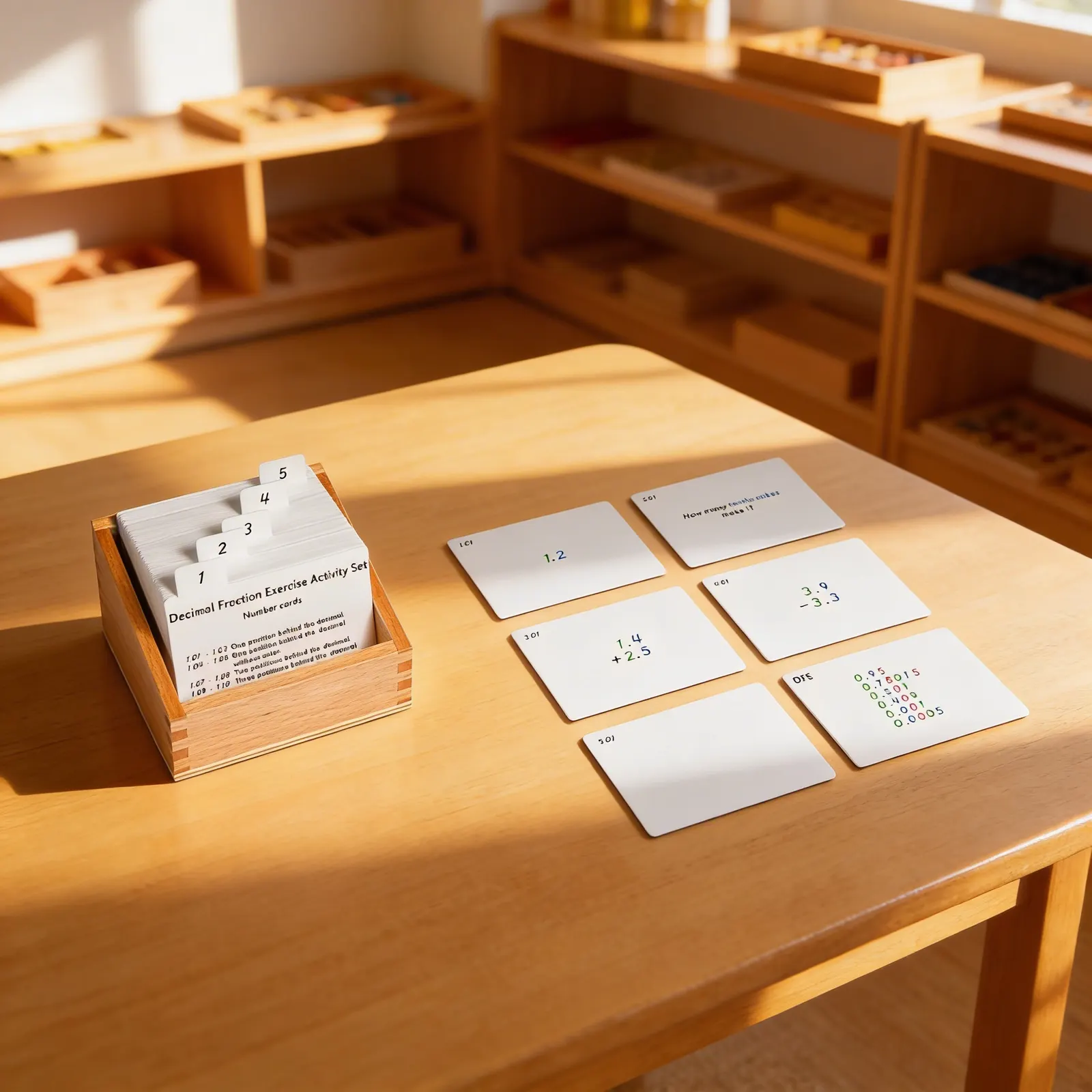
Exercise cards with divider tabs in a wooden box, extending the decimal fraction exercise. Decimal fractions are where the two halves of a child's arithmetic finally meet: the place value work says every column is ten times its neighbour, and the fraction work says a whole can be cut up, and a decimal is both statements at once, running to the right of the point instead of the left. That is worth many days of work, and these cards are the days. Decimal fraction exercise sold separately. Wood, cardstock and laminate, for ages 3 to 12.
Decimal Understanding
Visual representations help children grasp decimal fraction concepts through concrete imagery before moving to abstract notation.
Sequential Learning
Numbered dividers guide systematic progression through increasingly complex decimal fraction exercises.
Mathematical Precision
Clear visual patterns and organized presentation support accurate understanding of decimal relationships and values.
Independent Practice
Self-correcting exercise format allows children to work autonomously while building confidence in decimal operations.
How to present it
Place the wooden storage box on a mat. Remove cards from the first numbered section. Lay out any concrete decimal materials (golden beads, fraction insets) that correspond to the exercise level.
- 1Begin with cards showing visual representations of tenths, matching them to concrete materials
- 2Progress to cards showing decimal notation alongside visual models
- 3Work with comparison cards, ordering decimals from smallest to largest
- 4Practice conversion cards between fraction and decimal forms
- 5Complete operation cards for decimal addition and subtraction
3 tips for parents
- Practice decimal recognition during shopping by reading prices together
- Use measuring activities in cooking to reinforce decimal concepts
- Create a decimal hunt at home, finding decimals on packages, thermometers, and scales

If you are not sure it suits your child, we answer in person.
Norbert Kovalčín, founder of Faborino · write to him
There is no review here yet. We will ask you for one after you buy. Write the first review
What's in the Box
- Wooden Storage Box: With numbered divider system
- Exercise Cards: Multiple laminated decimal fraction task cards
- Divider Tabs: Numbered 1-5 for sequential organization
Size and material
| Packaging | 14 × 13 × 11 cm |
| Storage Box | Natural wood with dividers |
| Exercise Cards | Laminated cardstock |
| Divider Tabs | Numbered plastic tabs |
| Recommended Age | 6-12 years |
Care
Wipe cards with damp cloth; dust wooden box with dry cloth
Frequently Asked Questions
What age is appropriate for the Decimal Fraction Exercise Activity Set?
This material is designed for children ages 3-6 who have mastered whole number concepts and are ready to explore decimal fractions. Most children begin this work around age 5-6, after completing initial fraction work with the fraction circles or squares.
How does this exercise set complement other Montessori decimal materials?
This exercise set provides systematic practice to reinforce concepts introduced with the decimal board, decimal cubes, and fraction materials. It bridges the gap between concrete manipulatives and abstract understanding through visual representations and progressive problem-solving activities.
What types of exercises are included in the activity cards?
The laminated cards feature visual decimal representations, conversion exercises between fractions and decimals, comparison activities, and simple decimal operations. Each card builds systematically on previous concepts, moving from concrete visual models to more abstract numerical problems.
How should children progress through the numbered dividers?
Children should work through the exercises sequentially, as indicated by the numbered dividers. Each section introduces new concepts while reinforcing previous learning. Teachers should ensure mastery of each level before advancing, allowing children to repeat exercises as needed for confidence.
Can this set be used independently by the child?
Yes, after initial presentations, children can work independently with this self-correcting material. The visual representations and systematic organization allow for autonomous practice, though teacher observation helps identify when additional support or new challenges are needed.
Product safety
Manufacturer: Nienhuis Montessori, Anders Celsiusstraat 15, 7442 PB Nijverdal, Netherlands
Decimal Fraction Exercise Activity Set