
Decimal Work And Task Cards
The first photo is the maker's own. The other shots are illustrative.
Inv. no. NIE-ELC3058
- Maker
- Nienhuis Montessori, since 1929
- Material
- Durable plastic
- Finish
- Pre-cut with rounded corners
- EAN
- 8719924043926
Final price incl. VAT. Free delivery.
Advice, warranty and returns are handled by us.
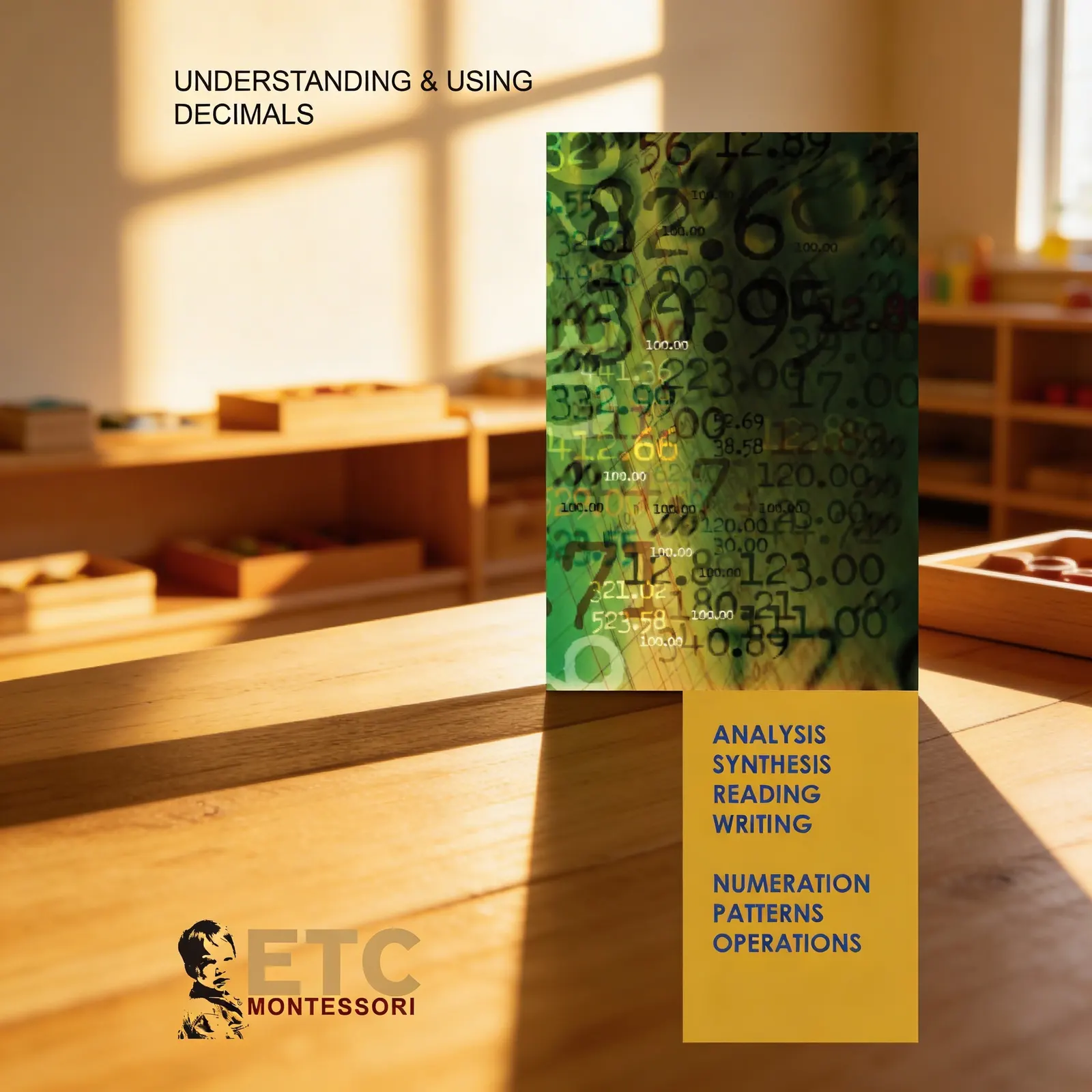
Decimal Work And Task Cards in a child's hands
Decimal Work And Task Cards, these comprehensive Decimal Work and Task Cards introduce children to decimal concepts through hands-on practice with mathematical operations. The laminated cards present decimal numbers with varying place values, supporting the transition from concrete Montessori materials to abstract decimal work. Each card provides clear, progressive challenges that build understanding of decimal relationships and operations.
Mathematical Abstraction
Bridges concrete decimal materials to abstract numerical understanding through progressive card work.
Decimal Place Value
Develops comprehension of tenths, hundredths, and thousandths through visual representation.
Operation Skills
Strengthens addition and subtraction abilities with decimal numbers through repeated practice.
Independent Learning
Self-correcting format encourages autonomous work and builds mathematical confidence.
How to present it
Arrange the decimal task cards in order of difficulty on a mat. Have golden beads or decimal board available for children who need concrete support. Place pencil and paper nearby for recording work.
- 1Begin with simple decimal reading cards, having the child read each decimal aloud
- 2Progress to decimal comparison cards, asking which decimal is greater
- 3Introduce decimal addition cards, starting with same place values
- 4Move to decimal subtraction when addition is mastered
- 5Challenge with mixed operations and word problems on advanced cards
3 tips for parents
- Practice reading prices at stores as decimals to connect learning to daily life
- Use a timer to show decimal parts of minutes when discussing time
- Let your child help with recipes that use decimal measurements

If you are not sure it suits your child, we answer in person.
Norbert Kovalčín, founder of Faborino · write to him
There is no review here yet. We will ask you for one after you buy. Write the first review
What's in the Box
- Task Cards: Approx. 30 laminated decimal work cards
- Storage Container: For organized card storage
Size and material
| Packaging | 28 × 12 × 2 cm |
| Material | Durable plastic |
| Finish | Pre-cut with rounded corners |
| Recommended Age | 3-6 years |
Care
Wipe with damp cloth, dry immediately
Frequently Asked Questions
Are decimal concepts appropriate for ages 3-6 in Montessori?
While this product is labeled for ages 3-6, decimal work is typically introduced to children ages 6-12 in Montessori environments. The 3-6 age range may be an error, as decimal concepts require prior mastery of whole number operations and place value understanding typically developed in the elementary years.
What prerequisite materials should children work with before these cards?
Children should have extensive experience with the Golden Bead Material, Stamp Game, Bead Chains, and have mastered whole number operations. They should also understand place value through millions and be comfortable with fraction work before beginning decimal studies.
How do these task cards support the transition to abstract thinking?
The cards bridge concrete manipulatives and abstract concepts by presenting decimal numbers in written form while encouraging children to verify their work with Golden Beads or Decimal Board materials. Progressive challenges help children gradually internalize decimal relationships without material support.
What types of decimal operations are included in this set?
The task cards cover addition, subtraction, multiplication, and division with decimals. They include exercises for converting between fractions and decimals, comparing decimal values, and understanding decimal place value relationships through tenths, hundredths, and thousandths.
How many cards are included and how are they organized?
While the exact number isn't specified, comprehensive sets typically include 50-100 cards organized by difficulty level and operation type. Cards are color-coded or numbered to indicate progression, allowing children to work independently through increasingly complex decimal concepts.
Product safety
Manufacturer: Nienhuis Montessori, Anders Celsiusstraat 15, 7442 PB Nijverdal, Netherlands
Decimal Work And Task Cards