Geometric Area Figures: Deriving Area Through Shape Superimposition
Geometric Area Figures: Deriving Area Through Shape Superimposition lets a child aged 3 to 6 place one wooden shape over another to discover that different figures can share the same area. Crafted from beech wood finished with non-toxic lacquer and a natural wood stain, the set turns an abstract mathematical idea into a hands on sensorial comparison the child performs by sight and touch. This AMI aligned Nienhuis material builds an early intuition for area and equivalence that supports geometry work children meet later in the Faborino shelf sequence.
“The senses, being explorers of the world, open the way to knowledge.”
This material embodies the Montessori principle of moving from concrete to abstract understanding through sensorial exploration.
- Understanding that area represents the space within a shape's boundaries
- Discovering relationships between triangles, rectangles, parallelograms, and trapezoids
- Developing spatial reasoning through shape transformation and superimposition
- Building foundation for mathematical formulas through concrete manipulation
Read More
Dr. Montessori recognized that children possess a mathematical mind that seeks to understand relationships and patterns in their environment. By physically manipulating geometric shapes, children internalize abstract mathematical concepts through their senses before encountering formal equations. The material respects the child's need for repetition and self-correction, allowing them to discover mathematical relationships independently. This work represents the culmination of years of sensorial preparation, where children have refined their visual discrimination, developed precise hand movements, and built a foundation of geometric understanding through materials like the Geometric Cabinet and Constructive Triangles.

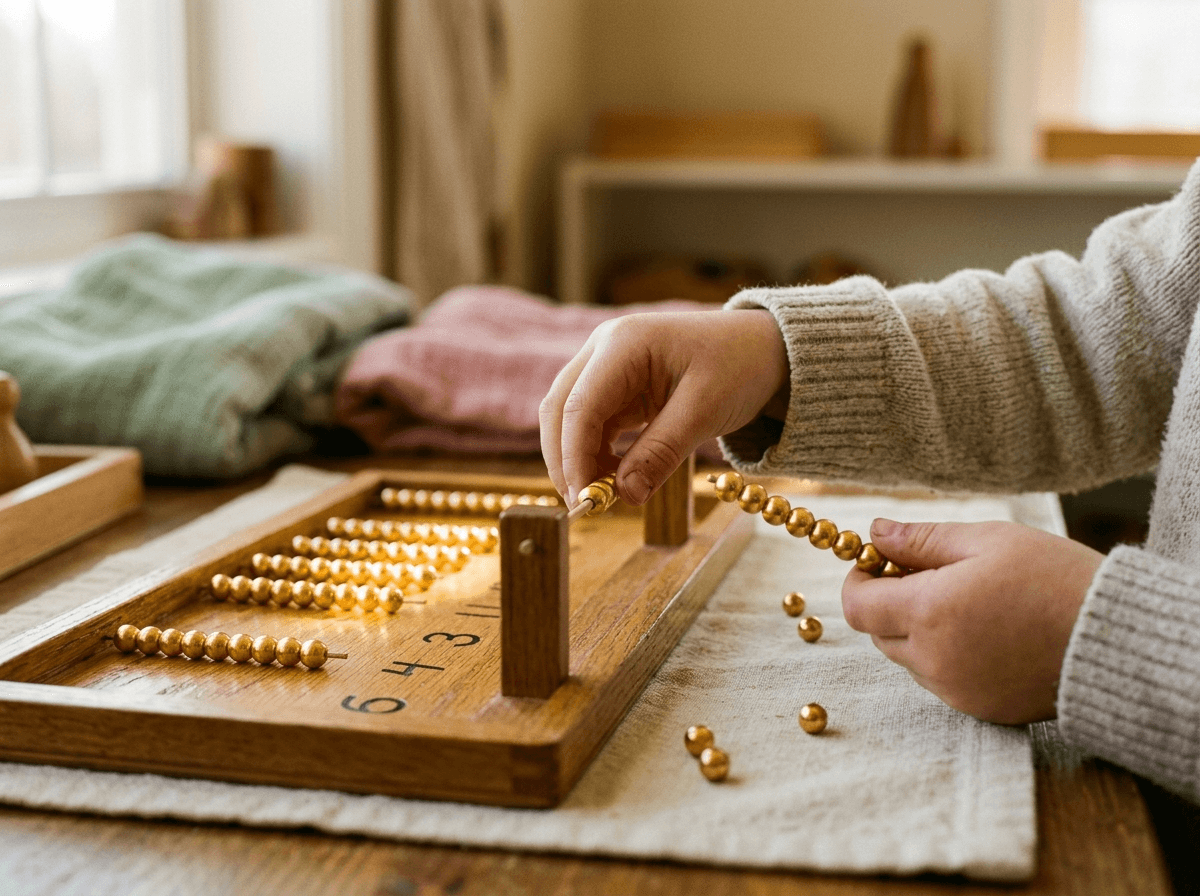
How to present it
Follow the Montessori method of presentation for optimal child development.
Place the material on a large work mat. Ensure all pieces are organized by shape type. Have a tray ready for pieces being manipulated. Work should be done on the floor to provide adequate space.
- 1
Begin with the rectangle, tracing its outline with two fingers to emphasize the enclosed space
Use slow, deliberate movements to help the child focus on the concept of 'space inside' - 2
Introduce the triangular pieces that fit exactly within the rectangle, demonstrating how two identical triangles form one rectangle
Allow the child time to explore this relationship through repeated manipulation - 3
Show how parallelogram pieces can be rearranged to form rectangles of equal area
Use the three-period lesson to introduce vocabulary: 'These shapes have the same area' - 4
Demonstrate transforming trapezoids into rectangles using triangular pieces
Let the child discover that adding and removing identical pieces maintains area equivalence - 5
Invite the child to explore relationships independently, superimposing shapes to compare areas
Step back and observe, intervening only if the child shows frustration or misuse
Every Child Is a Little Creator

Heritage
Since 1929

Brands used by
schools worldwide

European brands

AMI
Endorsed
Related Materials
Geometric Area Figures: Deriving Area Through Shape Superimposition
