
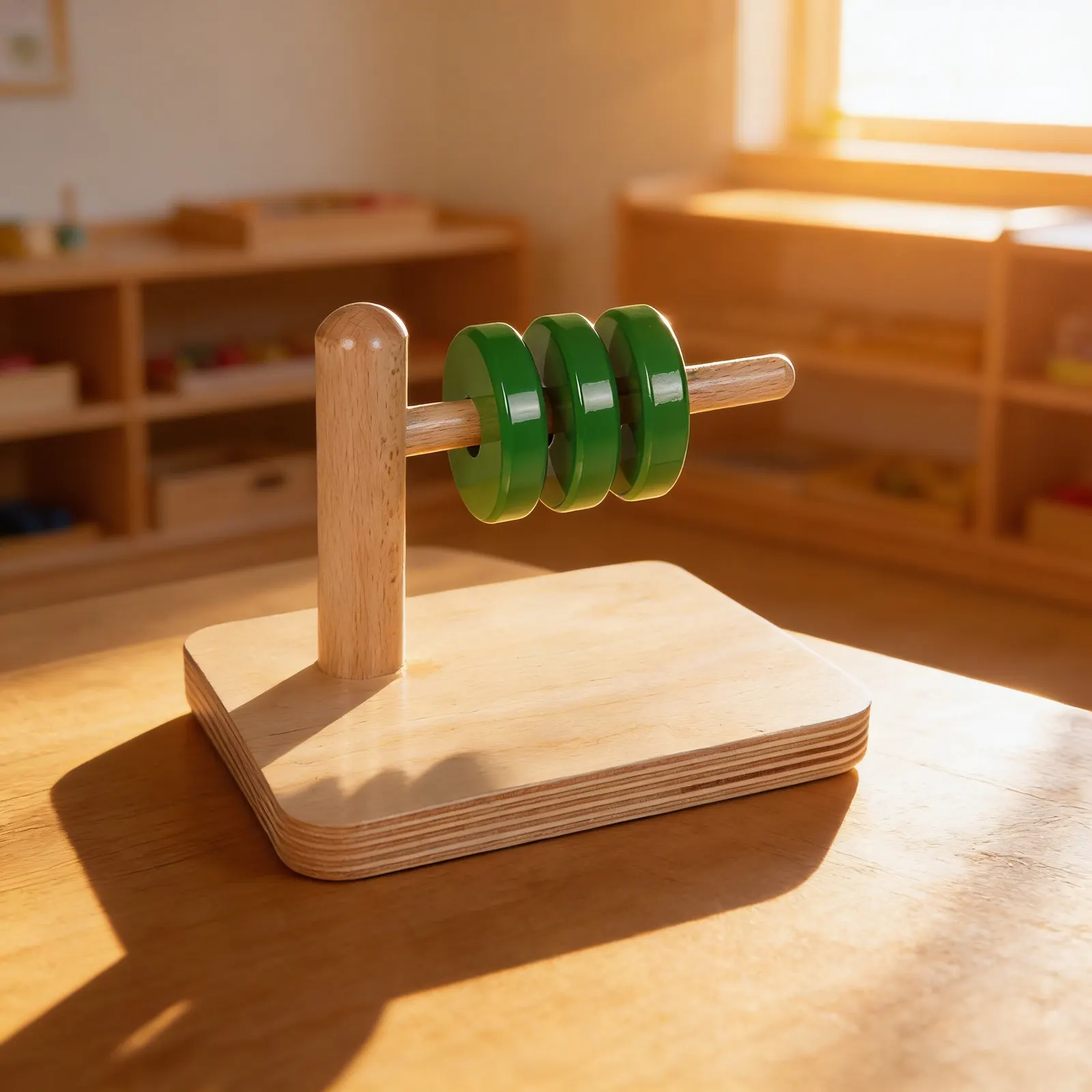
Discs On Horizontal Dowel
The first photo is the maker's own. The other shots are illustrative.
Inv. no. NIE-045300
- Maker
- Nienhuis Montessori, since 1929
- Approval
- AMI
- Base
- Layered plywood
- Discs & Dowel
- Solid wood
- EAN
- 8719924012755
Final price incl. VAT. Delivery €5.90, €107.10 to go for free delivery.
Advice, warranty and returns are handled by us.
Why it costs €41.90
Behind the price of the original are things you can check yourself.
AMI approval
The material is approved by the Association Montessori Internationale (AMI). Nienhuis has made Montessori materials since 1929.
A verifiable original
The EAN 8719924012755 is on the box. It is the maker's number, not ours.
Discs On Horizontal Dowel in a child's hands
Discs on a horizontal dowel, threaded on and pushed along. This is the base version of the horizontal dowel work and the one to give first, because several discs means the same successful movement can be repeated without resetting anything: thread, push, thread, push, until the dowel is full. Repetition without an adult reloading the material is what lets a very young child work for longer than a minute. Plywood and solid wood, for ages 0 to 3.
Wrist Rotation & Control
Threading discs horizontally develops the supination and pronation movements essential for later writing skills.
Spatial Awareness
Children learn to judge distances and angles as they align the disc opening with the horizontal dowel.
Hand-Eye Coordination
The precise movement required to slide discs onto the dowel strengthens visual-motor integration.
Concentration
The focused effort needed to complete this task builds attention span and persistence in young children.
How to present it
Place the horizontal dowel on a low shelf at child's eye level. Position the three green discs to the left of the base in a small basket or tray.
- 1Sit to the child's right. Slowly grasp one disc with thumb and fingers, showing the pincer grip clearly
- 2Bring the disc to the left end of the dowel, aligning the hole with the peg
- 3Rotate your wrist to thread the disc onto the horizontal dowel
- 4Slide the disc along the dowel to the right
- 5Repeat with remaining discs, then remove one at a time from right to left
3 tips for parents
- Practice similar horizontal threading at home with large beads on a chopstick or pencil
- Notice how your child's wrist flexibility improves over weeks of practice
- Resist helping unless the child shows frustration - the struggle to align builds important skills

If you are not sure it suits your child, we answer in person.
Norbert Kovalčín, founder of Faborino · write to him
There is no review here yet. We will ask you for one after you buy. Write the first review
What's in the Box
- Plywood base: with vertical support post
- Horizontal wooden dowel: permanently attached
- 3 green wooden discs: smooth finish, identical size
Size and material
| Packaging | 16 × 16 × 12 cm |
| Base | Layered plywood |
| Discs & Dowel | Solid wood |
| Recommended Age | 12 months - 3 years |
Care
Wipe with slightly damp cloth, dry immediately
Frequently Asked Questions
What age is the Discs on Horizontal Dowel appropriate for?
This material is designed for children ages 6 months to 3 years, with most children showing readiness around 8-10 months when they can sit independently and grasp objects with intention.
How does this differ from a vertical dowel activity?
The horizontal dowel requires a different wrist movement and spatial orientation than vertical threading. Children must rotate their wrist sideways and judge distance horizontally, which develops different neural pathways and prepares for activities like using utensils or turning doorknobs.
What skills does this activity develop?
This material develops hand-eye coordination, wrist rotation, spatial awareness, concentration, and the pincer grasp. It also builds the foundation for later practical life activities and strengthens the muscles needed for writing.
How do I present this activity to my child?
Sit beside your child and slowly demonstrate picking up one disc, aligning it with the dowel end, and sliding it on with a smooth wrist rotation. Use minimal words and exaggerated, slow movements. Then invite your child to try, allowing them to explore at their own pace.
Why are there only three discs?
Three discs provide the perfect challenge without overwhelming young children. This number allows for repetition and mastery while maintaining interest, following Montessori principles of isolation of difficulty and providing just enough challenge to engage without frustrating the child.
Product safety
Manufacturer: Nienhuis Montessori, Anders Celsiusstraat 15, 7442 PB Nijverdal, Netherlands
Discs On Horizontal Dowel