
Divided Hexagonal Prism: Decomposable 3D Shape for Advanced Geometry
Made by Nienhuis Montessori · shipped by Heutink International (Netherlands) About the maker
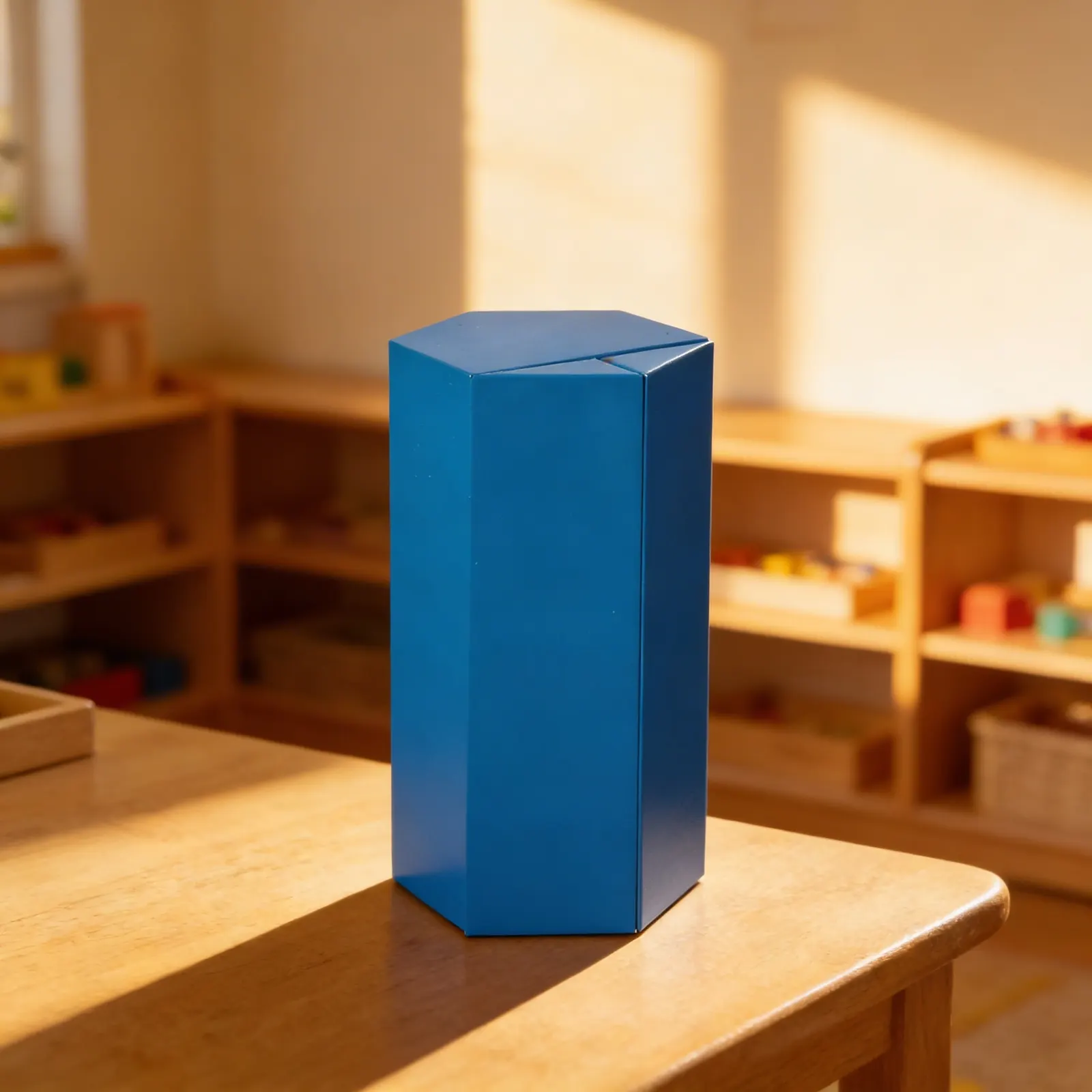
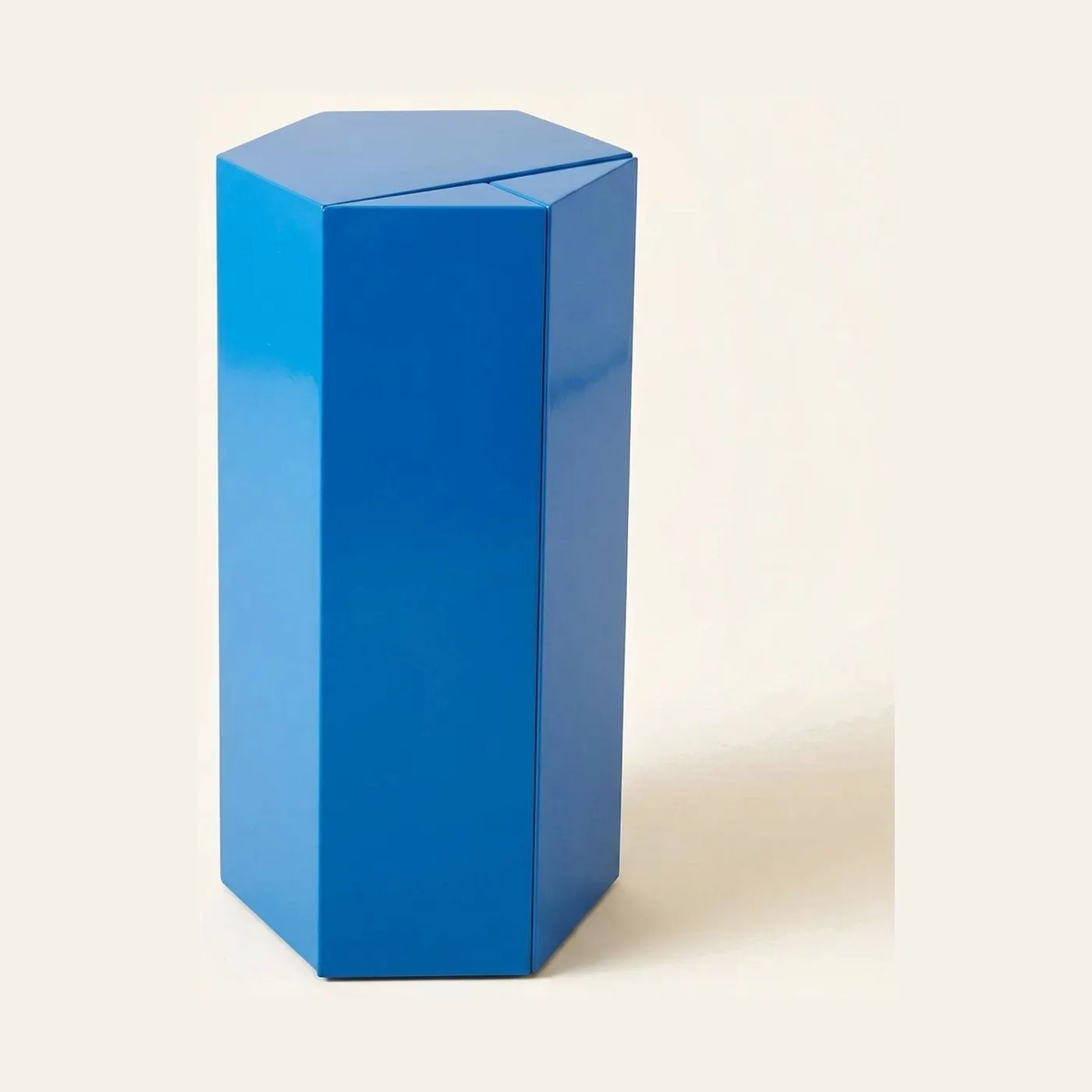
A hexagonal prism from the blue geometric solids, and one that comes apart. Splitting a hexagonal prism into its component pieces shows that a hexagon is six triangles, which is the fact everything else about hexagons follows from. Like the rest of the set it is derived from a base of 10 x 10 cm and a height of 20 cm, so its volume can be compared directly against the cylinder, cone and pyramid. Sold individually. Lacquered wood with hardwood, for ages 6 to 12.
“Children display a universal love of mathematics, which is par excellence the science of precision, order, and intelligence.”
The Divided Hexagonal Prism addresses children's natural fascination with how complex shapes relate to simpler geometric forms. This decomposable hexagonal-based solid reveals the mathematical relationships between polygonal bases and three-dimensional structures through direct manipulation.
- Decomposes hexagonal prisms into constituent geometric components through physical manipulation
- Identifies the relationship between hexagonal bases and rectangular lateral faces in three-dimensional solids
- Develops spatial reasoning skills by reconstructing divided hexagonal prism segments into complete forms
- Explores symmetry properties unique to six-sided polygonal prisms through hands-on investigation
Read More
Children at ages 6-12 are developmentally ready to understand that geometric solids can be broken down into component parts, making abstract spatial concepts concrete and tangible. The hexagonal prism's unique six-sided base creates opportunities to explore symmetry, angles, and proportional relationships that simpler geometric solids cannot provide. Dr. Montessori recognized that children learn geometric principles most effectively when they can physically separate and reconstruct three-dimensional forms. The Divided Hexagonal Prism satisfies this developmental need by allowing hands-on exploration of how flat surfaces combine to create volume. This lacquered wood solid prepares children for advanced mathematical concepts including surface area calculations, volume relationships, and geometric proofs. The decomposable design transforms abstract geometric theory into concrete understanding, building the foundation for later work in advanced mathematics and spatial reasoning.
How to present it
Follow the Montessori method of presentation for optimal child development.
Place the Divided Hexagonal Based Prism on a neutral-colored mat. Ensure both pieces are together forming the complete prism. Have paper and pencil available for optional sketching.
- 1
Invite the child to examine the complete hexagonal prism, tracing edges and vertices with fingers
Use slow, deliberate movements to model careful observation - 2
Demonstrate how to gently separate the two pieces along the diagonal plane
Hold the base firmly while sliding the top piece to prevent dropping - 3
Explore each piece individually, noting the different faces created by the division
Place pieces on different orientations to see all surfaces - 4
Challenge the child to reunite the pieces without assistance
If needed, suggest examining the matching surfaces for clues - 5
Trace the outline of the diagonal cut on paper
This helps visualize the plane of division abstractly
Every Child Is a Little Creator

Heritage
Since 1929

In classrooms
Around the world

European brands
Nienhuis, GAM, Educo

AMI approved
To the association standard
Divided Hexagonal Prism: Decomposable 3D Shape for Advanced Geometry
