
Division Working Charts (Nienhuis)
The first photo is the maker's own. The other shots are illustrative.
Inv. no. NIE-0142D1
- Maker
- Nienhuis Montessori, since 1929
- Approval
- AMI
- Charts
- Laminated cardstock
- Number Tiles
- Natural wood
- EAN
- 8719924007508
Final price incl. VAT. Delivery €5.90, €33.10 to go for free delivery.
Advice, warranty and returns are handled by us.
Why it costs €115.90
Behind the price of the original are things you can check yourself.
AMI approval
The material is approved by the Association Montessori Internationale (AMI). Nienhuis has made Montessori materials since 1929.
A verifiable original
The EAN 8719924007508 is on the box. It is the maker's number, not ours.
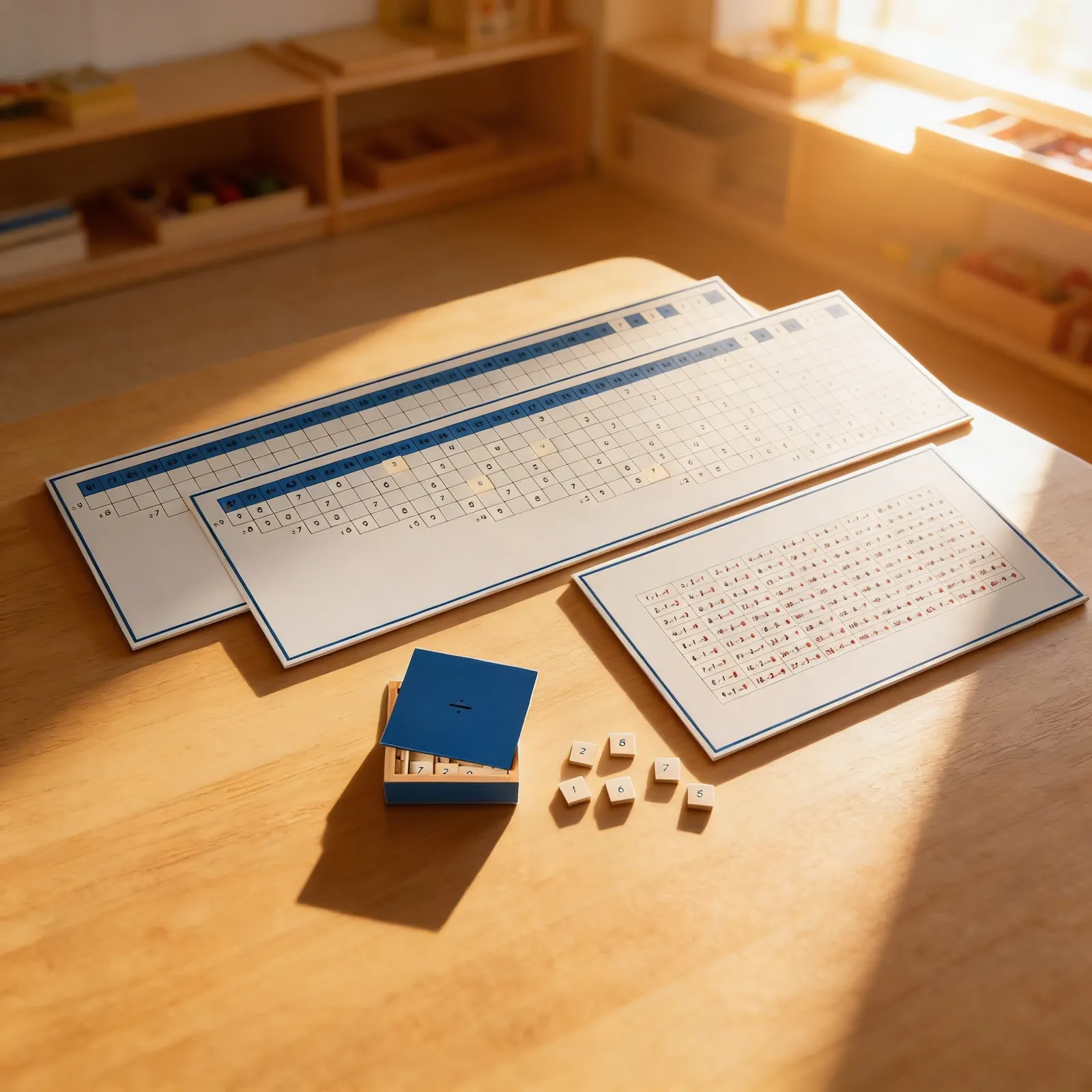
Division Working Charts (Nienhuis) in a child's hands
Two working charts, one control chart and a box of wooden answer chips for practising the division combinations. The design has a quiet trick in it: the first working chart later becomes the control chart, so the material tightens as the child improves rather than staying at one level. Placing a chip rather than writing an answer keeps the work reversible, which is what lets a child try, check and try again without the page filling up with crossings out. Laminated cardstock with wood, for ages 3 to 6.
Mathematical Fluency
Systematic practice with division facts builds automatic recall and understanding of inverse relationships with multiplication.
Pattern Recognition
Visual grid layout helps children discover mathematical patterns and relationships between divisors and quotients.
Independent Learning
Self-correcting nature of the charts allows children to work autonomously and build confidence through repetition.
Abstract Thinking
Progresses from concrete tile manipulation to abstract understanding of division as equal grouping.
How to present it
Place the first division chart on the work mat with the corresponding number tiles in a small basket. Ensure adequate workspace for tile sorting and chart completion.
- 1Begin with Chart 1, showing the child how to read the division problem in the first square
- 2Demonstrate finding the correct answer tile and placing it precisely in the designated space
- 3Continue with 2-3 more examples, then invite the child to complete the row
- 4Show how to check completed work by reading each equation aloud
- 5Demonstrate returning tiles to the basket before moving to the next chart
3 tips for parents
- Practice identifying equal groups in daily life: 'Can you divide these 8 cookies equally for 4 people?'
- Avoid rushing through charts - thorough practice with each divisor builds lasting understanding
- Celebrate pattern discoveries your child makes while working with the charts

If you are not sure it suits your child, we answer in person.
Norbert Kovalčín, founder of Faborino · write to him
There is no review here yet. We will ask you for one after you buy. Write the first review
What's in the Box
- Division working charts: 4 laminated grids
- Wooden number tiles: Complete set for answers
- Wooden storage box: For tile organization
Size and material
| Packaging | 77 × 25 × 6 cm |
| Charts | Laminated cardstock |
| Number Tiles | Natural wood |
| Storage | Wooden box |
| Recommended Age | 5-6 years |
Care
Wipe charts with damp cloth, dry wooden pieces immediately
Frequently Asked Questions
What age is appropriate for introducing the Division Working Charts?
While categorized for ages 3-6, the Division Working Charts are typically introduced around age 5-6, after children have mastered multiplication concepts and have worked with the division board. The child should understand the concept of sharing equally before beginning chart work.
How do the Division Working Charts differ from the Division Board?
The Division Board introduces the concept of division through concrete manipulation, while the Working Charts focus on memorization and pattern recognition. The charts provide systematic practice of division facts with divisors 1-9, helping children achieve automatic recall through repetitive work with number tiles.
What materials are included in the Division Working Charts set?
The complete set includes two control charts (Chart 1 showing equations and Chart 2 showing answers), blank working charts for the child to complete, number tiles for placing answers, and a storage box. Some sets also include equation tickets for additional practice variations.
What prerequisite skills should a child have before using these charts?
Children should have a solid understanding of division concepts through concrete materials, be comfortable with numbers 1-81, have experience with multiplication tables, and possess the concentration needed for systematic chart work. Fine motor skills for handling small tiles are also necessary.
How do these charts help children memorize division facts?
Through repetitive practice placing answer tiles on the blank charts, children internalize division combinations. The systematic progression from divisor 1 through 9 helps children discover patterns, while the control charts allow self-correction, building confidence and automatic recall of division facts.
Product safety
Manufacturer: Nienhuis Montessori, Anders Celsiusstraat 15, 7442 PB Nijverdal, Netherlands
Division Working Charts (Nienhuis)