
Dot ExerciseMathematical Operations
The first photo is the maker's own. The other shots are illustrative.
Inv. no. NIE-005050
- Maker
- Nienhuis Montessori, since 1929
- Approval
- AMI
- Surface
- Laminated cardstock
- Markers
- Dry erase markers
- EAN
- 8719924003050
Final price incl. VAT. Delivery €5.90, €109.10 to go for free delivery.
Advice, warranty and returns are handled by us.
Why it costs €39.90
Behind the price of the original are things you can check yourself.
AMI approval
The material is approved by the Association Montessori Internationale (AMI). Nienhuis has made Montessori materials since 1929.
A verifiable original
The EAN 8719924003050 is on the box. It is the maker's number, not ours.
Dot Exercise in a child's hands
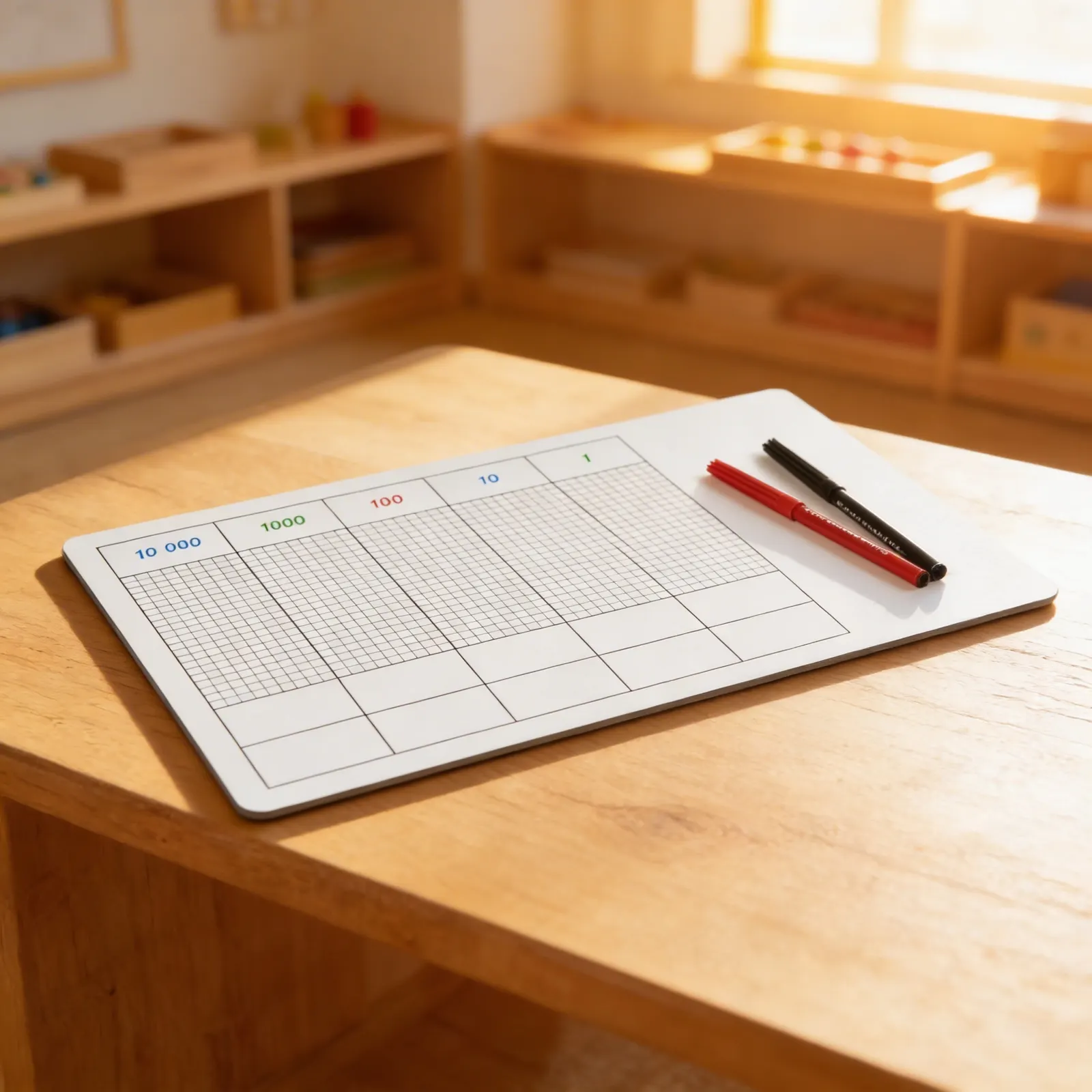
A whiteboard printed with the dot exercise grid, worked with water based pens in two colours, two of which are included. The dot exercise is where decimal addition becomes column addition: quantities are drawn as dots, ten dots in a column get crossed and carried, and the carrying that a written sum hides in a small figure above the line is here a thing the child physically does. A whiteboard rather than paper is what lets it be done wrong and redone. Whiteboard with pens, for ages 3 to 6.
Place Value Understanding
Children physically represent quantities in appropriate columns, building concrete understanding of units, tens, hundreds, and thousands.
Mathematical Abstraction
Bridges the gap between concrete manipulatives and abstract number symbols through visual representation of quantities.
Fine Motor Control
Precise dot placement within grid squares develops hand control and coordination essential for later writing.
Systematic Thinking
Organized column structure teaches logical arrangement and systematic approach to mathematical operations.
How to present it
Place the laminated Dot Exercise board on a table mat. Prepare a container with small markers or dots (beans, chips, or small counters). Ensure columns are clearly visible: units, tens, hundreds, thousands, ten thousands.
- 1Introduce each column by placing exactly one marker, naming: 'one unit,' 'one ten,' 'one hundred'
- 2Build the number 1,234 by placing 1 marker in thousands, 2 in hundreds, 3 in tens, 4 in units
- 3Demonstrate exchanging: when 10 markers accumulate in units, remove them and place 1 marker in tens
- 4Invite the child to build their own numbers, starting with 3-digit numbers before progressing
3 tips for parents
- Practice reading large numbers in everyday life (prices, addresses, page numbers) to reinforce place value
- Use the board to show your child how their age changes from 9 to 10 (units column clears, tens gains one)
- Keep sessions short (10-15 minutes) to maintain engagement with the mathematical concepts

If you are not sure it suits your child, we answer in person.
Norbert Kovalčín, founder of Faborino · write to him
There is no review here yet. We will ask you for one after you buy. Write the first review
What's in the Box
- Dot Exercise Board: Laminated grid with place value columns
- Dry Erase Markers: Approx. 2 markers for dot placement
Size and material
| Packaging | 45 × 33 × 1 cm |
| Surface | Laminated cardstock |
| Markers | Dry erase markers |
| Recommended Age | 3-6 years |
Care
Wipe clean with dry eraser or damp cloth
Frequently Asked Questions
What mathematical concepts does the Dot Exercise teach?
The Dot Exercise teaches place value understanding, decimal system comprehension, number composition and decomposition, and foundational skills for addition, subtraction, multiplication, and division through visual representation of quantities from units to ten thousands.
How do children use the Dot Exercise board?
Children place dots or markers in the appropriate columns (units, tens, hundreds, thousands, ten thousands) to represent numbers visually. They can compose large numbers, practice exchanging between place values, and perform mathematical operations by physically manipulating the dots.
What materials are included with the Dot Exercise?
The set includes a laminated grid board with clearly marked columns for place values from units to ten thousands. Additional dots or markers for representing quantities may need to be purchased separately or can be made using small counters or stickers.
Is this suitable for children who haven't learned numbers yet?
While designed for ages 3-6, children should have basic number recognition (1-10) and counting skills before using this material effectively. It builds upon earlier Montessori math materials like number rods and sandpaper numbers.
How does this differ from traditional place value teaching methods?
Unlike abstract worksheets, the Dot Exercise provides concrete, hands-on manipulation of quantities. Children physically build numbers and see the relationship between place values, making abstract concepts tangible and supporting the Montessori principle of learning through movement and touch.
Product safety
Manufacturer: Nienhuis Montessori, Anders Celsiusstraat 15, 7442 PB Nijverdal, Netherlands
Dot Exercise