
Dot Exercise Activity Set
The first photo is the maker's own. The other shots are illustrative.
Inv. no. NIE-060601
- Maker
- Nienhuis Montessori, since 1929
- Approval
- AMI
- Storage Box
- Natural wood
- Exercise Cards
- Laminated cardstock
- EAN
- 8719924013158
Final price incl. VAT. Delivery €5.90, €94.10 to go for free delivery.
Advice, warranty and returns are handled by us.
Why it costs €54.90
Behind the price of the original are things you can check yourself.
AMI approval
The material is approved by the Association Montessori Internationale (AMI). Nienhuis has made Montessori materials since 1929.
A verifiable original
The EAN 8719924013158 is on the box. It is the maker's number, not ours.
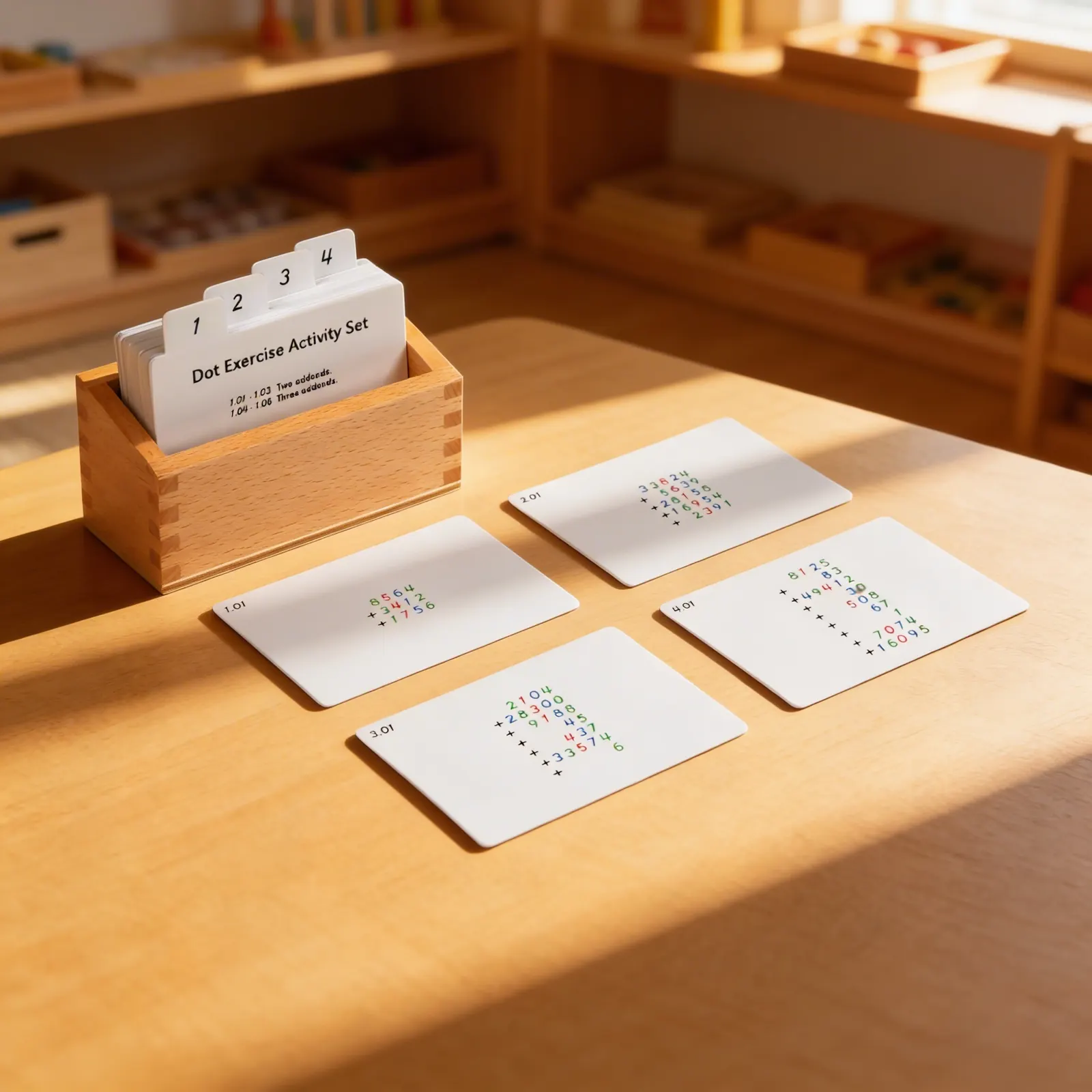
Dot Exercise Activity Set in a child's hands
Exercise cards with divider tabs in a wooden box, extending the dot exercise. The dot exercise is where addition of large numbers is done by drawing dots and grouping them in tens, which is the last stop before a child adds four digit numbers on paper with nothing to look at. It is also the material that makes the carried one visible instead of a mark scribbled above a column. More problems is the whole requirement at that stage. Dot exercise sold separately. Wood and laminated cardstock, for ages 3 to 6.
Mathematical Mind
Visual dot patterns help children understand quantity relationships and develop number sense through concrete representation.
Visual Discrimination
Comparing and analyzing different dot arrangements refines visual perception and pattern recognition skills.
Abstract Thinking
Bridges the gap between concrete counting and abstract mathematical operations through visual equation format.
Sequential Learning
Progressive card system supports scaffolded learning, building confidence as children master each level.
How to present it
Place the wooden storage box on a mat. Remove cards showing simple dot patterns (1-5 dots) first. Arrange selected cards in order from left to right.
- 1Begin with single quantity cards, inviting the child to count each dot by touching
- 2Introduce equation cards showing two groups of dots with a plus sign between them
- 3Demonstrate counting the first group, then the second group, then all dots together
- 4Invite the child to select their own equation card and work through the process
- 5Progress to subtraction cards when addition is mastered, showing dots being 'taken away'
3 tips for parents
- Practice recognizing dot patterns in everyday life - dice, dominoes, or arranged objects
- Avoid rushing to number symbols - dot recognition builds crucial number sense
- Create simple dot pattern games during wait times using fingers or small objects

If you are not sure it suits your child, we answer in person.
Norbert Kovalčín, founder of Faborino · write to him
There is no review here yet. We will ask you for one after you buy. Write the first review
What's in the Box
- Wooden storage box: with solid construction
- Exercise cards: numbered 1-4 with progressive dot patterns
Size and material
| Packaging | 13 × 11 × 7 cm |
| Storage Box | Natural wood |
| Exercise Cards | Laminated cardstock |
| Recommended Age | 3-6 years |
Care
Wipe cards with slightly damp cloth; clean wooden box with dry cloth
Frequently Asked Questions
What mathematical concepts does this Dot Exercise Activity Set teach?
This set introduces quantity relationships, visual number representation, basic addition and subtraction, and number composition/decomposition. Children learn to recognize dot patterns, understand how numbers combine and separate, and develop a concrete understanding of arithmetic operations through hands-on manipulation.
How does the progressive card system work in this activity set?
The cards are arranged in a systematic progression, starting with simple dot patterns and advancing to more complex equations. Each card presents dots in equation format, allowing children to visually see mathematical relationships. This sequential approach builds understanding gradually, ensuring mastery before moving to more challenging concepts.
What age-specific skills does this material develop for 3-6 year olds?
For ages 3-4, it develops number recognition and one-to-one correspondence. Ages 4-5 benefit from understanding quantity relationships and simple addition. By ages 5-6, children grasp more complex equations and develop abstract thinking skills, preparing them for formal mathematics while strengthening their mathematical mind.
How do children physically interact with this Dot Exercise Activity Set?
Children manipulate the cards to match dot patterns, arrange equations, and verify their answers through counting. They can physically move and combine cards to see how numbers work together, trace dot patterns, and use the materials for self-correction. This concrete manipulation is essential for understanding abstract mathematical concepts.
What makes this set different from traditional math teaching methods?
Unlike abstract number teaching, this set provides visual and tactile representation of mathematical concepts. Children see quantities as dot patterns rather than just symbols, making mathematics concrete and understandable. The self-correcting nature and hands-on approach align with Montessori principles of learning through discovery and manipulation.
Product safety
Manufacturer: Nienhuis Montessori, Anders Celsiusstraat 15, 7442 PB Nijverdal, Netherlands
Dot Exercise Activity Set