
Europe Control MapUnlabeled
The first photo is the maker's own. The other shots are illustrative.
Inv. no. NIE-555400
- Maker
- Nienhuis Montessori, since 1929
- Approval
- AMI
- Base
- Paper
- Surface
- Laminate coating
- EAN
- 8719924029500
Final price incl. VAT. Delivery €5.90, €128.10 to go for free delivery.
Advice, warranty and returns are handled by us.
Why it costs €20.90
Behind the price of the original are things you can check yourself.
AMI approval
The material is approved by the Association Montessori Internationale (AMI). Nienhuis has made Montessori materials since 1929.
A verifiable original
The EAN 8719924029500 is on the box. It is the maker's number, not ours.
Europe Control Map in a child's hands
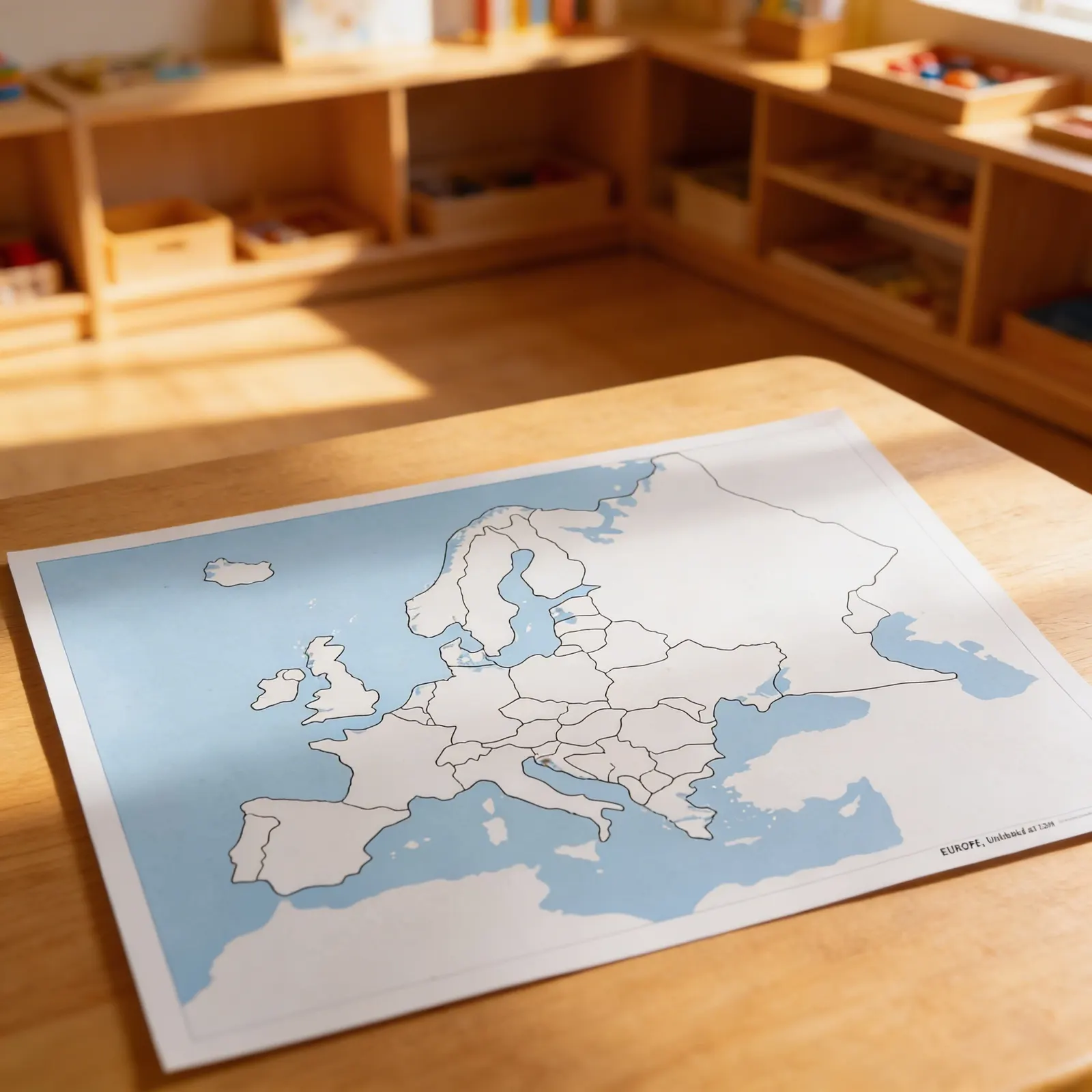
Part of the Puzzle Maps collection, this unlabeled Europe Control Map provides children with a clear visual reference for European geography, featuring distinct country boundaries without text labels. The laminated surface allows children to trace borders with their fingers while the high-contrast design (blue water, white land masses) helps young learners distinguish between countries and bodies of water during map work activities.
Geographic Awareness
Develops understanding of European political boundaries and spatial relationships between countries.
Visual Discrimination
Strengthens ability to distinguish shapes and boundaries through high-contrast design.
Preparation for Abstract Learning
Unlabeled format encourages memorization and prepares for more advanced map work.
Fine Motor Control
Tracing country borders develops precision and hand control needed for writing.
How to present it
Place the Europe Control Map on a low table or mat at child's eye level. Ensure good lighting and have a small basket nearby with pointing tools like a thin dowel or child-safe pointer.
- 1Invite the child to explore the map freely, observing which shapes catch their attention first
- 2Demonstrate slow, deliberate tracing of one country's border with your index finger
- 3Introduce geographic vocabulary naturally: 'This country is surrounded by water' or 'These two countries share a long border'
- 4Play matching games using the child's observations: 'Can you find another country shaped like a triangle?'
3 tips for parents
- Support map work at home by noticing shapes in everyday objects that resemble countries
- When children ask country names, turn it into exploration: 'Let's find that shape on our map together'
- Create simple stories about traveling from one country shape to another, building geographic relationships

If you are not sure it suits your child, we answer in person.
Norbert Kovalčín, founder of Faborino · write to him
There is no review here yet. We will ask you for one after you buy. Write the first review
What's in the Box
- Europe Control Map: Unlabeled, laminated
Size and material
| Packaging | 43 × 56 × 0 cm |
| Base | Paper |
| Surface | Laminate coating |
| Recommended Age | 3-6 years |
Care
Wipe with damp cloth, dry immediately
Frequently Asked Questions
What is the purpose of an unlabeled control map in Montessori education?
The unlabeled control map serves as a reference tool that children use alongside puzzle maps and labeled maps. It helps them verify their work independently, develop visual discrimination skills, and internalize the shapes and positions of European countries without relying on text labels.
What are the dimensions and materials of this Europe Control Map?
This control map features a durable laminated surface that allows children to trace country borders with their fingers. The high-contrast design uses blue for water bodies and white for land masses, making it easy for young children to distinguish between countries and surrounding seas.
How do children typically use this map in Montessori geography lessons?
Children use this map as a reference when working with Europe puzzle maps, for pin-punching activities, coloring their own maps, or placing country labels. They can also trace borders with their fingers to develop muscle memory of country shapes and practice identifying countries by their outline alone.
Why is this map designed without country names or labels?
The unlabeled design encourages children to focus on visual recognition of country shapes and spatial relationships rather than reading skills. This approach builds stronger geographical understanding and allows non-readers to engage fully with geography work while developing visual discrimination abilities.
What other materials work well with this Europe Control Map?
This map pairs perfectly with the Europe puzzle map, moveable country labels, flag work, colored pencils for map making, and pin maps. It also complements cultural studies of European countries, capital city work, and three-part cards featuring European landmarks or cultural elements.
Product safety
Manufacturer: Nienhuis Montessori, Anders Celsiusstraat 15, 7442 PB Nijverdal, Netherlands
Europe Control Map