
Fabric Box: Tactile Discrimination Through Paired Matching
Made by Nienhuis Montessori · shipped by Heutink International (Netherlands) About the maker
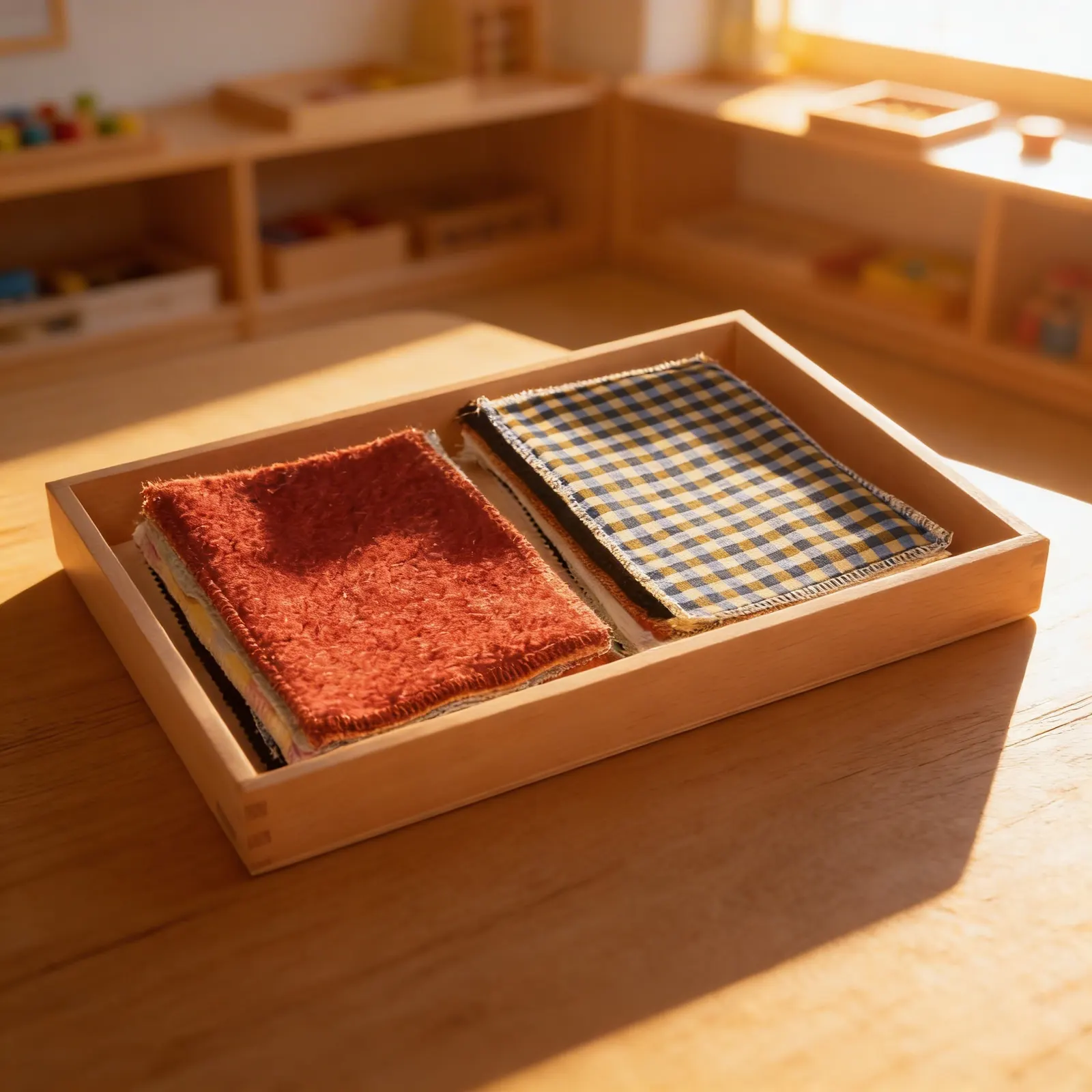
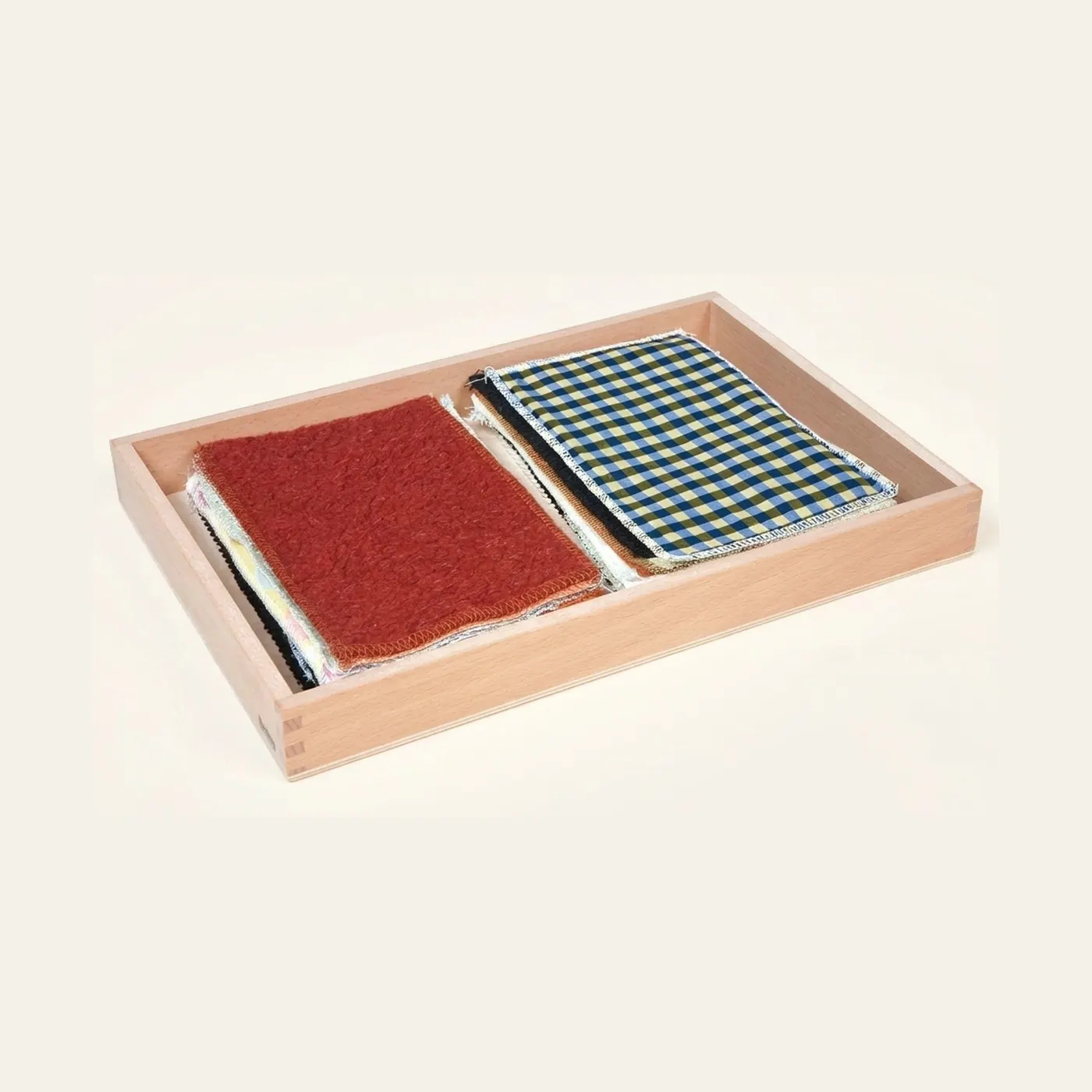
Pairs of fabrics in cotton, wool, jute, silk, leather and synthetic material, matched by touch alone in a beechwood box with a lid. Six materials that a hand can tell apart but the eye often cannot, which is why this work is usually done blindfolded. It is also the rare sensorial material where the vocabulary a child gains has an everyday use: knowing silk from synthetic is a distinction they will make in a shop at twenty. Wood, cotton, felt and textiles, for ages 3 to 6.
“The child is both a hope and a promise for mankind.”
The Fabric Box embodies Dr. Montessori's principle of sensorial education through isolation of difficulty.
- Refinement of tactile discrimination and stereognostic sense
- Development of vocabulary for describing textures and fabric qualities
- Strengthening of concentration through focused sensorial work
- Enhancement of fine motor control and pincer grip
Read More
By focusing solely on tactile qualities, the child develops refined discrimination of textures through their stereognostic sense - the ability to recognize objects through touch alone. This material follows the progression from concrete to abstract, as children first explore textures through direct sensorial experience before later connecting these impressions to descriptive language. The paired matching aspect introduces the mathematical concept of one-to-one correspondence while supporting the child's natural tendency toward order and classification. Through repeated exploration, children build neural pathways that enhance their overall sensory integration and prepare the hand for the subtle movements required in writing.
How to present it
Follow the Montessori method of presentation for optimal child development.
Place the wooden tray on a table mat. Ensure all fabric pairs are mixed and arranged randomly in the tray. Sit to the child's dominant side.
- 1
Invite the child, saying 'I'd like to show you something.' Remove all fabric pieces from the tray
Use slow, deliberate movements to model care and precision - 2
Select one fabric piece. Close your eyes and feel it slowly with your dominant hand's fingertips
Exaggerate the feeling motion, moving fingers in circular patterns - 3
Open your eyes, place the fabric to your left. Close eyes again and feel each remaining piece until finding its match
If unsure of a match, set it aside and continue searching - 4
When you believe you've found the match, open eyes and place it next to the first piece
Allow the child to verify matches visually after tactile pairing - 5
Continue until all pairs are matched. Invite the child to feel each pair to verify
Use minimal language during the presentation
Every Child Is a Little Creator

Heritage
Since 1929

In classrooms
Around the world

European brands
Nienhuis, GAM, Educo

AMI approved
To the association standard
Fabric Box: Tactile Discrimination Through Paired Matching
