
Four Maps Of Asia
Made by Nienhuis Montessori · shipped by Heutink International (Netherlands) About the maker
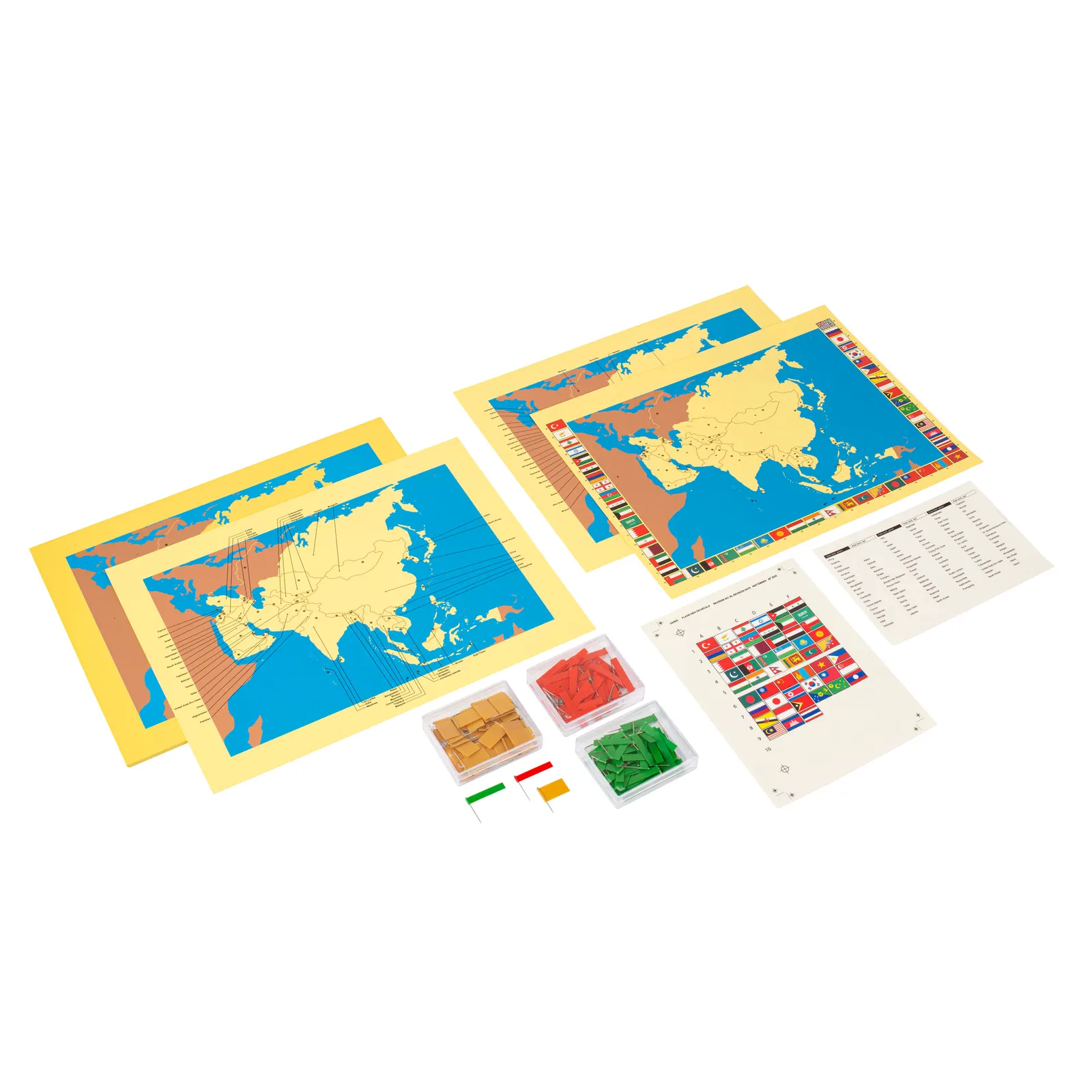
Four Maps Of Asia pairs three printed control maps with one working map pierced with holes, letting children pin small flags into place as they explore the continent's country names, capital cities and national flags at their own pace. Moving from the control maps back to the blank working map turns the exercise into a self directed memory check rather than a guided quiz. Made from laminated paper, wood and plastic for ages 3 to 6, it extends the continent study begun with the puzzle map, AMI aligned throughout.
“Free the child's potential, and you will transform him into the world.”
The Four Maps of Asia introduces continental geography when children demonstrate readiness for abstract representation, typically emerging after work with the sandpaper globe and continent puzzle maps. Each laminated map layer builds geographic understanding systematically - the wooden country pieces allow children to physically construct Asia while matching shapes to outlines. This progression from concrete wooden pieces to abstract political boundaries respects how young minds grasp spatial relationships through manipulation before visualization.
- Identification of Asian countries through shape recognition and spatial placement
- Association of national flags with corresponding countries and capitals
- Understanding of political boundaries versus physical geographical features
- Development of visual discrimination through map reading and symbol interpretation
Read More
The flag reference cards connect national symbols to geographic locations, satisfying children's desire to categorize and classify their expanding world knowledge. By offering both political and physical map representations, these materials address the developmental need to understand human-made boundaries alongside natural features. The wooden pieces provide the sensorial experience essential for geographic memory formation, while the laminated maps offer durability for repeated exploration. This careful balance between tactile wooden components and visual laminated references creates multiple pathways for geographic comprehension, meeting diverse learning styles within the prepared environment.
How to present it
Follow the Montessori method of presentation for optimal child development.
Place the base political map on a large work mat. Arrange wooden country pieces in a basket beside the map. Keep flag cards and physical maps nearby but separate initially.
- 1
Invite the child to remove wooden pieces and match them to outlined countries on the laminated political map
Start with larger, distinctly shaped countries like India or Japan for early success - 2
Introduce country names using three-period lesson as pieces are placed
Connect countries to children's experiences - 'China, where pandas live' - 3
Present flag cards, matching them to placed wooden countries
Begin with flags having simple, distinctive designs - 4
Explore the physical map, comparing mountain ranges and rivers to political boundaries
Use tracing paper to overlay physical features onto political maps - 5
Create a reference booklet with traced countries and corresponding flags
Children can color their own flag reproductions for better retention
Every Child Is a Little Creator

Heritage
Since 1929

In classrooms
Around the world

European brands
Nienhuis, GAM, Educo

AMI approved
To the association standard
Four Maps Of Asia
