
Four Maps Of South America
Made by Nienhuis Montessori · shipped by Heutink International (Netherlands) About the maker
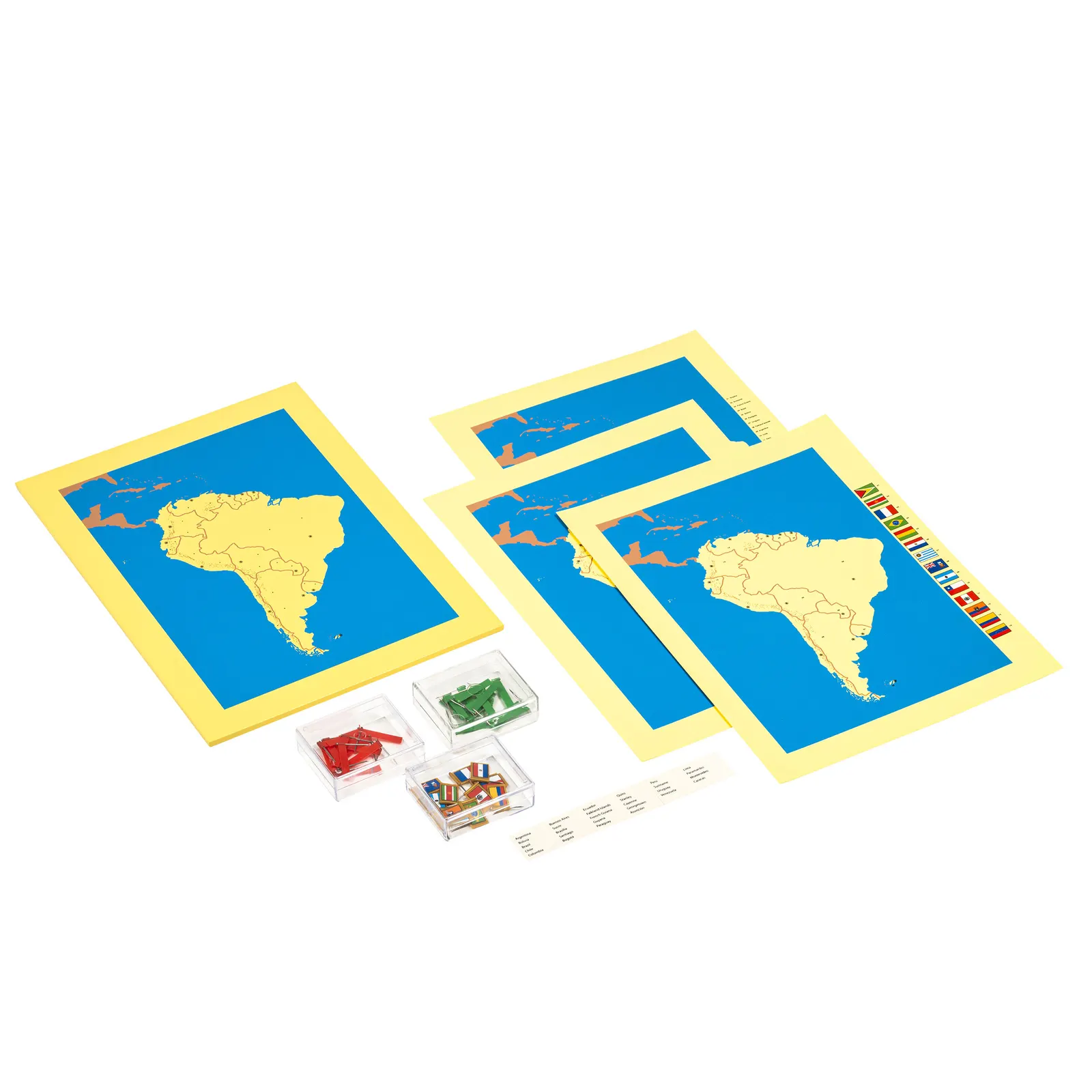
Four Maps Of South America bundles three printed control maps with one working map pierced with holes, so children can pin small flags into place while they explore country names, capital cities and national flags at their own pace. Working from the control maps back to the blank working map lets a child test memory independently, without a teacher checking each step. Made from wood, paper and plastic for ages 3 to 6, it deepens the continent study begun with the puzzle map, fully AMI aligned.
“The greatest sign of success for a teacher is to be able to say, 'The children are now working as if I did not exist.'”
The Four Maps of South America set serves as a concrete bridge between the child's immediate environment and the vastness of our world.
- Develops fine motor control through handling and placing individual country pieces
- Builds spatial reasoning by recognizing how countries fit together to form South America
- Acquires geographic vocabulary including country names, capitals, and regional terms
- Strengthens visual discrimination by matching country shapes to their locations
Read More
Each wooden puzzle piece represents a real country, transforming abstract political boundaries into tangible objects children can hold, trace, and place. The removable country pieces allow repetitive manipulation, satisfying the young child's need to perfect movements while building geographic knowledge. These maps progress from simple continent outlines to detailed political divisions, matching the child's expanding capacity for discrimination and classification. The accompanying cards and labels provide precise language at the moment of greatest interest, when the child has just fitted Brazil or Argentina into its proper place. This systematic exploration of South America's geography through puzzle work addresses the child's need to understand their place in the world through concrete, sensorial experiences.
How to present it
Follow the Montessori method of presentation for optimal child development.
Place one map on a work mat at child's eye level. Keep country pieces in a basket beside the map. Have cards and labels organized in a separate container.
- 1
Invite the child to remove all pieces from the map, placing them randomly on the mat
Let the child explore the weight and shape of each piece before attempting placement - 2
Select one piece and slowly trace its outline with two fingers, then trace the corresponding space in the map frame
Exaggerate the tracing movement to highlight the country's unique shape - 3
Place the piece in its location, pressing gently to ensure proper fit
If incorrect, simply remove and try another space without correction - 4
Continue with remaining pieces, allowing the child to work at their own pace
Some children prefer starting with larger countries like Brazil or Argentina - 5
Once complete, introduce country name labels, matching them to the completed map
Begin with 3-4 countries the child shows interest in
Every Child Is a Little Creator

Heritage
Since 1929

In classrooms
Around the world

European brands
Nienhuis, GAM, Educo

AMI approved
To the association standard
Four Maps Of South America
